[Pg. 330] -
At half-past
four o'clock on the morning of Apr. 12, 1861, General
P. T. Beauregard, in command of the Confederate
forces at Charleston, S. C., opened fire on Fort Sumter.
Its sound reverberated around the world and its echo has
not yet died away. The bombardment was fierce and
continued until the fourteenth inst., when Major
Robert Anderson and his small band of heroes, after
a gallant resistance, marched out and honorably
surrendered. The news flashed over the country
like wild fire. The patriotic heart of the great
North was stirred and thrilled to its innermost depth.
When the news was received in Hamilton the bells of the
old Neptune First company, of the First ward, were rung
by John R. Vaughan and Samuel Schofield,
calling the citizens of Hamilton together. The
excitement was at fever heat and is well remembered by
one whose fortune it was to participate in the ever
memorable events of that day. Armed traitors had
attacked the free institutions of the North and were
seeking to overthrow the Republic itself and to destroy
and dissolved the Union. There was a spontaneous
call to arms. Recruiting offices were opened,
volunteers began to the rapidly enrolled.
Regiments were organized and officered and the call of
President Lincoln on Apr. 15, 1861, for 75,000
men was speedily responded to and the country rang with
the enthusiastic song, "We are coming Father Abraham,
three hundred thousand more!" Men's souls were stirred
and the noble women of the country were at their backs
bidding them God speed in their country's cause.
The first company in the field, from Hamilton, Apr. 1,
1861, was Captain John P. Bruck's Jackson
Guards," which was assigned as Company K to the First
Ohio regiment.
On April 17, W. C. Margedant engaged Edward
Scheurer ads a drummer boy and visited the shops of
the city, where he recruited a company of fifty men.
On the evening of April 18, under command of W. C.
Margedant the company marched from Turner's Hall in
the Sohn building, and left for Cincinnati, and
joined the Ninth Ohio, which was being
Page 331 -
organized in that city. W. C. Margedant was
elected captain of Company B. He was afterward
detailed and assigned to General W. S. Rosecrans'
staff, as topographical engineer, with rank of Captain.
His maps, made before and after the battle of
Chickamauga were appropriated by a superior officer, who
published them as his own in the official report.
There are only five men living in Hamilton today that
were members of this company, namely, Jacob
Schlosser, W. C. Margedant, John Decher,
Edward Scheurer and John Deiters.
The Ninth Ohio, was a German regiment. Physically,
its members were ideal soldiers and the regiment was the
best drilled organization in the Western Army. Its
grand and effective charges at the battles of
Chickamauga and Missionary Ridge have passed into
history as being unsurpassed during the Rebellion.
On Saturday afternoon, Apr. 20, 1861, the young ladies
of Hamilton presented a handsome silk banner to the
Hamilton Guards, Company F, Third Ohio, under command of
Captain W. C. Rossman. The presentation
ceremony took place in the east portion of the court
house park. The exercises were opened with prayer
by Rev. A. Lowry, when Miss Kate Campbell
presented the banner to the Guards, in the following
patriotic address:
Hamilton
Guards: Your country demands your services, and you
are promptly honoring her call. Traitors have made
war upon our government and seek to overthrow our noble
institutions, secured to us by the wisdom, the toils and
the blood of our venerated forefathers.
Your sisters cannot share your dangers in the field, but
their hearts will go with you! They present
you this banner as a token of their earnest sympathies
with you, and the sacred cause of Freedom and Justice,
in which you go to fight. It is the same emblem of
constitutional liberty under which Washington, and
all our national heroes fought and conquered!
Stand by it with your lives, if necessary.
Let no rebel hands bring reproach upon its honored
folds. Let its Stars ever remind you of
your duty to the UNION, and its Stripes keep you
thoughtful of the punishment due to patricidal traitors.
Take it, soldiers, and carry it on to victory,
and may the God of battles watch over and protect
you, and may He preserve our country and our
constitution; to be the protectors of the oppressed of
all lands, to generations yet unborn.
ADDRESS OF CAPTAIN
ROSSMAN ON RECEIVING THE BANNER.
Young Ladies of Hamilton: Our
Country, which for so long a time has been the home of
peace and liberty, is now rocking in the storm of Civil
War.
Page 332 -
Armed desperadoes have insulted our flag, and defied our
government. Men have been found in this country
base enough to strike the mother who has reared and
protected them. The wounded government demands
reparation. In obedience to that call, we will
soon march to the scene of war. Going out from
you, we desire to take with us this work of love and
patriotism, at your hands, and if the ardor of the
company can be augmented, I can only wish that their
patriotism may be as bright as the stars, and their
loyalty as unfading as the colors of the flag, which has
been so handsomely presented. We accept this flag,
and in the coming contest, if our little band can do
ought to maintain the purity of our government, what man
in the Hamilton Guards but will, in that contest, strike
with renewed ardor by the remembrance of this day's
honor? We shall plant it on the outer wall, and
its post shall be to us the post of honor. Some,
perchance, in this company, in defense of that flag, may
fall. Some of us whose hearts today beat high with
proud hopes, and who are emulated to do deeds of glory
will return no more. But if a sacrifice from the
Guards is demanded to procure constitutional liberty and
our Union, the sacrifice shall be cheerfully given.
They won't die; but from their ashes, like as from the
ancient Phoenix, will arise their names, and in letters
of living light will they be enrolled on a page of an
immortal history. We accept the flag, and we
promise to bring it back with no lost laurels, with no
tarnished fame. Its symmetry may be destroyed by
the elements and by strife, but these shall be, in your
estimation, honorable scars.
An immense
congregation assembled in Beckett's Hall, Sunday
afternoon, April 21, to hear a discourse to the Hamilton
Guards by Rev. William Davidson. The
discourse was able, patriotic and eloquent, and was
listened to with earnest attention, and often with deep
emotion. The Reverend gentleman spoke of the cause
in which the loyal states were engaged as just and
righteous - that if the war of the revolution was holy,
this was thrice holy - if it was sanctified, this was
thrice sanctified. History left no record of any
war where the people were called upon more imperatively
to take part in its prosecution, than this people in
defense of their government against the traitors who are
now in array against it. If they were not subdued
our government was a nullity, and anarchy would reign
supreme.
After Dr. Davidson had finished his address, the
little daughter of Lewis Emmons proceeded to the
stand and presented Sol. Pretsinger with a
Testament and a revolver. The tears came to the
eyes of nearly every person in the house at this
touching scene.
Page 333 -
Captain
Rossman's company left Sunday night, Apr. 21, for
Columbus, where it was assigned to the position of
Company F, Third Ohio.
The Butler Pioneers, Company A, Twenty-sixth Ohio,
under command of Captain J. W. C. Smith and
Lieutenant F. M. Lefler, left for the front early in
the war.
Minor Millikin recruited an Independent company
for Burdsill's cavalry. Each man was
compelled to furnish his own horse, as the government up
to this time had not equipped any cavalry regiments.
Later Captain Clement Murphy, Charles H. Murray,
Charles E. Giffen and Alex. C. Rossman
recruited a company for the Fifth Ohio cavalry.
The Eighty-third regiment was organized in Cincinnati,
in August, 1862, under command of Colonel F. W. Moore.
Seven Companies were from Hamilton county and the other
three from Butler and Warren counties. This
regiment entered the service with 1,037 men. Twice
its ranks were filled by adding four hundred and fifty
recruits. At the close of the war only two hundred
and thirty-seven answered to roll call. Few
regiments saw more active service than the Eighty-third.
Our fellow townsman, Captain H. P. Deuscher
commanded a company in this organization.
M. C. Ryan was commissioned Colonel of the
Fiftieth Ohio Volunteer Infantry in September, 1861.
Colonel Ryan died October 20, of this year after
three companies had gone into camp at North Hamilton,
under command of Captains Patrick Dwyer, Cornelius
McGreevey, William Drummond, and Lieutenants
Robert Cullen and Michael McGreevey.
These companies remained in camp here until Mar. 27,
1862, when they left for Camp Chase, Columbus, when they
were assigned to the Seventy-fourth Ohio. This
organization was known as Fighting Parson Granville
Moody's regiment, which participated and bore an
important part in all the battles in Tennessee, Georgia
and North Carolina, from Stone river, in 1862, to
Bentonville, North Carolina, in 1865.
The Ninety-third Ohio Volunteer Infantry was recruited
in the Third Congressional District. It was
organized at
Page 334 -
Dayton, Ohio, Aug. 20, 1862, to serve three years.
Its first field officers were, Colonel, Charles
Anderson; Lieutenant Colonel, Hiram Strong;
Major, Alfred A. Phillips. It had
other regimental officers as follows: Colonels,
William H. Martin and Daniel Bowman; Majors,
William Burch and Robert Joyce.
Pursuant to an order from the War Department the members
whose term of service would have expired previous to
Oct. 1, 1865, were mustered out June 8, 1865, and the
remaining numbers transferred to the Forty-first
Regiment Ohio Volunteer Infantry. The list of
battles in which this regiment bore an honorable part is
as follows: Lebanon (Antioch church,) Stone river, Chicamauga,
Brown's Ferry, Orchard Knob, Mission Ridge, Buzzard
Roost, Reseca, Dallas, Kenesaw mountain, Siege of
Atlanta, Jonesboro, Lovejoy Station, Franklin and
Nashville.
A Company of Hamilton recruits enlisted in the
Thirteenth Missouri regiment, under command of Captain
Moses Klein. This organization was composed
largely of Ohio men, which was afterward accredited to
this state and designated as the Twenty-second Regiment
Ohio Volunteer Infantry. In May, 1862, Captain
Rind. Lawder, Lieutenants Zelotes B. Wood and
Patrick W. Ryan, recruited a company for the
three months' service and went to Columbus.
Rind. Lawder accepted a position under Colonel
Granville Moody, in the Seventy fourth Ohio
Volunteer Infantry, and Zelotes Wood found
employment in a shoe store in the Capital City.
The company, after remaining in Camp Chase for a week or
ten days, without officers, disbanded, its members
enlisting in the Eighty-fourth, Eighty-fifth,
Eighty-sixth and Eighty-seventh regiments. Captain
William H. Miller recruited the Hamilton Rifles, and
entered the service in the Kanawaha Valley, West
Virginia. While taking observations with his field
glasses in a tree, he was killed by a Confederate sharp
shooter. The raids of General Kirby Smith,
in 1862, and General John Morgan, in 1863, called
into existence numerous local organizations.
Hamilton was declared under martial law by Major
Keith, of Dayton, during the Morgan raid.
Captain Rans-
Page 335 -
ford Smith was appointed provost marshal.
T. V. Howell was elected major of a battalion.
To Major George W. Rue, of the Ninth Kentucky
Cavalry, our fellow-townsman rightfully belongs to the
honor of capturing John Morgan.
The Thirty-fifth,
Sixty-ninth and One Hundred and Sixty-seventh Regiments
Ohio Volunteer Infantry were organized in Hamilton
HISTORY OF THE
THIRTY-FIFTH O. V. I.
Seven
companies of this organization were entirely, or largely
composed of Hamilton men.
FIELD, STAFF and
COMPANY OFFICERS.
|
Ferd.
VanDerveer, Colonel - July 27, 1861.
Promoted from major July 16, 186e.
Charles L. H. Long, Lieutenant
Colonel - July 29, 1861. Resigned July
13, 1863.
H. V. Boynton, Lieutenant Colonel -
July 27, 1861. Promoted from major
July 16, 1863.
Joseph L. Budd, Major - Aug. 15,
1861. Promoted from captain, July 13,
1863.
Perkins A. Gordon, Surgeon - Sept. 7,
1861. Resigned, Nov. 3, 1863.
Francis D. Morris, Assistant Surgeon
- Aug. 21, 1861. Promoted surgeon,
Nov. 1, 1863.
Charles O. Wright, Assistant Surgeon
- Aug. 15, 1862.
Abram H. Landis, Assistant Surgeon -
Nov. 13, 1862.
George B. Wright, Adjutant - Aug. 2,
1861. Resigned Sept. 16, 1863.
James H. Bone, Adjutant - Aug. 15,
1861.
James E. Harris, Adjutant - Aug. 20,
1861.
John Van Derveer, Quartermaster -
Aug. 2, 1861.
John Woods, Chaplain - Sept. 28,
1861. Resigned Nov. 19, 1861.
Joshua C. Hoblet, Chaplain - Jan. 3,
1862. Resigned Feb. 19, 1863.
Benjamin F. Clark, Sergeant Major -
Aug. 9, 1861. Promoted from ranks
company B.
John Adams, Sergeant Major - Sept.
16, 1861. Promoted from corporal
company B to Second Lieutenant company G,
Oct. 4, 1862.
Lucius B. Potter, Sergeant Major -
Aug. 20, 1861. Promoted from private
company C.
Joseph F. Saunders, Quartermaster
Sergeant - Aug. 9, 1861.
Martin Betz, Quartermaster Sergeant -
Sept. 7, 1861. Promoted from private
company G.
George W. Leitch, Commissary Sergeant
- Aug. 9, 1861. Discharged June 30,
1862. |
Page 336 -
|
Joseph S. Claypool, Commissary
Sergeant - Aug. 20, 1861.
Lorenzo Brown, Commissary
Sergeant - Oct. 8, 1861.
Samuel Hart, Hospital Stewart -
Sept. 5, 1861. Discharged June 26,
1862.
Mordicai T. Cleaver, Hospital
Stewart - Sept. 5, 1861. Promoted
from company F.
William H. Buzzard, Principal
Musician - Oct. 10, 1861.
Clark Castator, Principal
Musician - Aug. 9, 1861. |
COMPANY B.
|
Thomas
Stone, Captain, Aug. 9, 1861.
Resigned June 6, 1862.
Ransford Smith, Captain, Aug. 9,
1861. Resigned Feb. 18, 1863.
Jonathan Henninger, Captain, Aug. 9,
1861.
William H. Eacott, First Lieutenant,
Aug. 9, 1861.
Samuel Houser, First Lieutenant, Aug.
9, 1861. Promoted First Lieutenant
Feb. 12, 1863.
Joseph Claypool, Second Lieutenant,
Aug. 20, 1861. Resigned Jan. 20, 1863.
Robert B. Davidson, Second
Lieutenant, Aug. 9, 1861. First
Lieutenant Mar. 19, 1864. |
COMPANY C.
|
John S.
Earhart, Captain, Aug. 20, 1861.
Died of disease, Aug. 10, 1862, at Dechert,
Tenn.
Fred W. Keil, First Lieutenant, Aug.
20, 1861. Promoted captain June 16,
1864.
Benj. F. Miller, Second Lieutenant,
Aug. 20, 1861. Promoted First
Lieutenant, Feb., 1864.
Joseph S. Claypool, Second
Lieutenant, Aug. 20, 1862.
Jas. E. Harris, Sergeant, Aug. 20,
1861. Promoted to First Lieutenant. |
COMPANY I.
|
Henry
Mallory, Captain - Sept. 15, 1861,
Resigned Feb. 17, 1862.
Andrew J. Lewis, Captain - Sept. 15,
1861. Wounded at Chickamauga, Sept.
19, 1862.
Philip Rothenbush, Captain - Sept.
15, 1861. Promoted to lieutenant Feb.
17, 1862. Promoted to captain Mar. 19,
1864. Wounded at Chickamauga Sept. 20,
1863.
William Andrews, Second Lieutenant -
Sept. 15, 1861. Resigned May, 1863.
Robert B. Davidson, First Lieutenant
- Aug. , 1861. Assigned to Company I. |
COMPANY K.
|
Joel K.
Deardorff, Captain - Sept. 13, 1861.
Wounded at Chickamauga, Ga., Sept. 19, 1863.
Died at Chattanooga, Tenn., Oct. 8, 1863.
Lewis Lambright, First Lieutenant -
Sept. 12, 1861. Wounded Nov. 25, 1863,
at Missionary Ridge.
David Stites, Second Lieutenant -
Oct. 8, 1861. |
Page 337 -
|
Benj.
F. Miller, Second Lieutenant, Aug. 20,
1861. Promoted First Lieutenant, Feb.
1864.
Joseph S. Claypool, Second
Lieutenant, Aug. 20, 1862.
Jas. E. Harris, Sergeant, Aug. 20,
1861. Promoted to First Lieutenant
Mar. 19, 1864. |
COMPANY D.
|
Nathaniel Reeder, Captain, Aug. 26,
1861. Died at Hamilton, Ohio, July,
1888.
James H. Bone, Captain, Aug. 15,
1861. Promoted from adjutant, Mar. 19, 1864.
William C. Dine, First Lieutenant,
Aug. 26, 1861. Resigned Feb. 12, 1863.
Julian R. Fitch, Second Lieutenant,
Aug. 26, 1861.
J. F. Saunders, Second
Lieutenant, Aug. 9, 1861. Promoted
from quartermaster sergeant, Nov. 19, 1862.
Jos. Meyers, First Sergeant, Aug. 26,
1861. Acting Captain, in command for
six months. |
COMPANY F.
|
Oliver
H. Parshall, Captain, Aug. 16, 1861.
Killed at Chickamauga Sept. 19, 1863.
J. C. Thoms, First Lieutenant, Sept.
5, 1861. Resigned Nov. 30, 1862.
Jos. M. Harlan, Second Lieutenant,
Sept. 5, 1861. Killed at the battle of
Chickamauga, Sept. 20, 1863.
Jos. H. Taylor, Second Lieutenant,
Sept. 12, 1861. First Lieutenant, Mar.
19, 1863.
Richard S. Ford, Second Lieutenant,
Sept. 12, 1861. Assigned to Company F. |
COMPANY G.
|
Samuel
L'Hommedieu, Sept. 7, 1861
George T. Earhart, Lieutenant, Sept.
7, 1861. Resigned Oct. 17, 1862.
William H. C. Steel, First
Lieutenant, Sept. 7, 1861. Promoted
captain, assigned to Company E.
John Adams, Second Lieutenant Sept.
7, 1861. Wounded at Chickamauga Sept.
20, 1863. |
The Thirty-fifth Ohio Volunteer Infantry was the
first entire regiment that went out from Butler
county. It was organized and mustered in at
Hamilton, Aug. 7, 1861. On September 26, the
regiment broke camp and moved to the "dark and
bloody ground of Kentucky," and on the same night
took a train on the Kentucky Central railroad for
Cynthiana, where the regiment went into camp at the
northeast quarter of the town on the Frazier
plantation. The ladies of Cynthiana
presented the Thirty-fifth with a handsome national
flag of regulation size, which was made at the house
of Mrs.
Page 338 -
George Morrison, a daughter of Dr. Robert
Breckenridge, professor in the Danville Theological
Seminary. The flag was placed in the care of Color
Sergeant Mark B. Price, and carried by the
Thirty-fifth during its term of service. Afterward
the regiment was ordered to Paris, where it remained
until November, when it marched to Somerset. At
Mill Springs the regiment was brigaded with the
Eighteenth Regulars, Ninth Ohio and Second Minnesota,
under the command of Brigadier-General Robert L.
McCook, remaining with the last two regiments during
their entire term of service. This was one of the
brigades long composing General George H. Thomas'
division. After the battle of Mill Springs the
regiment marched to Louisville, and thence took steamer
to Nashville, which was reached on March 4. The
suspension bridge had been destroyed; the cables had
been cut, and the wood work was still burning. The
rebel authorities desired to burn Nashville, to prevent
its becoming a union stronghold.
The Thirty-fifth participated in a number of skirmishes
during the siege of Corinth, and was among the first to
enter the Confederate fortifications. Afterward
they marched to Tuscumbia, Alabama, and in July, 1862,
to Winchester, Tennessee. It was on this march
that General Robert L. McCook was assassinated by
rebel guerrillas. In the two days' fight at
Chickamauga the Thirty-fifth Ohio lost just fifty per
cent. of those engaged. The regiment took
into the fight 391 officers and men. Of this
number 194 were lost. The loss of the brigade was
843, and of the division 2,353.
During the two days' fighting they were never driven
back; never gave an inch until ordered, and repeatedly
repulsed and drove back four times their number.
The Ninth Ohio retook a battery which had been captured
from the regular brigade. Following, we give
Colonel Boynton's official report of the battle of
Chickamauga:
| |
HEADQUARTERS
THIRTY-FIFTH O. V. I.,
CHATTANOOGA, TENN., September 24, 1863. |
Captain:
I have the honor to report the following as the part
taken by the Thirty-fifth Ohio in the action of
September 19th and 20th in this vicinity,
Page 339 -
Page 340 -
Page 341 -
Page 342 -
Page 343 -
Page 344 -
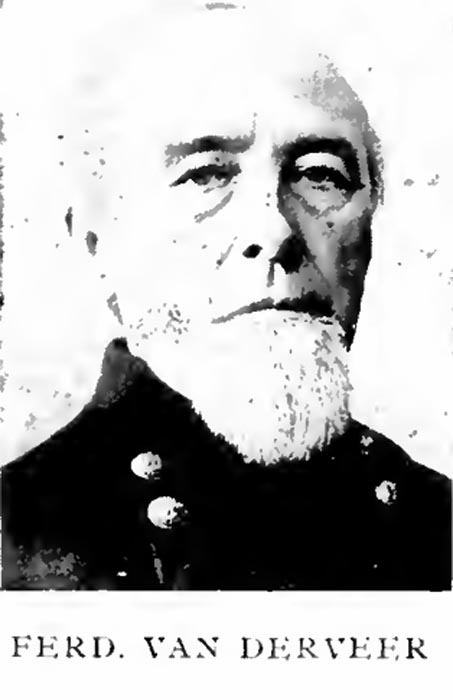
FERDINAND,
VanDERVEER was born in
Middletown, Butler county, Ohio, Feb. 27, 1825. He
attended school in his native village, and completed an
Academic course at Farmers' college, near Cincinnati.
He read law and was admitted to practice at Memphis,
Tennessee, in 1845. Shortly after being admitted
to the bar he returned to Hamilton, and continued his
legal readings under the tutelage of John B. Weller.
In the month of May, 1846, President Polk
called upon the state of Ohio to furnish three regiments
of soldiers as its quota for the Mexican war.
John B. Weller soon organized a company known as
Company I, First Ohio Rifles. Later on Weller
was appointed lieutenant colonel of the First regiment
and James George - who rose to the rank of
colonel of the Second Minnesota during the late war -
was elected captain. After the battle of Montery,
Sept. 19, 20, 21, 1846, Captain George
resigned and returned home, when Sergeant
VanDerveer was elected captain over the three
lieutenants. In this engagement Company I, had
three of its number killed, namely: John
Pierson, of Darrtown, Oscar Boehme and
Samuel Freeman, of Hamilton. After
Company I, was mustered out of service, Captain
VanDerveer exhumed their bodies and brought them
home at his own expense for burial. The funeral
service was held in the court house park, and the three
bodies were buried in one grave in Greenwood cemetery.
Captain VanDerveer participated in
most of the important battles of the Mexican war and was
noted for his coolness and bravery. He was
presented with a fine sword, sash, etc., by the citizens
of Middletown, on his return home. He was elected
sheriff of Butler county in 1847, serving until 1849,
the Yeargus murder at Busenbarks', defeating him
for a second term. Yeargus was arrested for
threatening to murder his wife and burn the houses of
his neighbor's. In default of a five hundred
dollar bond he was committed to jail. After
several months' confinement he was allowed the liberty
of the jail yard, and walked about the premises.
He was not locked in a cell, as the other prisoners
were. One night he stole out of the jail and
walked to Busenbark's, murdered his wife by cutting her
throat from
Page 345 -
ear to ear, returning to the jail before day light next
morning. General VanDerveer deplored
the rash act, as in the kindness of his heart, he
granted Yeargus the privileges above referred to,
who in return for the courtesy extended, betrayed the
confidence reposed in him, and committed a foul murder.
In 1849, and again in 1860 he edited the Hamilton
Telegraph, then the organ of the Democratic party of
this county. He was an able and forcible writer,
and woe be it to the individual who incurred his
displeasure as his trenchent pen was keen as a Damascus
blade. In the fall of 1860 he was elected
prosecuting attorney, and succeeded in sending more
criminals to penitentiary than any other prosecutor that
ever held the office.
At the
breaking out of the Civil War he organized the gallant
Thirty-fifth Ohio regiment and was commissioned colonel.
Inscribed upon its banners are Chickamauga, Mission
Ridge, Resaca, the Siege and general assault of Atlanta,
etc. On Chickamauga's bloody plane, Colonel Van
Derveer commanded a brigade. For bravery and
heroic conduct on this famous battle-field he won his
star and was made a Brigadier General. In action
he was cool, collected and knew not what fear was.
In 1865, General VanDerveer was appointed
Internal Revenue Collector, for the Third District of
Ohio.
He was appointed Postmaster Mar. 18, 1885, and served
until December fourth, when he resigned. In 1886,
he was elected judge of the court of common pleas, and
was again re-elected in 1891. He died Nov. 5,
1892.
LIEUTENANT
COLONEL CHARLES L'HOMMEDIEU LONG was born in Franklin, Warren county, Ohio, in 1827.
His parents moved to Cincinnati, when he was ten years
of age, and in which city he grew to manhood. He
attended the Woodward High school in Cincinnati, though
not a graduate. He left his class to learn the
printer's trade in the Cincinnati Gazette office.
At the outbreak of the Mexican war, Col. Long
enlisted in the First Ohio regiment. He made a
record as a
Page 346 -
gallant soldier. He responded to the call of
President Lincoln for 75,000 men. He organized
a company and was elected captain. His company was
assigned to the Fifth Ohio. He was elected major
of the regiment, afterward he received a
Lieutenant Colonel's commission and assigned to
the Thirty-fifth. Col. Long was identified
with the Thirty-fifth for nearly two years, a good part
of the time in command. He was full of energy, and
never sought to evade duty in any respect.
In July, 1863, Col. Long resigned and returned
to Cincinnati. He died in 1890.
MAJOR H. V. BOYNTON
came to Hamilton Aug. 20, 1861. He had been
commissioned major by the governor of Ohio, and ordered
to report to Col. Van Derveer at Hamilton.
The command of the regiment devolved upon him from the
close of the Tullahoma campaign to the Missionary Ridge
fight, where he was wounded. At the close of the
Civil War, General Boynton became the Washington
correspondent of the Cincinnati Gazette, taking the
place of Whitelaw Reid. He served over
twenty-five years for the same paper. He made a
reputation in this capacity. The enterprise with which
Gen. Boynton's name will be more particularly
associated, is the conception, developement
development and completion of the National Park,
embracing the battle field of Chickamauga and Missionary
Ridge. Chickamauga was the hardest fought field
during the Civil War considering the numbers engaged.
The park, covering a large part of both fields, will
perpetuate, for all time to come, the fierce battle here
enacted, as well as the bravery of the American
soldiers.
MAJOR JOSEPH L.
BUDD, was born in Mount Holly, New
Jersey, in 1833. His family moved to Hamilton,
Ohio, in 1836, where the subject of this sketch spent
his boyhood days in attending school at the old Hamilton
Academy, which was at that time in charge of C. C.
Giles. At the age of seventeen Joseph Budd
removed to Lebanon, Ohio, in Warren county, to enter
upon the mercantile profession. He continued
Page 347 -
in that business up to the breaking out of the Civil
War. Major Budd had a taste for the
military profession. In 1857 he was a member of
the "Warren Guards."
Major Budd was identified with the Thirty-fifth
as captain of company A, which he commanded until June,
1863, when he received promotion as major of the
regiment. He served after the battle of
Chickamauga on Gen. Baird's staff. After
the battle of Missionary Ridge he took command of the
regiment. From January, 1864, until the regiment
was sent north to be mustered out of the service,
Major Budd was in command of the regiment, or in
other words, he commanded the Thirty-fifth on the
Atlanta campaign.
JOHN S. EARHEART
was born in Jacksonburg, Butler county, Ohio, Mar. 10, 1824.
His parents moved to Hamilton when the subject of this
sketch was only two years of age. At this place he
attended the Hamilton Academy, and later he entered the Ohio
Farmer's college, then under the management of Freeman
Carey. Capt. Earheart studied civil
engineering. He assisted his father in building a
number of turnpikes in southern Ohio, in the Hamilton
hydraulic and surveying lands, as well as work connected
with railways. The Ohio division of the Junction
Railway was under Captain Earhart's management.
The first viaduct through the First ward of this city, a
masterpiece of engineering skill, was on the middle section
of the Miami and Erie canal, and when the Civil War began,
he resigned and assisted in recruiting the
Thirty-fifth. He commanded Company C of the regiment
until the spring of 1863, when he was appointed
topographical engineer and assigned on Gen.
Steedman's staff. Afterward he was advanced to the
same position on Gen. Brannan's staff. He
served in that place until his death, Aug. 10, 1863.
His death was notice in general orders, as follows:
"His zeal and undoubted ability in the discharge of his
arduous duties insured him the confidence of his superiors,
and his high moral character and gentlemanly deportment won
the respect and admiration of all. In the death of
Captain Earheart, the service loses a faithful and
efficient staff officer;
Page 348 -
society a worthy and respected member, and while we, his
associates in life, can but mourn his loss, let us
humbly hope that in his exemplary life and character,
death has gained for him peace above. By command
of
"BRIG. GEN. JOHN M. BRANNAN."

PHILIP ROTHENBUSH
CAPTAIN PHILIP ROTHENBUSH.
- The subject of this brief
sketch was born in Rossville, (now First ward of
Hamilton), July 1, 1842. He was educated in the
public schools of this city and Nathan Furman's
Academy. Afterward he was a drug clerk in his
father's store in the P. G. Smith building on the
West Side for six years. At the outbreak of the
Civil War he enlisted under Captain W. C. Rossman,
in Company F, Third Ohio Volunteer Infantry, for three
months' service. Later he enlisted in Company I,
Thirty-fifth Ohio, and was appointed orderly sergeant.
In February, 1862, he was promoted to first lieutenant,
and in March, 1864, received the rank of captain.
These advancements were the reward of merit. On
September 19th and 20th, 1863, he fought and was wounded
on Chickamauga's bloody plain, and in 1864, on Lookout
mountain; was one of the leaders who helped to crown the
North with glory on the these famous battlefields.
He was United States Assessor in 1865 of Fairfield and
St. Clair townships. In 1866, Captain
Rothenbush was appointed United States store keeper,
in the Third District of Ohio. In 1867, he engaged
in the fruit business in connection with Blair
Boger, who later sold out to James D. Ratliff.
This latter partnership covered a period of six years,
when Captain Rothenbush sold his interest to
George A. Miller. After several months rest he
opened his present establishment at No. 110 High street.
Captain Rothenbush is the oldest fruit dealer in
Hamilton. He was the first to introduce the sale
of bananas in this city when they sold at fifteen cents
a piece; was the first to handle poultry outside of
market. He makes a specialty of handling apples,
cabbage and potatoes by the car load. He keeps the
best and finest line of domestic and tropical fruits.
He carries a large and varied stock of seeds, candies,
cigars and tobacco. He is a thorough business man;
an energetic and untiring
Page 349 -
worker; has succeeded in building up a large trade.
Close application and personal supervision of business
are the secrets of his success. His place is
abreast of the times and his is justly considered as the
leading fruit house in Hamilton.
Captain Rothenbush was with his father, in 1865,
in the grocery business in the West End. He was
married, Jan. 16, 1856, to Ollie M. Ratliff.
They are the parents of three children, two sons and one
daughter. They are James E., Jennie M.,
and Clifford E. Mr. Rothenbush
is a member of the Grand Army of the Republic and Royal
Arcanum.
HISTORY OF THE
SIXTY-NINTH O. V. I.
This regiment
was recruited and organized in the Fair grounds at
Hamilton, in the latter part of 1861. Its first
Colonel was Hon. Lewis D. Campbell, who resigned
on August 9, 1862, and was succeeded successively by
Colonels W. B. Cassilly, M. F. Moore, and J. H.
Brigham. Its other regimental officers were as
follows: Lieutenant Colonels, Charles L. Gano,
George F. Elliott, J. H. Brigham; Majors, Eli J. Hickox,
James L. Hanna, Lewis E. Hicks; Adjutants, Richard H.
Cunningham, W. S. Mead, Thomas B. Hoffman, Joseph W.
Boynton; Quartermasters, Fred. B. Landis, Levi E.
Chenoweth. Following is the original
company officers:
J. H. Brigham, Company A; C. N. Gibbs,
Company B; G. F. Elliott, Company C; E. Hickox,
Company D; David Putman, Company E; Robert
Clements, Company F; William Patton, Company
G. L. C. Counsellor, Company H; J. V. Heslip,
Company I; J. J. Hanna, Company K. The
Sixty-ninth regiment was not wholly from Butler county.
It counts upon its lists the names of Montgomery,
Preble, Darke, Harrison and Fairfield. The
regiment left Hamilton Feb. 19, 1862, for Camp Chase,
Columbus, where it remained guarding rebel prisoners and
preparing for the field. On Apr. 19, 1862, the
Sixty-ninth left for Nashville, Tennessee, arriving
there on the 22.
It went into camp on the grounds of Major Lewis,
and was reviewed by Andrew Johnson, the warm
personal friend of the colonel, then the military
governor of Tennessee, and afterward the Vice-president
and President of the United States.
Page 350 -
This regiment
took part in the following battles: Gallatin, Tenn.;
Stone River, Tenn.; Mission Ridge, Tenn.; Resaca, Ga.
(including Pumpkin Vine Creek;) Kenesaw Mountain, Geo.;
Sherman's March to the Sea.
On May 1,
1862, the regiment went to Franklin, where it acted as
the guard for forty miles of the Tennessee and Alabama
Railroad. The rebel women of Franklin were
especially bitter, and on one occasion evinced their
venom against the national dead buried in the cemetery
by dancing on their graves. Colonel Campbell
issued an order commenting in severe terms upon this
indignity. On June 12, the regiment was ordered to
Murfreesboro, and thence it made its first march to
McMinnville, in pursuit of a rebel force, making
forty-eight miles in twenty-three hours. From
McMinnville, it advanced through the Cumberland
Mountains, to a point near Pikeville, when it was found
that the enemy were out of reach, and the column
returned. On coming back to McMinnville, a United
States flag was hoistered on a tall hickory pole, which
was standing in the square. On this occasion
General Dumont and Colonel Campbell addressed
telling speeches to the citizens, and the fervid
exclamations and the tears of many an old citizen,
attested their devotion for the "Old Flag." The
regiment returned - moved from McMinnville to
Nashville, where it was presently ordered on guard duty,
Colonel Campbell becoming Provost Marshal of the
city. This duty was performed until sometime
during the month of August, and the regiment was
organized with the Eleventh Michigan, the Eighteenth
Ohio and the Nineteenth Illinois, into the Twenty-ninth
brigade, commanded by Colonel T. R. Stanley of
the Eighteenth Ohio. The maiden engagement of the
Sixty-ninth took place at Gallatin, Tenn., early in
August, Morgan had taken possession of Gallatin
capturing the garrison. The regiments including
the Sixty-ninth, moved against Morgan engaging
him at Gallatin, driving him out of the town
Page 351 -
pell-mell, with a heavy loss to the rebels. In
this sharp fight, Isaac Repp, of Dayton,
was killed.
On November 5, the Sixty-ninth took part in the fight
on Franklin Pike, five miles from Nashville. This
was during the time that the Army of the Cumberland was
operating against Bragg, in Kentucky, and Nashville was
surrounded by the enemy. The demonstration on the
Franklin Pike was heavy but General Negley,
by a judicious disposition of his meager forces and an
abundant use of artillery, repelled the attack.
The Sixty-ninth met with but slight loss in this affair.
From November 7, till December 26, the troops were
resting, while the campaign which ended in Stone River
was planned and prepared. On this day, the army
started on the march to Murfreesboro. Several days
were spent in marching and skirmishing, and on the
memorable December 31, the Sixty-ninth was, with
Negley's division on the right center of the army,
were engaged in the Cedar Thicket fight, which for
fighting and carnage, had not been surpassed during the
war. On that day the regiment had five officers
wounded, two men killed, and about fifty wounded and
made prisoners. Thursday, January 1, General
Rosecrans sent Negley's and Rosecran's
divisions out on the right to draw the enemy out, but
without success. Bragg was getting
cautious. On Friday, these troops were sent down
on the left of the army, toward which quarter the enemy
were concentrating. On this day, occurred one of
the most brilliant acts in the history of the regiment.
Breckenridge's corps had passed down till Van
Cleve's division was falling back, from their
advantageous position on the east side of the river.
Heavy masses of the enemy were advancing down on
Negley's position, in force, apparently sufficient
to crush their left. At this critical juncture,
General Rosecrans, who was watching the field
with the utmost anxiety, called out, "Who will save the
left." Colonel Scott, of the Nineteenth
Illinois, sprang up and replied, "General, I am ready."
This gallantry was contagious, and in a few seconds the
Twenty-ninth brigade were on their feet, charging with
Page 352 -
tremendous cheers across Stone river and up the hill, in
the face of the advancing enemy. Breckenridge's
men intimidated by the charge, and the terrible fire of
the brigade, wavered, and then fell back in confusion.
Colonel Stanley was conspicuous in this
charge for his cool and daring courage. The brave
Colonel Scott, who inspired the charge,
was mortally wounded. Sergeant Frederick
Wilson, of the Sixty-ninth captured a rebel
battle flag, but in the eager pursuit it was dropped,
and afterward picked up by some other regiment. In
this charge the Sixty-ninth captured a part of famous
Washington Battery from New Orleans. The regiment
lost Captain Counsellor and six men killed
and about twenty wounded.
After the capture of Murfreesboro, the Army of the
Cumberland was reorganized; the regiments of the
Fifty-ninth brigade remaining together.
About the last of June, the Sixty-ninth marched with
the army on the Tallahoma campaign, arriving at the foot
of the mountains, July 4. Bragg fell back
without giving battle. At Cowan, Tennessee, when
the troops were sent forward, the Sixty-ninth was left,
until the entire army had advanced, when it was attached
to the reserve corps and moved to Rossville, Ga.
On the night of September 18, the Sixty-ninth was
ordered to the front, being attached to Colonel Dan
McCook's brigade. On the morning of Saturday,
the first day at Chickamauga, the Sixty-ninth performed
one of the most gallant acts of the war, in burning
Reid's bridge, over the Chickamauga. They
advanced at daybreak, in the face of heavy masses of the
enemy, piled up the plank on the brigade and set fire to
it, thus preventing the enemy from coming in on the rear
of the national army. The regiment then fell back
to Rossville, and immediately thereafter took charge of
the division trains. For this reason it did not
participate in the battle of Chickamauga. They
received a tremendous fire from the enemy, but completed
the work and then retired, before a heavy pursuing
force. This daring feat has received special
mention in the official reports. The trains were
all ordered to Chattanooga,
Page 353 -
the Sixty-ninth accompanied them to that point, and then
returned to the front, Saturday afternoon. When
the Fourteenth Army Corps, fell back, on Monday night,
the Sixty ninth stood advance picket guard covering the
retreat of the entire army. During the siege of
Chattanooga, by Bragg, this regiment worked
almost unremittingly in the trenches, much of the time
on half and one-third rations. It took an active
part in the magnificent series of operations by which
Grant drove Bragg from Lookout Mountain and
Missionary Ridge.
During the storming of Lookout Mountain, the Sixty
ninth was on picket, and from its position on duty, it
advanced in the grand assault on Mission Ridge. In
the assault, the regiment was in General
Johnson's division, on the right centre. The
Sixty-ninth bore as brave a front up that terrible
steep, as any other regiment engaged. On the
Ridge, the Sixty-ninth captured several guns and turned
them on the fleeing enemy. Its loss in this charge
was forty-four men, nine of whom were killed and
mortally wounded. Here within twenty yards of the
crest, full in the front, while crouching to avoid the
terrible fire, but proudly holding up the tattered flag
of the regiment, Color Sergeant Jacob Wetzel
received a ball through his head, and fell a glorious
martyr to the cause of liberty.
The performance of the regiment in that charge was such
that General Johnson, in visiting the
wounded, when he came to one of the men of the
Sixty-ninth, would say, "Ah! another Sixty-ninth boy-the
first to reach the top." During the advance up the
Ridge, while under a terrific fire of musketry and
artillery, a fragment of a bursted shell struck
Colonel Moore on his left side. He
would have been instantly killed but for his field
glass, which received and was shattered by the blow.
On the next day after the capture of Mission Ridge, our
troops pursued the enemy toward Dalton. The same
night, November 26, the brigade to which the Sixty-ninth
belonged, crossed Chickamauga creek, and advanced toward
a rebel encampment. Late in the night they came
near the camp and advanced, cautiously, near enough to
see
Page 354 -
the men about the fires. Here the Sixty-ninth
fired a volley and went in on full charge. The
rebels fled, leaving with the victors a battle-flag,
three pieces of artillery and one hundred and fifty
prisoners.
On September 7, the Sixty-ninth took part in the fight
at Jonesboro, and lost Lieutenant Jacob S. Pierson,
Martin V. Bailey, Color Sergeant Allen L. Jobes,
of Company D, and five men killed and thirty-six
wounded. The battle caused the evacuation of
Atlanta, and the national forces occupied that city.
The regiment participated in the subsequent chase after
Hood through the upper part of Georgia, and into
Alabama. It then returned to Atlanta, and joined
Sherman's march to the sea. Arriving in
Savannah, it took position in the front line.
In the campaign through the Carolinas the regiment was
engaged with the enemy near Goldsboro, North Carolina,
Mar. 18, 1865, and lost two killed and eight wounded.
This was the last affair in which it participated.
Then came to march through Richmond, the review at
Washington, the transfer to Louisville, and, lastly, the
final muster out of the service on July 17, 1865.
ONE HUNDRED AND
SIXTY-SEVENTH O. V. I.
This regiment
was organized in Hamilton, on May 2, 1864, and sworn
into the United States service on the fourteenth of the
same month. On May 18, it received marching orders
for West Virginia, and reached Charleston, in that
State, on May 21. It went into quarters at Camp
Piatt, named in honor of Colonel A. Saunders Piatt,
of the Thirty-fourth Ohio Volunteer Infantry.
Later the regiment removed to Loupe Creek, twenty-five
miles further up the Kanawha River, where four companies
were detached and sent to Gauley Bridge. At
these points they relieved the Second, Third and Seventh
regiments of West Virginia Cavalry. The duty this
regiment was called upon to perform was transporting
supplies to Generals Hunter, Crook and Averill
and guarding government stores. The regiment was
mustered out of service at Hamilton, in the latter
Page 355 -
part of September, 1864, after having served about a
month longer than its term of enlistment.
Following is a list of the officers of the regiment:
Colonel, Thomas Moore
Lieutenant-colonel, J. E. Newton.
Major, John F. Bender.
Surgeon, Moses H. Haynes
Assistant Surgeon, J. S. Ferguson.
Adjutant LaFayette Traber.
Quartermaster, Henry P. Dove,
Chaplain,
Jeremiah Geiger.
COMPANY A.
Captain, James
E. Stewart,
First Lieutenant, J. A. Kennedy
Second Lieutenant,
C. M. Dexter.
COMPANY B.
Captain, Edward
T. Jones
First Lieutenant, S. W. Woodruff
Second Lieutenant,
C. Vaughn
COMPANY C.
Captain, John
Koeninger.
First Lieutenant, Jacob Kurz.
Second Lieutenant,
P. Winkelhaus.
COMPANY D.
Captain, B. F.
Bookwalter.
First Lieutenant, A. W. Eckert.
Second Lieutenant,
A. Richardson. |
COMPANY E.
Captain, George
C. Warvel
First Lieutenant, Benj. F. Banker,
Second Lieutenant,
J. Busenbark
COMPANY F
Captain, John
C. Lewis
First Lieutenant, James F. Imlay
Second Lieutenant,
S. S. Garver.
COMPANY G.
Captain, David
B. Kerr
First Lieutenant, T. H. Robertson
Second Lieutenant,
W. McKecknie
COMPANY H.
Captain, James
A. Stevens.
First Lieutenant, L. D. Keil
Second Lieutenant,
Levi Jameson.
COMPANY I.
Captain, Samuel
K. Wickard.
First Lieutenant, Philip H. Welty
Second Lieutenant,
Henry C. Gray.
COMPANY K.
Captain, Daniel
D. Zellr
First Lieutenant, W. B. Davis
Second Lieutenant,
T. Whipple |
In all
enlistments, during the war, Hamilton and Butler county
furnished 3,750 recruits. Of this grand army of
men only 1,025 remain in the county. A number were
killed in battle; some have removed elsewhere, but a
majority of them have answered the last roll call and
have passed the lintels and portals, which calls to our
mind that beautiful dirge that we listened to
thirty-five years ago.
"A heart so leal and the
hand of steel
Are palsied, aye, forever,
But the noble deed and the patriot's need
Are left of the heroes' life.
The bugle's call and the battle ball
Again shall rouse him never.
He fought and fell, he served us well,
His furlough lasts forever. |
Page 356 -
STATE SENATORS
The
following persons have represented the Butler-Warren
District in the upper branch of the General Assembly
since 1804:
|
John Bigger |
1804-1806 |
|
Jacob Smith |
1806-1807 |
|
Richard S. Thomas |
1807-1808 |
|
Thomas Irwin |
1808-1820 |
|
James Heaton |
1820-1824 |
|
Joel Collins |
1824-1828 |
|
Daniel Woodmansee |
1828-1830 |
|
Fergus Anderson |
1830-1832 |
|
Daniel Woodmansee |
1832-1834 |
|
Elijah Vance |
1834-1838 |
|
John Saylor |
1838-1840 |
|
Robert Hazeltine |
1840-1844 |
|
James B. King |
1814-1848 |
|
Valentine Chase |
1848-1850 |
|
Jonathan Kilbourn |
1850-1854 |
|
G. W. Stokes |
1854-1845 |
|
Daniel Heaton |
1856-1858 |
|
Lauren Smith |
1858-1860 |
|
|
Thomas Moore |
1860-1862 |
|
A. G. McBurney |
1862-1866 |
|
N. C. McFarland |
1866-1868 |
|
William H.
Campbell |
1868-1870 |
|
Lewis D. Campbell |
1870-1872 |
|
Peter Murphy |
1872-1874 |
|
Benj. Butterworth |
1874-1876 |
P. M. Dechant
William Hl Stokes |
} |
1876-1878 |
|
William H. Stokes |
1878-1880 |
|
J. L. Mounts |
1880-1882 |
|
Lewis D. Anderson |
1882-1884 |
|
George F. Elliott |
1884-1886 |
|
William S.
Elzroth |
1886-1888 |
|
Estes G. Rathbone |
1880-1890 |
|
James L. Stephens |
1890-1892 |
|
Joseph J. McMaken |
1892-1896 |
|
In the list
will be found the names of men who were well versed in
law; who have made and are making our history today.
Among the list we mention Elijah Vance,
Valentine Chase, Thomas Moore, N. C. McFarland, William
H. Campbell, L. D. Campbell, Peter Murphy, George F.
Elliott, Estes G. Rathbone and J. J. McMaken.
COLONEL
THOMAS MOORE was born in the city
of Quebec, Canada, July 22, 1822. He was of
Scotch-Irish extraction. His parents removed to
Pennsylvania, in 1828, where his father died one year
later. In 1830, with his mother and two brothers
he came to Ohio, locating in Oxford, this county, where
he attended school until 1833, when he moved to Preble
county. When he was fifteen he began working at
the tailor's trade, and after completing his time,
labored for eight weeks as a journeyman, acquiring
enough money in this time to carry him through one term
at Miami University, in the fall of 1839. He was a
student in that institution for some four years, working
at his trade during vacations, and whenever
Page 357 -
the opportunity offered, and also teaching school, using
the money thus acquired to gain an education.
Completing his course, he entered the office of L. D.
Campbell, in Hamilton, about 1845, and read law with
him. From this he went to Jackson &
Hawkins, at Eaton, and was admitted to the bar of
the Supreme Court of Ohio, at Columbus, in the winter of
1845 and 1846. A year after he entered into
partnership with Judge William J.
Gilmore, which lasted a year, and was dissolved by
Judge Gilmore going to Eaton. Colonel
Moore was elected State Senator from the
Butler-Warren district, in 1860, being the first
Republican to fill that position.
As Senator he introduced and pushed to its final
passage a bill repealing the Criminal Cost Act.
Under the provisions of this law constables were
authorized to pursue criminals anywhere in the United
States, and render a certified copy of the cost bill to
the county auditor, who in turn was authorized to draw a
warrant on the treasury for the same. In those
days the offices of justice of the peace and constable
were a valuable sinecure, worth at least $10,000 per
annum.
He was mayor of Rossville in 1850-51, a position he
soon after resigned. He was originally a member of
the Associate Reformed church, but for ten years before
his death was a member of the Presbyterian church.
In 1864, he was elected Colonel of the One Hundred and
Sixty-seventh Ohio, and commanded it during its service
of four months in West Virginia. Colonel Moore
was married in 1845, to Miss Mary C. Caldwell,
who was born in Preble connty county,
in 1823. Mr. and Mrs. Moore are the parents
of seven children, of whom five are living.
Colonel Moore was long an active and laborious
worker in the Republican cause, and before that in the
Whig. He was a frequent political speaker, also at
temperance and Sunday school meetings, and was
interested in everything that concerned this city or
locality. Colonel Moore died June 19, 1893.
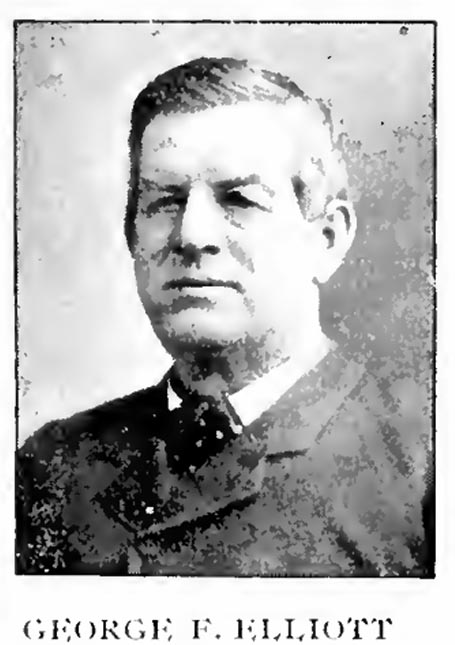
GEORGE F. ELLIOTT
COLONEL
GEORGE F. ELLIOTT was born Apr. 8,
1826, near the famous old Spring Meeting house in
Liberty township, which has often resounded with the
pious eloquence of
Page 358 -
his father. He was the youngest
of seven sons of Rev. Arthur Elliott, who came
out to this county from Maryland to fill the manly part
of a pioneer exhorter. At the age of fourteen,
George was sent to St. Clair township where he spent
several of the following years in farm work, attending
such schools as circumstances permitted. The
greater part of his educational training was acquired in
a school conducted by a Mr. Wade in the basement
of the old Episcopal church in this city. At the
outbreak of the Civil War, Colonel Elliott of his
own accord and almost entirely by his own exertions
recruited Company C, of the Sixty-ninth O. V. I.
His record as a soldier shines pre-eminent in the annals
of Butler county's achievements in the great struggle.
He was appointed Major on Aug. 9, 1862, and Lieutenant
Colonel in October, 1862. The crowning event of
his military record was his brilliant performance on the
bloody field of Stone River. Through those six
hideous days he led his regiment with courage and
ability. The serious sickness of his wife called
him to his home shortly before the final declaration of
peace, and he continued in the pursuit of agriculture on
his homestead farm, until 1866, when he embarked into
wider fields of industry.
During the three following years he engaged in the
distilling business in his city. He operated two
distilleries which in the short course of their
existence, paid into the Government exchequer upwards of
$2,000,000. In 1873, Colonel Elliott family
retired from business life, and then began his career of
eminent public service. His first public office
was that of member of the Decennial State board of
Equalization. His excellent services in this
capacity secured him the Democratic nomination for State
Senator in 1881. Although his nomination for State
Senator in 1881. Although his nomination was
unanimous he was defeated by the small margin of
twenty-seven votes. In 1883, he was again
nominated and elected to the senate, where he left a
long record of distinguished services in behalf of the
district which he represented. Not the least of
Colonel Elliott's claims to public gratitude is the
fact that he fathered the first appropriation bill which
was ever passed in behalf of Miami University. In
[Page 359] -
November, 1889, he as appointed to a place on the
Soldier's Relief Commission to fill a vacancy caused by
the death of Charles E. Giffen. He was also
a member of the United States Land Commission, whose
function it is to recover abandoned or swamp lands, and
until 1888 he had entire jurisdiction over the states of
Oregon and Washington. He was also a director of
the Second National bank in the years of 1868-9 and has
always been an active and useful member of the Grand
Army of the Republic. In 1854, Colonel Elliott
was united in marriage to Miss Eleanor Hueston,
whose father had served as captain of pack horses in the
famous expedition of Mad Anthony Wayne, which
forever broke the hold of the Indians in the valley of
the Miami. Upon his marriage he received from his
father a grant of 200 acres of farm land. He had
been a strong and useful man, and the abundant energies
of his life were directly applied to the interests and
improvements of his native city, county and state.
Colonel Elliott died Wednesday evening, May 13,
1896. The funeral was held from the home on North
B street at 2:30 o'clock Friday afternoon, May 15, and
was conducted by Rev. J. W. Peters in conjunction
with the Rev. W. I. Fee, a life-long friend
of the deceased. The pall bearers were: E. G.
Rathbone, F. W. Whitaker, Dr. S. L. Beeler, Dr. W. C.
Miller, Dr. James W. Roll and G. K.
Shaffer.
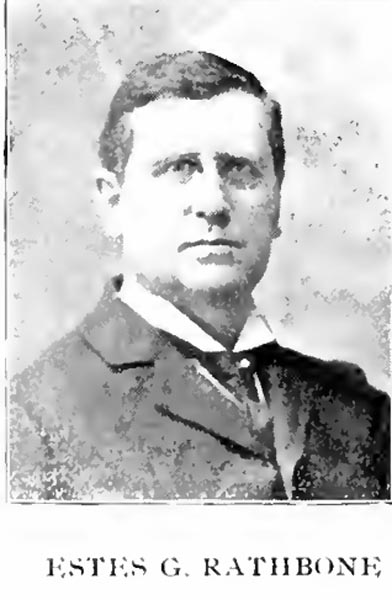
ESTES G. RATHBONE
ESTES G. RATHBONE
was born in Hebron, Pennsylvania, July 30, 1848.
His childhood was spent in the locality of his birth,
and he was passed from the public schools into Alfred
college in New York. After his father's death the
management of the family estate gave him his first taste
of active business in which he has since been so long
immersed, and the ability with which he conducted the
family's affairs pledged the success of his after life.
In 1874 he began his extensive public career as a
Special Agent in the treasury department where he
remained until his promotion in 1883 toa place of
importance in the Pension Bureau. Before the close
of the administration under which he was appointed he
had increased
Page 360 -
the bureau staff to more than five times its original
size and efficiency.
His residence in Hamilton dates from the year 1885 when
he came to this city to assume control of the large
interests of the Lewis D. Campbell estate.
Public honor speedily followed him to his new home and
he was returned to the State Senate in 1887 by the
largest majority ever given a Republican candidate.
At the expiration of his term he passed into the Federal
service, serving with distinction as Chief Post Office
Inspector and afterward as Fourth Assistant Postmaster
General. His authority and usefulness in this
position were almost without limit. His keen
intelligence and diligent interest in department affairs
made him really the leading spirit of the postal service
and his work in purifying the mails. of a great and
hideous taint merits for him the gratitude of the
nation. We have men who have attained to honorable
eminence in the service of their state and nation; we
have men whose names are known to the tradesmen of the
world; but we have only one who unites in himself, in
such perfect symmetry the various elements of birth,
culture and citizenship, and the will and ability to
apply them to the public good. We are all aware of
the extent of Major Rathbone's public life, but
there are phases of it which the average man does not
know. Major Rathbone is descended from the
proudest race of our land. His Puritan ancestors
came out of old England on the little Mayflower, in
1620, and none of his posterity has ever forgotten the
requirements which such a lineage implied. The
Rathbone family tree is old, and broad, and high;
but her age is the strength of maturity, not the
feebleness of decay. He was married in 1884, to
Mrs. Josephine Campbell Millikin, the daughter of
one of Butler county's most distinguished families.
J. J.
McMAKEN was born in the old family
homestead, in this city, in January of 1848. His
early education was obtained in the public schools of
Hamilton. He afterward entered Miami University,
from which institution he was graduated in 1870.
His mind had long before been fixed upon the law, and he
immediately set about preparing him
Page 361 -
self for his profession by entering the office of
ex-Governor James E. Campbell. Two years later
he was duly admitted to the bar, and has ever since
practiced in this city, save for the interruptions
caused by his frequent entrance into public life.
If we consider his career with fairness, Senator
McMaken may be said to have in his later years
stepped entirely beyond the limitations of professional
routine into the broader field of public service.
From the time of his election, in 1889, to the Ohio
Legislature he has been almost incessantly in official
life. From the Lower House he was quickly elevated
by a proud and confiding constituency into the dignified
body of the Senate of the State of Ohio. His
record in this capacity is full of work and honor.
During the two terms of his incumbency he was a real
factor in all the moreimportant legislation of that
time. He has always been found on the side of
justice and humanity. In the passage of the noble
"Fellow Servant Act" and the equally useful Australian
ballot law he did yeoman service. Since his
retirement from the Senate, Mr. McMaken
has been honored with the position of United States
Commissioner whose duties now claim his time equally
with the law. In the ranks of the Democracy of
Ohio he has served his full time. No man has stood
higher or been more often consulted in the local
councils of the party, than has he. Mr. McMaken
stands as the representative of a family which has stood
for a century in the fore-front of the great world of
affairs. He has carried his part well and the
family of McMaken and the city of Hamilton is the
better and the wiser that he lives. As the son of
that grand old man Mark C. McMaken, he was born
into the world with a responsibility, and the credit and
honor of a great name has seldom fallen on more worthy
shoulders. He was married in 1871 to Miss Belle
McElwee. Senator McMaken's soldier
record is a proud one.
SOLDIERS' RELIEF
COMMISSION.
The commission was duly organized
under an act of the Legislature passed Mar. 16, 1877.
It is now working under an amended act passed Apr. 15,
1889, as follows:
Page 362 -
"It is hereby made the duty of tpe Soldiers' Relief
Commission, hereinafter provided, in each county in this
State, as soon as practicable after the passage of this
act, and annually thereafter on the first Monday in
January in each year, to appoint for each township, in
such county, and for each ward in any city in any such
county, a Soldiers' Relief committee, consisting of
three persons, residents of each such township and ward,
who shall be honorably discharged Union soldiers,
sailors or marines, provided that if there are no such
soldiers or sailors or marines who are residents of any
such township or ward, then there shall be appointed
three reputable citizens, one of whom shall be
designated as chairman of such township or ward
soldiers' relief committee; and to fill all vacancies
that may occur in any such committee, and to remove any
member of any such committee for cause; and it shall be
the duty of each such township and ward soldiers' relief
committee, in its respective township or ward, to
receive all applications for relief, under the
provisions of this act, from applicants residing in such
township or ward, to examine carefully into the case of
each applicant, and on the first Monday in May in each
year, to make a list of the names of all
indignant indignant Union soldiers sailors and
marines, and the indigent parents, wives, widows and
minor children of the same, who are residents in such
township or ward, who have been bonafide residents of
the State one year, and of the county six months, next
prior to said first Monday in May, and who, in the
opinion of any such township or ward relief committee,
require aid, and are entitled to relief under the
provisions of this act; and it shall be the duty of the
chairman of each township and ward soldiers' relief
committee, or other member of such committee authorized
by such committee, to deliver such list to the soldiers'
relief commission, hereinafter provided, or its
secretary, on or before the last Monday in such month of
May, together with a statement of each applicant for
relief, of the income, if any, of the applicant, the
amount of taxable property, real and personal, of
(stocks, bonds, moneys on hand, loaned or deposited in
any bank or elsewhere, shares in building associations,
mortgages, notes or other articles of value) from which
an income or revenue is derived by the applicant; said
statement shall be made up in blanks which shall be
furnished by the soldiers' relief commission, and shall
be subscribed by the applicant; and in case any false
statement is made therein by any applicant for relief,
or guardian for such applicant, such applicant or
guardian shall be deemed guilty of a misdemeanor, and,
upon conviction before any court of competent
jurisdiction, shall be fined in any sum not exceeding
fifty dollars, nor less than twenty dollars, and be
imprisoned in the county jail for a period not exceeding
sixty days nor less than thirty days. And on said
last Monday in May said commission shall meet and
determine from said lists the probable amount
necessarary necessary for the aid and relief of
such indigent persons for the ensuing year, together
with an amount sufficient, in the judgment of said
commission, to furnish relief to any such indigent
persons not named in said lists, whose right to such
relief shall be established to the satisfaction of such
commission. Such commission, after determining the
probable amount necessary for the purposes aforesaid,
shall certify the same to the county commissioners of
the county, who, at their June session, shall make such
levies as shall be necessary to raise the required
relief, not exceeding three-tenths, except in counties
containing a national soldier's
Page 363 -
home not exceeding five-tenths, of a mill per dollar on
the assessed value of the property of the county."
On May 7,
1887, Capt. Philip Rothenbush was appointed for
three years, Aaron Wesco for two and Henry
Knight for one year. Philip Rothenbush
was elected President and Aaron Wesco, Secretary.
He resigned Jan. 3, 1888. Judge Van Derveer
appointed W. W. Lane to fill the unexpired term.
Charles E. Giffen was appointed in the place of
Philip Rothenbush, resigned.
On Oct. 14, 1889, Adam Bridge and S. L.
Beeler were appointed on the commission vice W.
W. Lane and Henry Knight, removed. On
the death of Charles E. Giffen, in 1881,
Colonel George F. Elliott was appointed a member of
the commission, serving until his death, May 13, 1896.
J. H. Beard, of Middletown, was appointed to the
vacancy caused by the resignation of Adam Bridge,
who removed from the county. George A. Van
Degriff succeeded Dr. S. L. Beeler, May 29,
1884. On June 12, 1894, George F. Elliott
and J. H. Beard met and elected themselves
President and Secretary, respectively. Noah
Stubbs was appointed Aug. 1, 1894. The
commission met on the seventh of the same month, and
reorganized by electing Noah Stubbs President and
G. A. Van Degriff, Secretary, both of whom are
serving in the same capacity today. On May 25,
1896, Judge Giffen appointed John Decher
for a term of three years, vice Colonel George F.
Elliott, deceased. Under the present
management the records of the commission are kept in
first-class condition by the efficient secretary.
No previous secretary has equaled him. He devotes
considerable time to outside work; and is the first and
only secretary that ever made an annual report of the
commissions' transactions.
NOAH STUBBS,
President of the Soldiers' Relief Commission, was born
near Morrow, Warren county, Ohio, Nov. 16, 1841.
He attended school at the Washington District, in a log
building, where oiled paper was used for light. He
was employed in a woolen mill and followed farming until
1861. When the Civil War broke out, he - Putnam
like - enlisted in
Page 364 -
Company A, Twelfth Ohio Regiment Volunteer Infantry, for
a term of three months. Afterward, Sept. 10, 1861,
he joined Company H, of the Second Ohio, serving three
years and one month. The regiment was mustered out
of service at Camp Chase, Oct. 10, 1864. In
February, 1888, he came to Butler county, locating at
Heno, where he has remained ever since. Mr.
Stubbs was appointed a member of the Soldiers'
Relief Commission, Sept. 17, 1894. He has a
reputation as a citizen and official, resting upon a
basis of absolute merit.

GEORGE A. VAN DEGRIFF
GEORGE A.
VAN DEGRIFF, Secretary of the
Soldiers Relief Commission, was born in Cincinnati,
Ohio, Mar. 2, 1845, where he attended school until he
was thirteen years old when his parents came to Butler
county, locating at Lindenwald. Here he attended
district school four years. On May 14, 1864, he
enlisted in Company F, One Hundred and Sixty seventh
Regiment, O. V. I. After his return from the army
he followed farming until 1867. Later Mr. Van
Degriff learned the carpenter's trade, with
William D. Blackall, which occupation he has
followed ever since as contractor and builder. In
May, 1894, he was appointed by Judge Giffen a
member of the Soldiers' Relief Commission; was
re-appointed May 1, 1895, for a term of three years.
He is a member of the Grand Army of the Republic, having
served in official capacity as chaplain and officer of
the day; was an organizer of Esther Court No. 4, Tribe
of Ben Hur, of Hamilton; is county deputy of this
society, by appointment of the Supreme Court. He
was united in marriage to Miss Agnes J. Cooper,
Nov. 30, 1875. One son, Robert, resulted
from this union. Any cause undertaken by Mr.
Van Degriff, finds in him an enthusiastic champion.
His records as Secretary of the Soldier's Relief
Commission, are models of neatness and accuracy.

JOHN DECHER
JOHN DECHER, a
successful pension agent, was born in Hesse-Darmstadt,
Germany, May 20, 1835. He received his instruction
in the schools of his native country, and when
Page 365 -
fifteen began learning the shoemaker's trade. On
July 4, 1852, he came to America, where he followed his
occupation in Buffalo, New York, and also in Canada.
In 1857 he located in Hamilton and was employed by
Isaac Whistler, till Sept. 13, 1861, when he
enlisted in the Seventeenth Missouri Volunteer Infantry.
He bore an honorable part in the battle of Pea Ridge,
Vicksburg, Arkansas Post, Yazoo Pass, and at the siege
of Vicksburg. After the surrender of Vicksburg, he
was attacked with typhoid fever, and was an inmate of
the hospital for eight months. Upon recovering he
was transferred to the Veteran Reserve Corps, and was on
duty in Virginia for a short time, being then
transferred to Elmira, New York, acting as a guard until
the conclusion of his term of service, Dec. 18, 1864.
He resumed his former situation with Mr. Whistler,
and upon the death of the latter, in 1867 or 1868, he
began business for himself, at which he has since
continued. He is now at 112 Third street, where he
does a good business in custom work. He was
married in 1859, to Miss Kate Vinson, and is the
father of seven children. He is a member of the
Grand Army of the Republic, and also of the Temple of
Honor, and in politics is a Republican. Mr.
Decher is an honest, industrious and well informed
man, and is worthy of the high estimation in which he is
regarded by all.
|