[Pg. 133] -
|
1.
Robert Hargitt |
1855-57 |
|
2.
John S. Wiles |
1857-59 |
|
3.
Ransford Smith |
1859-61 |
|
4.
Daniel Longfellow |
1861-66 |
|
5.
A. C. Stephenson |
1866-71 |
|
6.
M. N. Maginnis |
1871-73 |
|
7.
J. B. Lawder |
1873-75 |
|
8.
M. N. Maginnis |
1875-77 |
|
|
9.
Edward Hughes |
1877-79 |
|
10.
Frederick Egry |
1879-81 |
|
11.
F. B. Puthoff |
1881-83 |
|
12.
D. B. Sanders |
1883-87 |
|
13.
Alex. Getz |
1887-89 |
|
14.
John Dirk |
1889-91 |
|
15.
L. M. Larsh |
1891-93 |
|
16.
Charles S. Bosch |
1893-97 |
|
After the union
of the two villages of Hamilton and Rossville, under the
name of Hamilton, the Mayor's court was first held in the
Second ward engine house - the building is now occupied by
James Everson for livery stable purposes.
Subsequently it was removed to the Loher building,
two doors west of the jail; thence to the Lohman
block, and lastly to the old "Hamilton and Rossville
Academy" building, its present location.
Wonderful changes have been wrought in these forty-two
years. It is sad to contemplate the fact that a once famous
institution of learning has been turned into a prison vile.
ROBERT HARGITT.
[See
Postmasters of Rossville.]
JOHN
S. WILES was born in Lebanon, January 29, 1802.
He learned the smith trade in the town of his birth, and
followed it for a number of years. Subsequently he removed
to Black Bottom, where he taught district schools. He
came to Hamilton in 1836, taught school and served several
terms as constable, marshal, justice of the peace and
trustee of the poor.
In 1857, he was elected Mayor, serving until April,
1859,
[Pg. 134]
when Ransford Smith succeeded him. In
the sixties he was again elected constable.
In the twilight of life he was an active and
enthusiastic worker in the cause of temperance, being a
member of Hamilton Temple of Honor No. 17. On this
subject he was a fluent talker and ready debater.
Mayor Wiles was a man far above the average in
ability. He discharged his official duties without
fear or favor. He died January 22, 1874.
RANSFORD
SMITH was born in Oxford township in 1834. He was
graduated from old Miami in the class of 1855. While
attending college he studied law with his father, W. H.
Smith.
In 1855-56 he taught school in the "old church
building" in the First ward. In 1857 he was admitted to the
bar and opened an office on the East side. On April 4,
1859, he was elected Mayor, defeating Edward
Dalton, the Democratic nominee. Sectarianism entered
into this contest to a considerable degree, as the Catholic
clergy were opposed to the text books used and the reading
of King James' version of the Bible in the schools. In
August, 1861, he enlisted in Company "B," Thirty-fifth
regiment, O. V. I., and was commissioned first lieutenant.
He was afterward promoted to the captaincy, and resigned in
1864. Upon his return from the army he resumed the practice
of law in Hamilton and Cincinnati. In the latter city he
formed a partnership with Governor Thomas
Young and Samuel Crawford and took up his residence at
Riverside, where he remained until 1878. In 1879 he removed
to Ogden, Utah, where he was successful as a lawyer.
He was a territorial delegate to the Chicago National
convention of 1884 that nominated Cleveland for president.
He died in 1895.
DANIEL LONGFELLOW was
born in 1834, on the homestead farm in St. Clair township on
the old Eaton road. In 1853 he married Miss
Margaret Deleplane and immediately thereafter
moved to Rossville and engaged in the grocery busi-
[Pg. 135]
ness in
the Chatman property, on the corner of Main and D
streets.
He was an enthusiastic working member of the old
Neptune Volunteer Fire company on the West side.
He was constable of St. Clair township four years.
In 1861, he was elected Mayor of Hamilton, serving two full
and a part of the third term. He died May 25, 1866.
A.
C. STEPHENSON. The subject of this sketch was
born in Reading, Hamilton county, December 10, 1826; was
educated in the common schools; followed farming and school
teaching from 1849 until the fall of 1854, when he came to
Hamilton. His first employment here was in the
capacity of book keeper for the Hamilton Distilling Company,
operated by Robert McAdams and James
Beatty. In 1858, he engaged in the brewing
business on Canal street. In 1864, he was a partner in the
Hamilton Distilling Company composed of D. W. Brant,
Major A. A. Phillips and Peter Schwab.
He was book keeper for Murphy, Stillwaugh &
Ruoff. He was deputy sheriff under Colonel A.
A. Phillips until Alf Reese's election. He
was elected justice of the peace of Fairfield township and
the East Side in 1863 and served until June, 1866, when he
was appointed by council, Mayor pro tern, to fill out the
unexpired term of Daniel Longfellow, who died
May twenty-fifth of the same year. In April, 1867, he was
elected Mayor, and was re-elected in 1869.
On December 13, 1877, he was chosen justice of the
peace and served continuously until December 27, 1893.
During his entire official term he had the respect and
confidence of the bar. His decisions were fair and
impartial, as he had, in all these years, but few cases
reversed in the higher court. He is justice of the peace at
present.
M. N. MAGINNIS
was born near Frederick City Maryland. He received a
liberal education in Eastern colleges, and came West.
He studied law with Governor John W. Stevenson, of
Kentucky, and Judge James Clark, of Hamilton.
He was admitted to the Butler county bar in 1861, and was
actively engaged in the profession for ten years.
[Pg. 136]
He was a disciple
of John C. Calhoun, and ably defended nullification.
He was noted for the courage and ability with which he
expressed his convictions.
On Aug. 3,
1861, the Democratic party held a convention in the court
house. The Civil War had many opponents in Butler county.
Mr. Maginnis was the leader of this convention.
He introduced the following resolutions, which we take from
the Telegraph, of August 8, 1861:
WHEREAS, the "Bill of Rights" of Ohio affirms that "all
political power" (or sovereignty) "is inherent in the
people" of each state respectively; and that they have the
right to alter, reform or abolish their government whenever
they may deem it necessary"; and
WHEREAS, "Governments are instituted among men deriving
their just powers from the consent of the governed;" and
WHEREAS, the coercion of a state to endure a form of
government obnoxious to its people unsettles the whole
theory of the independence of the "United States of
America;" and
WHEREAS, the people of eleven States have refused to
acknowledge the authority of the Constitution, or permit the
execution of laws made in pursuance thereof within their
boundaries, having deliberately revoked the dele gated
powers heretofore exercised by their trustee, the United
States Government; and
WHEREAS, an immense army has been raised for the avowed
purpose of compelling the people of several States to
recognize the Constitution of the United States as their
supreme law and irrevocable act; and
WHEREAS, by the act of the president of the United
States, instigated thereto by the irrepressible fanatics, a
furious internecine war exists, which has aroused every
latent animosity, and which promises to increase and
intensify every prejudice in the minds of the people of the
contending states; and
WHEREAS, the Democracy of the state of Ohio are called
upon to make preparation to resume the reins of government
which the bastard "Phaetons" of Abolitionism have so
unskillfully handled, and to endeavor to restore peace to
their distracted country, therefore:
Resolved, I. That the Democracy of Butler County
in Convention assembled, declared as the result of their
deliberate judgment, that a war for forcing upon the
sovereign people of a State, even the best form of
government, is neither wise, just, Constitutional, nor
practicable; that we solemnly protest against its further
continuance for so fatuous a purpose, demand a Peaceable
adjustment of all controversy existing between the United
and Confederate States, and insist upon the immediate
appointment of Commissioners by our own Government to hear
and report such proposals on amity as the Commissioners of
the Confederated States may be instructed to offer.
Resolved,
2. That the president of the United States in exercising the
executive, legislative, and judicial powers of the
government, by declaring
[Pg. 137]
war, raising armies, providing navies, establishing
blockades, expending money without appropriation by law,
suspending the privilege of the writ of habeas corpus;
proclaiming martial law, increasing the regular army and
navy, and by authorizing subaltern military officers to
prescribe special regulations for the military service,
imprison citizens at their discretion, and disregard the
mandate of a co-ordinate branch of the government, has
seriously jeopardized the rights of these states; has
flagitiously violated the constitution; has made his will
and not that instrument, the measure of power, has invoked
the condemnation of every patriot, and deserves impeachment,
for his high crimes and misdemeanors.
Resolved,
3. That the incapacity of the party which has clambered to
power over the fragments of a nation is made glaringly
apparent, when the Republican Congress has no rebuke to
offer for its violated privilages, when it fails to
perform its Constitutional duty, in calling the culpable
Executive to a rigid account, when with eager sycophancy it
votes one-fourth more men and money than the President
demanded, or the emergency required, and when with
unequalled folly it attempts to patch a broken Constitution
with such worthless rags as retroactive laws.
* *
* *
*
Resolved,
4. That treason against the United States consists only of
overt acts of levying war against the same, or in adhering
to the enemies, giving them aid and comfort, that "every
citizen may freely speak, write and publish his sentiments
on all subjects;" and that no one can be justly stigmatized
as a traitor for the honest exercise of that privilege.
A minority report
was submitted by Judge James Clark. It was
moved to adopt the majority report. The motion was
vigorously assailed by the leaders of the minority,
Thomas Millikin and Robert Christy,
and ably defended by M. N. Maginnis, author of the
preamble and resolutions, and Hon. Christopher Hughes.
The motion to adopt the majority report prevailed.
The convention adjourned with three cheers for "Vallandingham
and Maginnis:
Dr. John P. P. Peck, one of the editors of the
Telegraph, refused to publish the Maginnis "Bastard
Phaeton" resolutions and the True Telegraph was
established, which name was afterward changed to the
Butler County Democrat.
At the October election in 1861, the larger portion of
the Democratic county ticket was defeated, owing to the
adoption of the Maginnis resolutions.
In 1876 he examined the commissioners detailed state-
[Pg. 138]
ment, and severely criticised the board for careless,
extravagant and unlawful expenditures.
In 1871 he was elected Mayor. Hamilton
had been for a long time terrorized by the criminal classes
and the people of the city without distinction of party,
elevated him to the Mayorality. He was re-elected in
1875, and during his second term, procured the passage of an
act by the legislature, establishing a police force in
Hamilton. He thorough suppressed crime and lawlessness
during his administrations. He is now located in San
Francisco, California.
J. B. LAWDER
was born near Piqua, Miami county, Ohio, in 1820. He
received his education in the country schools of his native
county. He became a resident of Hamilton in 1864, and
was engaged in the insurance business. In 1873 he was
elected Mayor. His first official act was to issue a
proclamation closing the saloons on Sunday. The order
was acquiesced in for a time, but later the saloons were
opened and the Mayor defied. Numerous arrests were made but
no one was convicted, so the proclamation ordering the
saloons closed was a dead letter. Rev. William H.
Lewder was chief clerk to the Mayor. During his
term of office the ever memorable crusade was organized and
begun its work. Mayor Lawder endeavored to
treat both sides fairly, but was powerless to protect the
women from insults, as the city was under the control of a
marshal and three deputies. Afterward a number of
special policemen were employed, and thereafter the
crusaders were protected. He sold out his property interests
in our city at the end of his official term and moved to New
Paris, Preble county, Ohio, where he died about ten years
ago from the effects of a cancer.
EDWARD HUGHES was born in
Symmes Corner, June 25, 1848. He was educated in the
public schools of Hamilton, and in 1873 entered
Bartlett's Commercial college, of Cincinnati, where he
received a thorough business training. After
graduation he immediately entered upon his chosen profession
as book keeper for Hunter & Brant in the old
mill at the east end of the suspension bridge. In turn
he was
[Pg. 139]
employed by William Murphy on the West
side; Kinsinger & L'Hommedieu, at Canal mills,
and by John W. Sohn. In 1874, he married
Miss Clara B. Mars. Six children have resulted
from this union—three girls and three boys. In 1877 he
was elected Mayor, defeating M. N. Maginnis who stood
for re-election. He was Governor Campbell's executive
clerk and has been in his employ for the last ten years.
FREDERICK EGRY
was born
in Germany, Nov. 14, 1840. In 1852, he emigrated to
America, locating at Dayton, Ohio. He learned the art
of printing in the Journal office, then edited and
owned by Richard and William Comley.
In 1857, he edited, and, as a printer, did the composition
on the first German daily newspaper published in the Gem
City. In 1859, he came to Hamilton and purchased an
interest in the Shildwache. On Oct. 24,
1861, Egry & Williams purchased the Hamilton
Telegraph from Dr. John P. P. Peck. This
paper espoused the Union cause and refused to publish
Maginnis' secession resolutions. The Telegraph
subsequently absorbed the Hamilton Intelligencer.
The larger portion of the Butler county Democracy were of
the Calhoun stripe; opposed the war and set up a new
journal, the Hamilton True Telegraph, Sept. 26, 1861. Mr. Egry was owner
of the Telegraph until Dec. 17, 1879, when he
sold out to C. M. Campbell. He was elected
Mayor in 1879, and his administration was one of good order.
He has been elected councilman from the Second ward for a
number of terms. He is engaged in the insurance
business which is large and profitable. He is a
Democrat in politics.
FREDERICK B.
PUTHOFF was born in Cincinnati, April 20, 1843.
He received his education in a boarding school at Dayton,
Ohio, and St. Xavier college, Cincinnati. At the
breaking out of the Civil War he tried to enlist, but on
account of his age was rejected. He did not receive the
refusal with resignation. In 1864 he enlisted in the
Second Ohio cavalry and served until the end of the war.
After his return from the army he engaged in the furniture
business in Cincinnati Ohio, and St. Louis, Mo. In
1870, he purchased a
[Pg. 140]
stock of goods and opened a hat store on
Main street, in West Hamilton. He was elected a member
of council from the First ward in 1878. During the
term of office he made a vigorous and successful effort for
sewerage and public improvements generally. He took an
active part in cutting off the canal basin. In 1881,
he was nominated for Mayor and was triumphantly elected,
receiving the largest majority ever given in the city.
His opponent was the popular M. N. Maginnis.
After serving two years he engaged in the real estate
business and has directed his efforts toward the raising of
the buildings on Main street in West Hamilton. This
was brought
about mainly through the efforts of Mr. Puthoff,
and is a standing monument to his energy. He with his
wife and four children reside at 211 South Third street. One
married daughter, Mrs. B. H. Connell, lives in
Cincinnati.
D. B. SANDERS
was born in Guilford county, North Carroliua, in
1819. At the age of ten years he walked from his birth
place to Richmond, Indiana, where his mother resided.
Here he was "bound out" to a Mr. Holman, who
treated him badly, and he ran away. In March, 1830,
barefooted, he walked from Richmond to Oxford, where
Joseph Stafford, his cousin resided. Here
he learned the smith trade with Frank Davis.
In 1844, he came to Hamilton and entered the employ of
Philip Berry, at the corner of Basin and Reily
streets. In 1848, at the head of the basin, he opened
a restaurant on a small scale and begun the manufacture of
cigars. At that time the basin extended to Smith
street, in the rear of Dr. Markt's drug store.
In this locality fighting was a favorite pastime and it was
no uncommon thing for three or four encounters to take place
during a single day.
Subsequently he removed to No. 17 Third street, in the
property now occupied by C. A. Stroble and continued
in business at this location for upwards of thirty years.
There was a time when every man, woman and child in Hamilton
knew the genial "Brook Sanders." He had
a kind word and pleasant smile for every one. He began
on a capital of $25.00, but by
[Pg. 141]
close application to business and gentlemanly treatment
amassed a competence in a few years. He was Mayor of
Hamilton from 1883 to 1887, and his administration was a
creditable one. He resides in a fine residence on
Dayton street. In the twilight of life he is the same
" Brook Sanders" as of
old. He is prominent in the order of Odd Fellows and
the Canton of Patriarchs Militant of this city was named
after him.
ALEXANDER GETZ
was born on the ship Havre, at sea, Dec. 21, 1846.
He received his education at St. Stephen's Catholic school
and at the age of fourteen began clerking in a general
store. In 1865, he went into business for himself, selling
out in 1873. He was elected recorder in 1878, and was
again re-elected in 1881. He was united in marriage
with Miss Catherine Beck, Apr. 13,
1869. Five children resulted from the union. Mr.
Getz was elected Mayor in 1887.
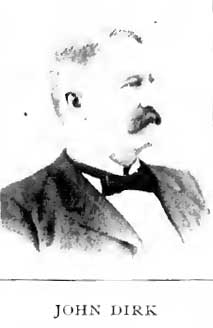
John Dirk
JOHN DIRK was
born in Rossville, Feb, 5, 1848. He attended the
public schools for a number of years, afterward serving an
apprenticeship at the Boston bakery. On Aug, 12,
1863, he enlisted in the Second Ohio Heavy Artillery,
serving until the close of the Civil War. He was
elected constable in 1867 and served continuously until
1879, when he was elected marshal, and served as chief of
police. He declined a re-election and embarked in the
pump business on the West Side in which he was very
successful. He was a member of the city council from
1876 to 1879 and was president of the body in 1888 - 1889.
To him belongs the credit of first agitating the idea of the
city owing its gas works. He was elected Mayor in
1889. His administration was noted for good order.
In August 1892, he was appointed by Governor
McKinley a member of the board of managers of the Ohio
penitentiary, which position he retained up to his death.
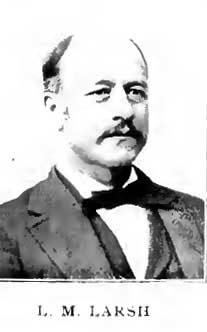
L. M. Larsh
L. M. LARSH was
born in Preble county, near Eaton, February 9, 1851.
He received a liberal education at Antioch college, Yellow
Springs, and Miami university, of Oxford,
[Pg. 142]
Ohio. He
followed farming for a number of years, previous to 1S74,
when he became a resident of our city. In 1874-75 he was
employed on the Big Four railroad. In the latter part of
1875 he entered the employ of D. M. Kennedy &
Company of the Hamilton Boat line, and remained with them
until 1891, when he was elected Chief Magistrate of this
city. Mayor Larsh's administration will be
remembered in our local history as an able, fair and liberal
one. He is not a recluse; is easily approached and is
popular with the masses. As a rule official perferment
unfits a man for future business. Not so with Mayor
Larsh. In May 1893, he and Walter Sherer
organized The Sherer Milling Company, and began
soliciting orders and delivering flour. Subsequently
Mr. Sherer retired, the style of the business
was changed to the Ft. Hamilton Milling Co., and as such it
is now conducted by Mr. Larsh. He believes in honest
labor and is not ashamed to perform it. He is a 32d degree
Mason, a Knight of Pythias and a member of the Elks and is
held in high regard in secret society circles.
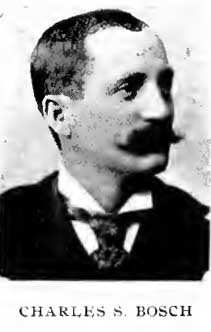
Charles S. Bosch
CHARLES S. BOSCH, the
Chief Executive of Hamilton, was born in Butler county, July
11, 1858. At the age of eleven years his parents moved
to Hamilton, when he entered the public schools, where he
remained until he was fourteen years of age. In 1872,
he decided to learn the profession of printing, and entered
the offices of the Butler County Democrat and
National Zeitung under the management of T. H.
Hodder and L. B. De La Court. A short time
afterward he went into the cigar business and subsequently
accepted a position as depot master with the C. H. & D.
railroad.
He was a member of the Board of Education from the
Fourth ward for four years, and was clerk of the board
during his last term. In April, 1893, he was nominated
for Mayor on the independent ticket. With three
candidates in the field he was elected by a plurality of
186. Mayor Bosch is thoroughly
identified with the prosperity and growth of our city, and
is personally popular. He always takes a prominent
part in politics.
|