|
[Pg. 238] -
Thomas Millikin
Isaac Robertson
Alex F. Hume.
S. Z. Gard.
Israel Williams.
P. C. Conklin.
William E. Brown.
Stephen Crane.
H. L. Morey.
Allen Andrews.
John C. Slayback.
Williaml H. Harr.
John F. Neilan.
Warren Gard.
William S. Giffen.
J. J. McMaken |
B.
F. Thomas.
James E. Campbell.
M. O. Burns.
Robert N. Shotts.
Brandon R. Millikin.
D. M. McClung.
Claren ce Murphy.
David Pierce.
Aaron Wesco.
P. B. Holly,
J. E. Morey.
William O. Campbell.
Edgar A. Belden.
Edward H. Jones.
U. F. Bickley.
Samuel D. Fitton, Jr.
R. P. Hargitt. |
Charles S. Haines.
C. J. Smith.
Frank P. Richter.
H. H. Haines.
G. C. Morey.
H. L. Krauth.
Nelson Williams.
James P. Whitmore.
W. C. Shepherd.
Isaac M. Warwick.
Robert S. Woodruff.
B. W. Baker.
Hinckley Smith.
John F. Heath.
Eugene C. Poicey.
J. W. Meckley. |
The first session of Court was held in Hamilton, May 10,
1803, at the home of John Torrence. This
building is still standing at the corner of Dayton and Water
streets, owned by G. A. Rentschler.
The first regular term began with Francis Dunlevy as
presiding judge, and Daniel Symmes prosecuting
attorney. The first term of the Supreme court was on
Oct. 11, 1803, and was composed of Judges Samuel
Huntington and Samuel Sprigg; Arthur St. Clair, Jr., as
Prosecuting Attorney. Judge Dunlevy was a man
of great strength of character, and possessed wide
influence. He had not originally been intended for the
bar. There were, indeed, few regularly bred lawyers in
the country. Judge Dunlevy's family were originally
from Spain, having become Protestants and fled from that
country to France, where they remained until the revocation
of the edict of Nantes.
[Pg. 239]
-
The name of Daniel Symmes appears as that of
the first Prosecuting Attorney. He was at that time,
and ever after, a resident of Cincinnati, and was appointed
to the position because there was no resident lawyer here.
He was a son of Timothy Symmes, and a nephew of
Judge John Cleves Symmes, and was born in Sussex county,
New Jersey, in 1772. He was a graduate of Princeton
college, and came West with his father. He was married
to Elizabeth Oliver in 1795. Arthur St.
Clair, Jr., succeeded him. He was a son of
General St. Clair, and a man of considerable attainments
and means. Before coming out here he had run away with
a Quaker lady, who made him a good wife, and who bore him
several children. He was a candidate for territorial
delegate, at the very beginning of the history of Ohio, but
was defeated by William Henry Harrison.
WILLIAM CORRY
was Hamilton's first lawyer. He was born in Washington
county, Pennsylvania, Dec. 14, 1778; received a liberal
education at Parson Duke's academy, in Tennessee. In
1798, he came to the Northwestern Territory and studied law
with William McMillan, of Cincinnati. In 1803
he removed to Hamilton and began practice. In 1807 he
was appointed prosecutor for the State, which office he held
until his removal from Hamilton in the year 1810. In
March, 1810, Mr. Corry was married to Eleanor
Fleming. He then determined to abandon the
practice of law, and removed from Hamilton and settled on
his farm near Cincinnati. He removed to Cincinnati in
1811, where he again resumed the practice of law. He
was elected and represented the county of Hamilton in the
General Assembly; was appointed by the town council to the
office of Mayor, and held it until 1819 by appointment.
He died in that city on the 16th of December, 1835.
DAVID K. ESTE
was the second lawyer who settled in Hamilton. He was
born at Morristown, New Jersey, Oct. 21, 1785, where he
received the rudiments of his education. He afterwards
entered Princeton College, where he graduated
[Pg. 240] -
in September, 1803. In the spring of 1804 he began the
study of law, and was in due time admitted to the bar in his
native state. In May, 1809, he left that state and
came to Ohio, and in June following settled in Hamilton, and
commenced the practice of his profession. In 1810 he
was appointed Prosecuting Attorney in the place of
William Corry, who had removed to Cincinnati, holding
this office until April, 1816.
JOSEPH S. BENHAM was born near Lebanon, Ohio; in 1808 and
1809, attended school in Hamilton; studied law with David
K. Este, and was admitted to the bar and commenced
practice in this city. He died in Cincinnati, July 15,
1840.
BENJAMIN COLLETT
came to Hamilton from Lebanon, Warren county, Ohio, in 1815.
He was a graduate of Dickinson College, Carlisle,
Pennsylvania; studied law at Lebanon with his brother,
Joshua Collett, and with Judge John
McLean. He was a classical scholar. As a
well read lawyer he was excelled by none in the state.
He soon acquired a very respectable practice. In
April, 1816, he was appointed Prosecuting Attorney for the
county of Butler, and held the office until 1820. A
year or two afterwards he returned to Lebanon.
GEORGE SARGEANT
located in Hamilton in 1816, studied law with Joseph S.
Benham. He was admitted to the bar upon the
completion of his course of study, and began practice
immediately afterward. He continued to practice until
about the year 1826. In September 1827, he became so
much deranged that he was strictly confined. The
Masonic Fraternity, of which he was a member, appointed a
committee of their members to see to his condition. He
was supported and cared for by the society for about a year.
He was afterward taken to an asylum in Cincinnati, where he
remained several years chained to the floor, and was then
removed to the asylum at Columbus. He never recovered
from his derangement, dying in 1852.
The following accomplished lawyers attended court in
Hamilton in the early days: Jacob Burnett,
afterward Judge, Nicholas Longworth, George
P. Torrence, Elias Glover and
[Pg. 241] -
Ethan Allen, of Cincinnati; Thomas Freeman and
Thomas L. Ross, of Lebanon; John McLean,
afterward a Justice of the Supreme Court of the United
States, and Joshua Collett.
In 1842, the resident lawyers of Hamilton were: John
Woods, F. D. Rigdon, William Bebb, J. P. Reynolds, Jesse
Corwin, Alfred C. Thomas, Elijah Vance, Thomas Millikin,
John B. Weller, Michael C. Ryan, Oliver S. Witherby, Ezekiel
Walker and Thomas H. Wilkins. At this date
Lewis D. Campbell and John M. Millikin had
retired from active practice.
MICHAEL SARGEANT
was an early, brilliant member of the
bar. He was a fine classical scholar, and conversant
with elegant literature as well as a thorough lawyer.
Mr. Sargeant died suddenly on the night of Apr. 19,
1830, aged thirty-three years. He was found in the
morning dead in his bed. He lies buried in the Fourth
ward burying-ground, now the park. He was a man of
large capacity, and had he lived would have won fame.
From 1844, to 1858, we give the list of Hamilton
Attorneys: Charles Richardson, Valentine Chase, William
Shottwell, Robert Hazelton, Moore C. Gilmore, Rossville,
Thomas Millikin, Isaac Robertson, George Webster, William H.
Miller, William P. Young, John B. Weller, J. M. Nutt, I. W.
Crosby, Thomas Moore, John W. Wilson, James Clark, James B.
Millikin, William E. Brown, E. V. Wilson, J. H. Gist, Alex.
F. Hume, Josiah Scott, N. C. McFarland, Jessse Corwin
and Elijah Vance.
JAMES CLARK
was born in Adams county, Ohio, in 1830; graduated from
Miami university in 1854; studied law; was admitted to the
bar and elected Common Pleas Judge. He was a man of
marked ability as a lawyer, judge and scholar. His
range of reading was very wide, and he collected a fine
library. Judge Clark died at the Magnetic
Springs House, in Statesville, New York, Dec. 28, 1881.
Attorneys at law in 1866: Isaac Robertson, Thomas
Millikin, N. C. McFarland, M. N. Maginnis, Bobert Christy
[Pg. 242] -
Alex. F. Hume, William E. Brown, J. B. Millikin, Thomas
Moore, A. W. Scott, Elijah Vance, Ransford Smith, Ferd.
VanDerveer, Israel Williams, S. Z. Gard, W. A. Kinneer, P.
C. Conklin, Stephen Crane, A. W. Eckert and Alex. C.
Hughes.
S. C. Symmes, Frank H. Shaffer and N. E.
Warwick, were here in 1870 and Houston James came
ten years later.

THOMAS MILLIKIN
THOMAS MILLIKIN
the oldest practicing member of the Hamilton Bar, was born
in Rossville, Sept. 28, 1819. He was the son of
Robert B. Millikin, a well-known physician, and Sarah
(Gray) Millikin. The latter was from Virginia and
the former from Pennsylvania. Thomas Millikin
began his classical studies with the Rev. Joseph G.
Monfort, in Rossville, in 1832, and entered Miami
university in September, 1834, graduating from that
institution in July, 1838. He began the study of law
with Elijah Vance, in the fall of 1838, and was
admitted to the bar Dec. 20, 1840. Three years later
he was appointed Prosecuting Attorney, and served as such
for one year. From that time to this he has
uninterruptedly followed the practice of his profession.
Mr. Millikin was originator of the Hamilton Gas
company, and also of the Hamilton and Lindenwald Electric
Transit company, of which he has been president since its
incorporation. Since 1852 he has been the attorney for
the C., H. & D. Ry. Co., and is also the attorney for the
Big Four. In the year 1874 he was tendered a
commission as judge of the Supreme court of Ohio to fill the
vacancy caused by the resignation of Judge John A. Corwin,
but declined the honor. Mr. Millikin has often
delivered public addresses on various topics. On July
4, 1876, at the Hamilton Centennial anniversary celebration
of the signing of the Declaration of Independence, he
delivered one of the principal orations, and was president
of the citizens committee during the Centennial celebration
of the building of Ft. Hamilton. When the corner stone
of the present court house was laid he also delivered an
address. A few years ago he took two partners, his
grandson Brandon R. Millikin, and Mr.
[Pg. 243] -
Robert N. Shotts, who are associated with him under
the firm name of Millikin, Shotts & Millikin.
He was married at Columbus, Ohio, Nov. 4, 1841, to
Mary, daughter of the late William B. VanHook.
She was born in 1824, and after a happy married life of
fifty-two years she was called to her eternal rest Jan. 13,
1894 while on a visit to her children at Peoria, Ill.
Mr. Millikin and his wife were the parents of seven
children William B., Robert B., Sallie G., Murray G., May
M., Ira S., and Julia M. Millikin. Of these
William B., Murray G., and May M., are deceased.
William served in the Thirty-fifth O. V. I. and
Robert in the Ninety-third during the war.
It is as a lawyer that he will always be known and
remembered. He has won many important suits at court,
among which was the Deshler will case at Columbus, a
case which he prosecuted with vigor and ability and which he
brought to a successful termination.
No man stands higher in the city and county of his
birth than Mr. Millikin. His name is a synonym
for all that is honorable. In spite of his years he is
as active as ever in his professional duties. He loves
the history of the records of the past and is thoroughly
informed on the events of the past seventy years with which
he has had any connection. His life has been an open
book and he will leave behind him what is more valuable than
earthly riches-a good name. Few men have left a deeper
impress on the city and state in the last forty-five years
than he, and none have won success and made as much law for
our great commonwealth as Mr. Millikin.

ISAAC ROBERTSON
ISAAC ROBERTSON
- The subject of this biographical sketch, was born in
Germantown, Montgomery county, Ohio, Sept. 6, 1818, being a
son of Isaac and Eleanor (Doke) Robertson. His
grandfather, John Robertson, was born in New Jersey
and took part in the Revolutionary War. In 1804, he
came to Ohio, settling in Warren county, where he engaged in
farming, and there died. The father of the subject of
this sketch was the eldest of seven children and came to
Butler
[Pg. 244] -
county when he was a boy. He was a soldier in the war
of 1812, and died at Germantown, Ohio, in 1871, aged
eighty-six years. By trade he was a contractor and
builder. Isaac Robertson attended college at
Miami university, but did not graduate, owing to ill health.
When he was a young man he read law and taught school,
finishing his studies in the office of Lowe & Lowe,
in Dayton, Ohio. After being admitted to the bar in
1844, he continued to teach school for four years, and later
began practice in Hamilton. He was Prosecuting
Attorney of Butler county from 1852 to 1856. After the
annexation of Rossville to Hamilton, in 1854, he took a
prominent part in the educational affairs of this city.
For many years Mr. Robertson has been justly
considered one of Hamilton's best citizens. As
a lawyer he enjoys a reputation for integrity, true worth
and merit. He possesses the sincere respect and esteem
of his brother attorneys and of the citizens of this city
and county. He has made a good record for him self and
he will leave an honorable name behind him.
ALEXANDER F.
HUME was born in Delaware county, New
York, Apr. 20, 1831. He was reared in Clarke county,
this state; received his higher education in the high school
at Springfield, Miami university and at the college at
Danville, Kentucky, from which latter he was graduated in
1850. On taking up law, he studied in the offices of
Judge William A. Rogers and Judge William White,
of Springfield. In 1852, he was admitted to the bar,
and soon afterward came to Hamilton, where he formed a
partnership with L. M. Farrow one of his fellow
students, who afterward became Postmaster of Hamilton.
In 1859, he was elected Judge of the Court of Common Pleas,
in which capacity he served for five years, then refusing
renomination. Afterward he resumed law and devoted
himself to his extensive and increasing practice. In
1875, he was re-elected to the same position, in which he
had proved him self so efficient in former years.
After serving as judge for twelve and one-half years, he
again declined further candidacy. In 1878, he was a
candidate for Judge of the Supreme Court
[Pg. 245] -
of the state on the Democratic ticket, and came within three
thousand votes of an election. He carried his own
county by a majority of three thousand. He was one of
the organizers and the first president of the Second
National Bank, of Hamilton, resigning the position
afterward.
The marriage of Judge Hume was celebrated Sept.
5, 1854. He was the father of six children. He
is one of the most prominent and influential citizens of
Hamilton. He is a lawyer of rare ability, and no one
in the profession has a larger or more lucrative practice in
this locality than he enjoys. In the legitimate lines
of his calling, he has been active and has acquired a goodly
fortune.
WILLIAM S. GIFFEN. -
Our subject was born in Hamilton, Apr. 8, 1851, and is the
son of Stephen E. and Rachel (Crane) Giffen. He
attended the public schools of this city and graduated from
the High school in 1876. He entered Miami university
in September of this year, where he remained four years,
being graduated therefrom in 1871. He read law in the
office of ex-Governor James E. Campbell for two
years, attending the Cincinnati Law school at the same time.
He was graduated from there in 1880, and was admitted to the
bar in the same year, when he began the practice of law in
this city, with John M. Davidson as his partner.
In 1881, Judge Giffen was elected attorney for the
Home Loan and Building association and continued in this
capacity until he was appointed Common Pleas Judge. In
1887, he was the Republican candidate for Mayor of the city
of Hamilton, against Alexander Getz, Democrat, and
was defeated by one hundred and fifty-seven, the city at
that time being normally 1,200 Democratic. In October,
1891, he was nominated at Dayton, Ohio, for Common Pleas
Judge in the first sub-division of the second judicial
district, comprising Butler, Darke, Montgomery and Preble
counties. His Democratic opponent was General Ferd.
VanDerveer, who was a candidate for re-election.
Judge Giffen met with defeat at this election,
the district being about 4,000 Democratic. In
November, 1892,
[Pg. 246] -
Judge VanDerveer having died, President McKinley,
then Governor of Ohio, appointed Judge Giffen to fill
the vacancy thus occasioned, and to serve until the next
regular election. Again, in 1893, he was nominated by
the Republican party to fill the unexpired term of Judge
VanDerveer to be completed Feb. 9, 1897. His
Democrat opponent was Judge P. G. Berry, since
deceased. Although the district was normally 4,000
Democratic, Judge Giffen was elected by five hundred
majority, thus achieving the proud distinction of being the
first Republican to be elected in this judicial sub-division
since it was organized, in 1852. In the spring of
1894, the Legislature re-arranged the sub-divisions of this
judicial district and made Butler county a sub-division by
itself. In August, 1896, Judge Giffen was again
nominated for Common Pleas Judge, his Democrat opponent was
John F. Neilan, and the campaign waged by Judge
Giffen at this election was the most aggressive that had
ever been made by any Republican in this county, although he
was defeated by the meager majority of four hundred and
ninety-nine, Bryan carried the county by 2,749 over
McKinley.
Judge Giffen in all his political
contests has shown himself to be a phenominal
phenomenal candidate, and it is predicted that the future
has in store for him greater political honors than he has
achieved in the past.
On Aug. 28, 1894, Judge Giffen was united in
marriage to Miss Emma Brant at Trinity Episcopal
church.

ALLEN ANDREWS
ALLEN
ANDREWS - The subject of this sketch
was born in Muncie, Indiana, Aug. 11, 1849. He enjoyed
the advantage of a good common school education and was
graduated from Liber college, in his native state; was
subsequently a student at the National Normal school at
Lebanon. He entered the teacher's profession. In
1871-72, was superintendant of the schools of New Madison,
Ohio. He studied law in the office of Judge William
Allen, at Greenville, Ohio, and was admitted to practice
by the Supreme Court of Ohio, Mar. 16, 1874. On Feb.
29, 1876, he came to Hamilton
[Pg. 247] -
and began practising his profession. On Oct. 18, 1880,
he became associated with H. L. and J. E. Morey,
since which time the firm of Morey, Andrews &
Morey has gained a wide reputation as one of the best
legal firms in this section of Ohio. Mr. Andrews
enjoys the well earned distinction of being the only
thirty-third degree Mason in Butler county. This honor
came to him unsolicited and it is a matter of record that no
previous resident of Butler county ever attained this
elevation. He is one of the best known Masons, having
served two years as Grand Master of Ohio Masons. On
Jan. 29, 1879, Mr. Andrews was married to Miss
Belle Davis, daughter of J. P. Davis of this
city. The union was a most happy one and Mr. and
Mrs. Andrews are the parents of five interesting
children.
With his family he is a regular attendant at the First
Methodist Episcopal church although not a communicant.
He is closely identified with the Sunday school of this
church. In politics he was reared a Republican, but
since 1876 has affiliated with the Democratic party.
Mr. Andrews is a lawyer of the highest
standing and for years has been a leader in his profession.
He is devoted to his life study of the law, and gives all
his energy to his practice. He has a judicial mind, is
keen, careful and discriminating, and is a natural and
pleasing orator. As a man he is genial and generous
and is well liked by those with whom he comes in contact.
His ability is unquestioned and as he is a young man there
is undoubtedly opening out for him a career that is bright
with promise.
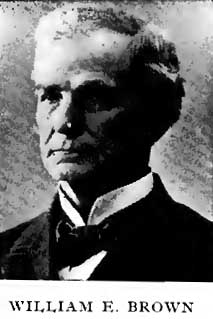
WILLIAM E. BROWN
WILLIAM E. BROWN,
President of the Second National Bank, of Hamilton, was
born in Xenia, Greene county, Ohio, Nov. 13, 1825.
His father was a mechanic of moderate means, and his son
was obliged to obtain an education by his own exertions.
He made his own start in life, and by industry has
accumulated a large and valuable estate. He was
early taught to labor, and at the age of seventeen was
in Northern Mississippi, a journeyman shoemaker.
He subsequently passed eighteen months in New York City.
At the age of twenty-one
[Pg. 248] -
he commenced the study of law
in Xenia. He completed his preparatory legal
studies in Dayton, and was admitted to the bar on the
29th of March, 1849. The following spring he
settled in Hamilton, with very little money. Up to
this time he had worked at his trade to pay expenses.
Before the expiration of his first year's practice in
Hamilton, he had business enough to support himself.
He married the daughter of Robert Beckett in
1852. In 1855 he was elected an elder in the
United Presbyterian church of Hamilton. He gave up
the practice of law for a while on account of impaired
health, but afterward resumed it. He was elected
president of the Second National Bank of Hamilton, in
1870. Under his able management this institution
has nearly trebled its business. It was, in a
great measure, through his advice and direction that the
handsome building of this bank was built. Mr.
Brown is not only a thorough lawyer, but he is also
an energetic man of business and a safe counsellor.
He is a man of strong character.

ISRAEL WILLIAMS
ISRAEL
WILLIAMS was born in Montgomery
county, Ohio, Aug. 24, 1827. He spent most of his
boyhood days in Champaign county. He came to Hamilton
in 1856. He attended Granville college; in 1853
graduated from Farmers' college, studying law in the office
of Gunckel & Strong, of Dayton, and he was admitted
to the bar in March 1855 in Cincinnati. Since 1856 he
has practiced in this city steadily, and as a practitioner
and counsellor at law he has long enjoyed the confidence and
esteem of a large clientage. He is a man of earnest
and decided convictions, and he is in full touch with the
progressiveness of his day and generation. In every
way he is admirably adapted for the successful discharge of
his professional and other duties. He is one of those
who materially helped make our city what it is today, and
his influence in this community can hardly be over
estimated. Mr. Williams was a Democrat before
the Civil War, but when Fort Sumter was fired upon became an
ardent supporter of the Union cause. In connection
with Frederick Egry he purchased the Telegraph
then the Democratic organ of Butler county, and merged it
[Pg. 249] -
with the Intelligencer. Under their management the
paper was a great aid to the union cause, upholding the
vigorous prosecution of the war.
On Jan. 9, 1860, he was married to Maggie Wakefield. His domestic life has always been happy, and his family is
well known in the social circles of Hamilton.
C. J. SMITH
[See Prosecuting
Attorneys]
CLARENCE MURPHY
[See
Probate Judges]

JOHN C. SLAYBACK
JOHN C. SLAYBACK
was born in Liberty township, Butler county, Ohio, Feb. 16,
1848. His boyhood life was that of the ordinary
country boy. He lived on the farm until he was twenty
years of age, attending the district school, securing a good
common school education. When he left the farm, he
taught one school and immediately afterward began a course
of study at the National Normal university at Lebanon, where
he completed a classical course, graduating from four
departments - commerce, teaching, science and classics.
Mr. Slayback spent one year in the law department of
the University of Michigan at Ann Arbor. In the summer
of 1878, he read law in the office of ex-Governor James
E. Campbell, and in the fall of this year he entered the
Cincinnati Law school and on May 14, 1879, he was admitted
to the bar. On July 1, 1879, he came to Hamilton and
took a desk in Mr. Campbell's office. Here he
remained for eight months, when he moved into the quarters
he still occupies in the Hamilton House building.
Subsequently Mr. Slayback became a partner of
Frank H. Shaffer, under the firm name of Slayback &
Shaffer. This partnership lasted for three or four
years when it was dissolved, Mr. Shaffer removing to
Cincinnati. A couple of years later Mr. Slayback
formed a partnership with William Beckett, son of the
late William Beckett, under the firm
name of Slayback & Beckett. A few years ago the
partnership was dissolved, Mr. Beckett locating in
the West. From this time onto 1888 Mr. Slayback
practiced alone, but in this year he formed a partnership
with ex-Probate Judge William H. Harr
[Pg. 250] -
and Peter B. Holly. This partnership existed
for two years when Mr. Holly retired. Since
that time the firm has been Slayback & Harr.
During his legal career, Mr. Slayback has been
retained in many cases of importance. His close
attention to business is proverbial and the success he has
achieved has been well deserved. There are few, if
any, attorneys in Southwestern Ohio, who have a better
practice.
In politics Mr. Slayback is an ardent
Republican. He has never held public office. Mr.
Slayback has been a delegate to the State convention
of the Ohio Republican league and has been honored by being
chosen as a delegate to the convention of the National
organization. He is a member of all the Hamilton
Masonic bodies, including the commandery of Knights Templars
of which latter body he has been recorder for several years.
He is a thirty-second degree Scottish Rite Mason, being a
member of Ohio Consistory, and is also a member of Syrian
Temple, Nobles of the Mystic Shrine. He is a Past
Regent of Hamilton Council No. 338 Royal Arcanum.
In Hamilton and throughout the county, Mr. Slayback
is held in high esteem and regard. He is the head of a
happy family prominent in the social circles of this city.

U. F. BICKLEY
U. F. BICKLEY
- The subject of this brief biographical sketch was born at
St. Charles, Butler county, Ohio, Mar. 27, 1867. He
attended district school until he was sixteen years old,
when he entered the High school at New London, Ohio.
Subsequently he taught school in the village of his birth
for four years. He followed up this experience with a
year on the road as a traveling salesman for a large book
establishment. Coming to Hamilton, he read law with
the late lamented Edward E. Hull. In the fall
of 1892, he entered the University of Michigan, at Ann
Arbor, taking the law course and also pursuing studies in
the literary department of this well known institution.
He graduated in 1893, ranking among the first ten in a class
of three hundred and thirty students. Before leaving
the university he was paid the high compliment of being
offered Assistant Professorship by the Dean of the law
[Pg. 251] -
department. He declined the position, as he desired to
immediately enter active practice. Mr. Bickley
spent four years with the law firm of Babcock &
Garrigus, of Minneapolis, Minnesota. He then
returned to Michigan and finished his law course, and was
admitted to the bar in the spring of 1893. During this
year he was admitted to practice in the United States
Circuit Court and the Circuit Court of Appeals of Michigan.
During his senior year at the University, of Michigan, he
was appointed by the faculty as editor of The Michigan Law
Journal under whose editorship the journal was made a state
and the standard legal publication of the state.
Returning to Ohio, Mr. Bickley was
admitted to the bar at Columbus, in December, 1893,
receiving the highest grade in a class of one hundred and
twenty. In January, 1894, he began the practice of his
profession in Hamilton, being associated with Judge P. G.
Berry. At the death of his friend Mr. Berry,
Mr. Bickley assumed charge of the large and lucrative
practice of the deceased, which clientage he has held by
virtue of his ability as an attorney and counsellor at law.
Mr. Bickley has a thorough knowledge of the law, is a
young man of good address and pleasing manners, and a bright
future is predicted for him. The vast field of the
legal profession affords him ample scope for the exercise of
those qualities which are possessed by all successful
lawyers, and which are naturally his. He is a safe
counsellor.
Mr. Bickley is a member of Lone Star Lodge, No.
39, Knights of Pythias. He is naturally kind and
benevolent in disposition, and his presence and kindly ways
are in themselves an encouragement and pleasure to those who
know him.

P. B. HOLLY
PETER B. HOLLY
was born in Lemon township, Butler county, Ohio, Sept. 28,
1853. His youthful days were passed on the homestead
farm, where he gained a thorough knowledge of agriculture.
After an early schooling in his immediate neighborhood he
attended the Mennonite college at Wadsworth, Ohio, for one
year; and later he taught school for five years.
Afterward, he graduated from the National Nor-
[Pg. 252] -
mal university, of Lebanon, completing a successful course
in the teacher's, business, and scientific departments.
While a student in Lebanon he was Professor of German in the
Normal university and the public schools. On his
return to the home farm he resumed its cultivation for five
years. In the fall of 1885 he began the study of law.
During this period he still superintended the farm, and it
was his custom to ride ten miles to Lebanon when his day's
work was ended, and recite in the evening with his classes.
In 1886 he was graduated from the law department of the
Normal university and was admitted to practice in Ohio,
having passed two examinations, one by the local committee,
and the other by the Supreme Court committee. All this
was after less than one year's study, as he crowded the
junior and senior years into one. Afterward he took a
post graduate course in the Cincinnati College of Law, and
on June 10, 1887, he opened an office in Hamilton.
Since that date he has conducted and managed a general
practice. He has made a high place for himself as a
lawyer and is held in well deserved esteem. Mr.
Holly has a desirable class of clients and is
intrusted entrusted with much responsible legal
work in the way of settling estates. For a young
lawyer he has been very successful. He is justly
regarded as one of Hamilton's tried attorneys. He
superintends the management of the home farm and has
manufacturing interests in this city. In politics
Mr. Holly is a Democrat; socially, he is a member of
Lone Star Lodge, No. 39, Knights of Pythias, in which order
he has been honored with important offices. Mr.
Holly's thorough knowledge of the German language makes
his services invaluable to people of that nationality.
WILLIAM H. HARR
[See Probate Judges]
J. J. McMAKEN
[See State Senators]

EDWARD JONES
EDWARD H. JONES
was born of Welsh parentage, in the village of Gomer, Allen
county, Ohio, Feb. 2, 1865. In childhood he removed
with his parents to Paddy's Run, Butler county. He was
educated in the public schools of Morgan township and at
Miami university. In the summer of 1890, he
[Pg. 253] -
entered the law office of Morey, Andrews &
Morey. After some months of invaluable experience,
he entered the Cincinnati Law school whence he was
graduated, a finished barrister in the spring of the
succeeding year. In 1891 he was elected clerk of the
board of State Deputy Supervisors of Elections, and
re-elected on the two following years. From this
position he passed logically into the office of city
solicitor which he still holds to his own profit and the
advantage of the city.

FRANK P. RICHTER
FRANK P. RICHTER
was born in Hamilton, Ohio, June 24, 1867. He was
educated in the schools of this city, graduating from the
High school in 1885. Subsequently he studied law and
attended the Cincinnati Law school, from which he was
graduated in the summer of 1888. Mr. Richter
stood third in his class at the law school out of sixty
students. Immediately after his graduation he was
admitted to the bar and commenced the practice of his
profession in this city, which he has continued ever since.
Mr. Richter has been an industrious and successful
member of the Hamilton bar. There are few men of his
age in Southwestern Ohio, who command greater respect among
lawyers or in the general estimation of the business
community. In 1889, he was elected Secretary of the
Board of Public Affairs and was afterward elected Secretary
of the Board of Elections. He was one of the
organizers of the Butler County Bar Association and acted as
Secre-
[Pg. 254] -
tary of that organization for four years. At present
he is the attorney for the Home Loan and Building
Association, having succeeded Judge Giffen to that
position when he was elevated to the common pleas judgeship.
He was the unanimous choice of the Republicans of this
county in convention assembled in September, 1893 for the
highly important and dignified position of Probate Judge and
against great odds, he made a very brilliant and energetic
campaign. In the Second and Fourth wards of this city
Mr. Richter received the highest number of votes ever
cast for a Republican candidate which is a strong
testimonial of the esteem in which he is held in this city.
In February, 1894, he was elected vice-president of the Ohio
Republican league which convened at Columbus; and was
re-elected in 1895, at Cincinnati. He is of
German-Irish extraction, his father's ancestors being
German, and those of his mother Irish. His
great-grandfather, Samuel Dillon, was the first
coroner of Butler county, and his remains are now buried at
the east gate of the court house park, the grounds where the
court house now stands at one time being a burial ground.
Mr. Richter has laid a good foundation for a
large and steady practice. He is one of the best known
and most able young attorneys at the Hamilton bar.

M. O. BURNS
M. O. BURNS was born in
this city Apr. 26, 1867. He was educated in the public
schools of Hamilton, and Notre Dame university, at South
Bend, Indiana, from which institution he was graduated in
1886. He then proceeded to gratify his ambition by
attending the Cincinnati Law school. Having good
application beside being naturally quick, he left a good
record behind him when he graduated in 1888, entering the
Butler county bar shortly after. Since then Mr.
Burns has been practicing in this city, meeting with
success. He numbers among his clients many of the
wealthiest and best citizens of Hamilton, and is successful
in caring for their interests. In April, 1891,
he was the successful candidate in the race for the city
solicitorship. Taking his office in the following
Septem-
[Pg. 255] -
ber, Mr.
Burns entered upon a term of office which was very
eventful and a severe test, before which a less able man
would have failed. His official career was marked by
nothing save success, though he handled the formidable gas
legislation, which case was taken before the Supreme Court.
The great move toward public improvement such as electric
lighting and sewerage was began while he was in office and
he success fully met all problems which they have involved.
Mr. Burns is the present efficient City Clerk.
His past career commends him to the public. There are
few young lawyers in this section of the state who have a
larger practice or one involving heavier responsibilities.

NELSON WILLIAMS
NELSON WILLIAMS
- The subject of this brief biographical sketch was born in
St. Paris, Champaign county, Ohio, Mar. 23, 1853, and is the
son of George and Margaret (McKinley) Williams.
He resided in the county of his nativity until thirteen
years of age, when his parents moved to Conover, Miami
county. There he attended a graded school, after which
he engaged in teaching for a period of three years. It
had been his ambition to become an attorney, and in the
pursuit of this desire he came to Hamilton in March, 1874,
and began the study of law in the office of Israel
Williams. Admitted to the bar in April, 1876, he
remained with his former preceptor until 1881, when, in
July, he began practicing alone. Mr. Williams
is at present in the employment of a good general practice.
He is a careful, conservative lawyer, and at the same time a
young man of broad culture and genuine ability. In
1882, he became attorney for the Provident Life and Trust
Company, of Philadelphia, and since 1887 he has had full
charge of their extensive legal business in Ohio.
On Oct. 21, 1880, Mr. Williams was married to
Miss Sue Mallory, daughter of Dr. Henry Mallory.
In the Masonic order, the only secret society to which he
belongs, Mr. Williams is quite prominent, and
deservedly so as he has earned the dignities he has attained
by true and faithful work in the quarries of the ancient
fraternity. He joined the order
[Pg. 256] -
in 1886 and since that date he has served two years as the
Worshipful Master of Washington Lodge No. 17 F. and A. M.;
one year as the High Priest of Hamilton Chapter No. 21, R.
A. M.; one year as the Thrice Illustrious Master of Hamilton
Council No. 19, R. and S. M. , and one year as Eminent
Commander of Hamilton Commandery No. 41, Knights Templars.
He is a thirty-second degree Scottish Rite Mason and a
member of the order of Nobles of the Mystic Shrine. In
the Grand Lodge of Ohio, F. and A. M., he served one year as
Grand Orator, and at present is the Grand Senior Warden.
He is also the conductor in the state council of high
priests or the "order of high priesthood." In other
ways he is prominent in Masonry and his poems of a Masonic
nature have received the compliment of being printed and
preserved by those who have heard him recite his lines.
In politics Mr. Williams is a Republican, and
has served as executive committeeman of the Ohio Republican
league. He has presided over several local conventions
of his party with ability and impartiality and his services
as an orator are often called into requisition on public
occasions. He is a forcible speaker, both on the stump
and at the bar.
BRANDON R.
MILLIKIN was born in Hamilton, Aug.
19, 1867. The foundation for his early education was
laid in the public schools of this city. In 1885, he
entered the classical course of Amherst college in
Massachussetts. Returning from this institution he
read law a year in the office of his grandfather,
Thomas Millikin, after which he entered the Cincinnati
school of law, from which he was graduated in 1891.
Upon the completion of his collegiate course he returned to
this city and was taken in as the junior member of the firm
of Millikin, Shotts & Millikin.
While at Amherst college Mr. Millikin became a member
of the Beta Theta Pi fraternity. He is a charter
member of the Sons of Veterans of Hamilton. Mr.
Millikin is a popular and talented young attorney.
He is well read, both in current and standard literature.
On Jan. 9, 1895, Mr. Millikin was married to Miss
Grace E. Jewett, of Wyoming, Ohio.
[Pg. 257] -

H. H. HAINES
HENRY H. HAINES was born in Preble
county, Ohio, Oct. 3, 1862. He is the son of
Charles S. and Francena Haines. In 1872, his
parents moved to Hamilton; and in 1882, Mr. Haines
graduated from the Hamilton High school. At an early
age he was inclined toward the legal profession and carrying
out his intentions he attended the law department of the
University of Michigan, at Ann Arbor, from which institution
he graduated in 1885. In 1886, he was admitted to
practice in Ohio. During 1887-88 he resided in
Findlay, Ohio, and from 1889 to 1893 he lived at Washington,
D. C., where he held an important and responsible position
in one of the departments. Mr. Haines returned
to Hamilton in 1893, and began the practice of law. He
stands well in the profession; is a bright and energetic
young man. He is well informed on all questions of law
and is destined to take a front rank in his chosen calling.
In 1890, Mr. Haines was united in marriage to
Miss Rose Giddings, of Green Springs, Ohio. In
politics, Mr. Haines is a pronounced Republican.
STEPHEN CRANE
[Pg. 258] -

JOHN F. HEATH
JOHN F. HEATH - The subject of this
sketch was born in New Haven, Connecticut, June 21, 1856.
He attended school in his native city, including the Yale
preparatory school, until he was twenty years of age, when
he was employed by Professor Basche, of the United
States coast survey, and worked for two or three seasons.
Subsequently he was employed by the New York, New Haven and
Hartford Rail way company. He served in the baggage
department of the road at New Haven. In November,
1879, Mr. Heath came to Hamilton and began the study
of law in the office of John F. Neilan. After
pursuing his legal studies for two years, he was appointed
Deputy Sheriff under F. D. Black, serving in this
capacity, until Mr. Black's term expired.
Mr. Heath filled the same position under George W.
St. Clair, and when that official's term expired, he was
appointed deputy under A. J. Welliver, clerk of the
court of common pleas. At the expiration of Mr.
Welliver's term, Mr. Heath was elected Secretary
of the City Board of Gas Trustees, a position he fills most
capably at the present time. Mr. Heath is a
careful accountant and his clerical duties are performed
with the greatest accuracy. He began as secretary in
January, 1894, and has given entire satisfaction. In
October, 1889, Mr. Heath was admitted to the bar, by
the Supreme Court at Columbus, and he has a thorough
knowledge of his profession and its requirements. For
two years Mr. Heath was a member of the City Board of
Equalization. He is a worthy young man, a desirable
citizen, and is highly esteemed by all who know him.
On Apr. 15, 1885, Mr. Heath was united in
marriage to Miss Eliza Goldrick. Three bright
and happy children grace
[Pg. 259] -
the family circle. Mr. Heath is a member of the
Catholic Knights of Ohio, the Catholic Benevolent Legion,
and the American Sons of Columbus. Politically,
Mr Heath has always been a Democrat, all his
affiliations having been with that party.
EDGAR A. BELDEN
was born in Hamilton, Ohio, Nov. 28, 1855. He was a
graduate from the Hamilton High school in 1872, and began
the study of law in the office of Thomas Millikin.
After a thorough course of legal inquiry rendered doubly
valuable by the constant presence and example of his
distinguished friend and preceptor, Mr. Belden was
admitted to the bar in 1881 and entered upon a career of
active practice, which he has since pursued uninterruptedly
with uniform success and satisfaction. Mr. Belden
has followed the law through all its intricacies and is
fully competent to care for interests of what ever nature.
He has seen fit to devote himself in great part to the more
dignified and lucrative field of commercial law. He
practiced independently until July 7, 1894, when with the
association of S. D. Fitton jr., the present firm of
Belden & Fitton was organized. His
active connection with the Methodist church and his still
more intimate association with the history of the local Y.
M. C. A. which he was instrumental in founding and on whose
board of trustees he has continually served, are pleasant
features of his life and bespeak much for the character of
the man.
In politics he has also figured to no inconsiderable
degree. In 1884 he was the Republican nominee for the
office of Prosecuting Attorney and the glory of his defeat
and the narrowness of its margin speak volumes for the
esteem in which he is held among his own people.
Mr. Belden is often a conspicuous figure at Republican
gatherings. His services as chairman of the recent
county and judicial convention will not be soon forgotten.
His opening speech was a model of chaste rhetoric and sound
and convincing argument.
He was married in 1888 to Miss Elisa Potter of
this city. Two children, Horace and Lucia
have been born into their
[Pg. 260] -
home. Mr. Belden has practiced his profession
among us for fifteen years with distinguished ability and
success.
S. D. FITTON, JR,
ROBERT S. WOODRUFF
[Pg. 261] -
J. E. MOREY
HINCKLEY SMITH
[Pg. 262] -
DAVID PIERCE
ROBERT N. SHOTTS
was born in Hamilton, Aug. 28, 1855. He was educated
in the public schools of this city, graduating from the High
school in 1872. He read law with Thomas Millikin.
Afterward he entered the Cincinnati Law school; began
practicing his profession in Hamilton, in
[Pg. 263] -
1877. He became a member of the firm of Millikin,
Shotts & Millikin in 1891. This firm
ranks among the solid, substantial and representative legal
firms of this city. Mr. Shotts is a
young gentleman of genuine ability, prompt, courteous and
honorable in all his transactions. He is a member of
the Knights of Pythias and Royal Arcanum.
Mr. Shotts was married to Miss
Bertha Phillips, June 20, 1885. They are
prominent in society circles.
CHARLES S.
HAINES was born in Boston, Mass. ,
Nov. 17, 1836. While yet a boy his parents came west,
locating in Eaton, Preble county, Ohio. He was
educated in the public schools of his adopted town; read law
in the office of his father, Judge Abner Haines.
Charles Haines came to Hamilton in 1872. A
short time afterward he was elected justice of the peace of
Hamilton township. He was admitted to the bar in 1877,
and immediately began practicing in this city. In
1892-93, he followed his profession in Seattle, Washington.
He returned to Hamilton in 1894. As an attorney he is
a gentle man of no mean ability; he merits encouragement,
and to all he offers full and faithful legal service.
In politics, Mr. Haines has always been identified
with the Democratic party.
|