|
OHIO GENEALOGY EXPRESS

A Part of Genealogy
Express
|
Welcome to
Richland County,
Ohio
History & Genealogy
|

|
BIOGRAPHIES
 Source
Centennial Biographical History
of Richland Co., Ohio
Illustrated
By A. J. Baughman, Editor
Published Chicago - The Lewis Publishing Co.
1901
<
CLICK HERE TO RETURN
TO 1901 BIOGRAPHICAL INDEX >
< CLICK HERE TO RETURN
TO LIST OF BIOGRAPHIUCAL INDEXES >

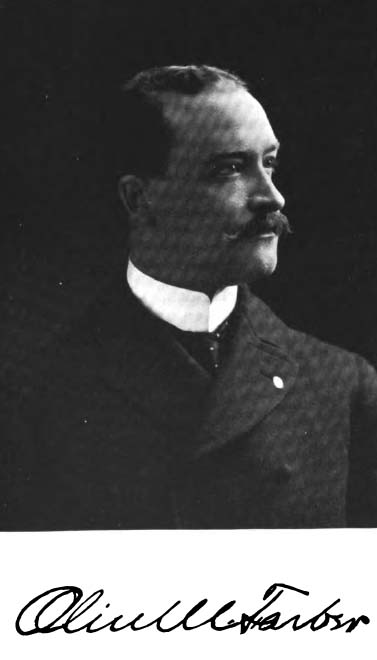
Olin M. Farber |
|
|
|
FREDERICK M. FITTING.
For many years Mr. Fitting was an active representative
of the business interests of Richland county. He became
engaged in merchandising and speculating, and not in a desultory
fashion did he prosecute his business interests, but with energy
and strong determination he carried forward the work which he
planned, and as a result of his well-directed labors won a hand
some competence. He was born Oct. 3, 1810, just across the
line in Knox county, Ohio, his parents being Casper and
Fannie (Markley) Fitting, the former a native of
Pennsylvania and the latter of Ohio. The father was a
farmer who met with very creditable success in his undertakings.
Of the Presbyterian church he was an active member and an
earnest Christian life was closed when he died, at the age of
eighty-three years. He was buried in Ankenytown, Knox
county, and his wife passed away at the age of seventy years.
Frederick M. Fitting was a boy of about seven or
eight years when his parents removed to Richland county,
locating on a farm near Bellville, where he was reared to
manhood. He walked about two miles to a country school in
order to acquire his education, and after putting aside his
text-books he began driving stage between Bellville, Sandusky
and Wooster. For several years he was thus engaged, after
which he conducted a general mercantile store in Bellville for a
number of years. He also built a flouring mill near the
town and successfully operated it for ten or twelve years, after
which he sold that property and purchased his father-in-law's
farm, that is now occupied by his daughter, Mrs.
Schuler. At one time he owned about two hundred and
fifty acres, a part of which has since been divided into
residence lots in Bellville. He laid out a street there
and greatly improved his addition to the city. In his
later years he engaged in superintending his farms and in
speculating in stocks and grain, and his business interests,
guided by keen discrimination, resulted in success financially.
In 1836 Mr. Fitting was united in
marriage to Miss Ruth Markey, daughter of John and
Mary (Walsh) Markey, both of whom were natives of Baltimore,
Maryland, where they were married. In 1826 they came to
Richland county, locating on a farm near Johnsonville, where
they remained for several years, after which they removed to
Bellville, where Mr. Markey engaged in merchandising.
After selling his farm to his son-in-law he purchased another
farm in Worthington township. He died at the age of
fifty-eight years. He was an active member of the
Methodist church and his wife also held membership in that
church and passed away in Bellville, at the age of sixty-one.
Their daughter, Mrs. Fitting, was only seven years of age
when brought to Richland county, where she spent her remaining
days, passing away on the 28th of April, 1896, at the age of
seventy seven years. She attended the Presbyterian church
and was a lady of many excellent qualities. She had but
two children and one died at the age of nine years.
The surviving daughter, Jennie E., was born in
Bellville, was educated in Mansfield and married Ferdinand
Schuler. She now owns the old home stead of fifty-six
acres within the city limits and sixty acres near the town.
She has five daughters: Florence, the wife of Edward
Kelly, of Bellville; Ida J., who is the widow of
W. P. Jackson and resides with her mother; Mary,
the wife of W. B. Elston, of Peoria, Illinois;
Katherine. the wife of Dr. N. R. Eastman; and Nora,
the wife of W. A. Goss, of Peoria. Mrs.
Schuler is a lady of culture and refinement, whose friends
throughout the community are many.
In his political views Mr. Fitting was a
zealous Democrat who did all in his power to promote the growth
and insure the success of his party. He was recognized as
one of its leaders in the state, yet he never sought or desired
office, although several prominent positions were tendered him.
In business he enjoyed a high reputation as a reliable man of
marked energy and sound judgment, and the success which he
achieved was the merited reward of his own labors. He died
Aug. 18, 1884, at the age of seventy four years, and in his
death the community lost one of its valued citizens, a man whom
to know was to respect and honor.
Source: A Centennial Biographical History of Richland Co., Ohio
- Publ: Mansfield by A. A., Graham & Co. - 1901 - Page 138-140 |
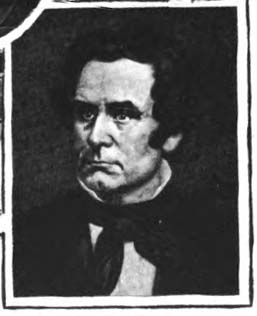
Col. Thomas H. Ford |
|
| |
ENOCH HEGG FRANCE.
The venerable citizen whose name introduces this biographical
mention was born in Yorkshire, England, Jan. 6, 1821, and has
therefore not only rounded the psalmist's span of three-score
years and ten, but has completed four-score years upon life's
journey. His parents, William and Malinda (Davenport)
France, were both natives of Yorkshire, born near leads, and
were of pure English lineage. The father was a weaver by
trade and was especially skilled in the weaving of fancy
fabrics. He came to the United States in 1828 and located
in Northfield, Ohio. About a year later his wife and three
children sailed for this country to join him, but on the ocean
voyage one of the sons died and was buried in the Atlantic.
The other children were Enoch H., of this review; Ann,
now the widow of David Lillie and a resident of
Spokane, Oregon; Sarah McClure, of Dale City.
Iowa; Lillie Peters, also of Dale City; James
France, in Iowa; Walter France, at Spokane;
and George France, at Hoquiam, Washington.
Accompanied by two children, the mother joined her husband in
Northfield, where the family resided for about five years and
then came to Richland county. he father established a
woolen-mill near Lucas and operated it for several years, after
which he sold it to his son and a Mr. Lawnsdale,
and removed to Guthrie county, Iowa, where he followed farming
the remainder of his days. He passed away about twenty
years ago, at the age of sixty-nine years.
Mr. France, of this sketch, was about
eight years of age when he accompanied his mother to the new
world and under the parental roof he was reared, receiving his
business training in his father's mill, of which he after ward
became a half owner. In connection with his partner, Mr.
Lawnsdale, he operated the woolen-mill near Lucas until
about the time of the outbreak of the Civil war. He then
purchased his partner's interest, becoming sole proprietor, and
for about six years following he continued the manufacture of
woolen cloth, blankets, stocking yarn and other goods in that
line.
On abandoning the enterprise he at once became engaged
in the business of supplying wooden ties to the railroad
companies under contract, and later he took contracts for
supplying crushed stone for railroads, public roads and street
improvement. In that business he met with gratifying
success from the beginning and after a time he admitted to a
partnership his sons, who are excellent business men and in late
years have contributed largely to the success of the enterprise,
which has been conducted under the firm style of
E. H. France. At Bloomville and Middle Point they
operate two large lime stone quarries. where three thousand
yards of stone is crushed daily, and their sandstone quarry is
located in Coshocton county. Their trade has now assumed
mammoth proportions, and in addition to contracting in crushed
stone Mr. France and his sons have constructed
many miles of railroad.
Mr. France began life with a limited
common-school education. as a son of a poor weaver, from whom he
learned the trade, and when he began what has been a very
successful business career he had an extremely limited capital.
His career, however, has been an active and useful one. He
has ever been industrious, energetic and determined, has
improved his opportunities and has utilized his ability to the
best advantage. Far-sighted in matters of business. and
with ambition and wisdom, he has directed his affairs
to successful completion. and has established for himself an
excellent reputation as a reliable and energetic business man.
At the same time he has secured a handsome competence as the
result of his integrity and honorable dealing, and he has long
held the respect and esteem of his contemporaries in the
business world.
On the 9th of Oct., 1851, Mr. France was joined
in wedlock to Miss Rachel Ross, a daughter of Natcher
and Sophia (Arnold) Ross She was born near Lucas,
Richland county, May 10, 1829. Her parents were natives of
Harrison county, Ohio, and were of Scotch-Irish extraction.
At an early period in the history of this portion of the state
they cae to Richland county and spent their remaining days
within its borders, being numbered among its respected and
worthy pioneers. Mr. and Mrs. France have his five
children, namely: Mary, now deceased; Ira Fremont
a contractor, residing in Bloomville, Ohio; Myra Myrtie,
the wife of R. A. Hale, of Mansfield; Natcher Ross
a contractor and a resident of Bloomville; and Willie Grant,
a contractor who is living in Middle Point, Ohio.
In his political affiliations Mr. France is a
Republican, but has never sought official preferment. To
his business affairs he has given his time, efforts and strict
attention. He and his wife are members of the Presbyterian
church and are numbered among the oldest and most highly
esteemed citizens of the county seat, where they have long
resided and are well and favorably known.
Source: A Centennial Biographical History of Richland Co., Ohio
- Publ: Mansfield by A. A., Graham & Co. - 1901 - Page 223 |
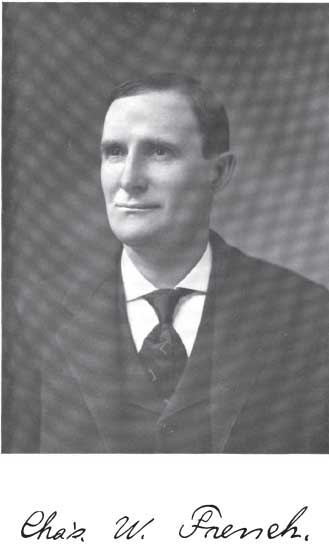
Chas. W. French
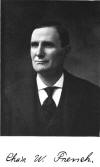 |
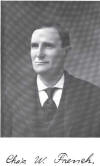
CHARLES W. FRENCH was born
on a farm beside what is now known as the southern division of
the Lake Shore road, near Wakeman, Huron county, Ohio, Sept. 2,
1862. His progenitors on the side of both father and
mother were of Connecticut stock, and it is not known for how
many generations they had lived in America.
The eldest son of parents who were indebted for much of
the purchase price of their farm, he cheerfully assumed a share
of their burden of toil while yet a child. At the age of
eleven years he loaded and stacked forty-four acres of grain,
his father pitching both ways. He was patient and careful
in his work. He was kind to domestic animals and pets,
with all of which he was a welcome playfellow. He would
sometimes work in summer with as many as three chipmunks playing
about him, each one ready to scamper into his pockets if
alarmed. A fine, yet spirited, young horse used to carry
him on errands to the village at a dead gallop without so much
as a rope on. He was deeply attached to his mother, who
died just before he was fourteen years old, and to a few other
good women with whom he came in contact in childhood.
Their influence has survived the shock of nearly a score of
eventful years. Neither liquor, tobacco nor profanity has
he ever indulged in. He scorned the so called lighter
follies of youth. A reverence for womanhood has always
been one of the strongest traits of his character. There
has not been anything in his private life from which a good
woman would need to shrink or a little child should avoid.
This was not so much because he resisted allurement of evil, to
which, in fact, he never paid serious attention, as it was that
he yielded to a craving for the good.
His opportunities for attending school were limited to
a rural district and later a village high school. After he
was ten years old he did not attend school in summer, and did
not average quite sixty-days per year in school from the age of
ten to that of nineteen, after which he attended no school
whatever.
To a misfortune that clouded his early years he is
indebted in a large measure for a mental training that widely
influenced his later life. As a child he was frail in body
and shy in spirit, naturally diffident to a painful degree.
He was born a stammerer and so seriously was he thus afflicted
that it was often difficult to understand his attempted speech.
The usual fellowships of childhood were therefore shunned by
him. He was not without compensation. He had access
to a good library. Early driven by the wounds to which a
sensitive spirit was ever exposed to the society of his own
thoughts and the fellowship of his own mind, the history of the
world was his playground, its episodes his toys. The
senate of Rome, the assemblies of France, the parliaments of
England and the congress of the United States had much more to
do with forming his character than did either the precepts of
his elders or the examples of his fellows. He delved into
the lore of ancient Greece, southern Asia and all vanished
peoples. He marched with the legions of Rome from the
Euphrates to Gibraltar. He cried himself to sleep over teh
ruin of the Roman empire. He paced the corridors of the
great hall, watching the growth of that spirit of personal
liberty which is the crowning glory of the Anglo-Saxon. He
walked the aisles of the great abbey, musing upon the record of
generations that have made our race illustrious forevermore.
Thus a shy, nervous boy, dressed in home-made clothes, grew up
under the shadow of characters that have ennobled human life in
all ages.
As a youth he had almost no social life. His
attempts to make the acquaintance of other young people usually
resulted painfully to him. An incident of his childhood
will illustrate the degree of misunderstanding to which he was
subjected when seeking social intercourse. At a revival in
a village church a woman who was a zealous worker approached him
with the query, "My boy, are you prepared for death?" With
grave simplicity this child, who had lived with the centuries,
stammered, "Yes, ma'am; I would be willing to die if I thought
that I could then talk with William of Orange for a few
minutes." The effect produced by this peculiar profession
of faith so abashed the boy that he fled from the church.
At the age of sixteen he began attending debating
societies in the school districts and villages of Huron county.
To his surprise, when addressing an audience the bonds of the
stammerer seemed to fall away from him. The faces before
him often appeared to fade away and in their place there
assembled about him the famous dead of all ages with whom he had
been familiar rather than with the living. As a public
speaker he attained some degree of success.
At the age of nineteen he began life for himself,
commencing with a job of cutting stove-wood in the winter of
1881-2. During most of the summer of 1882 he worked on a
farm. In the fall of that year he began blowing stumps
with dynamite. He rapidly became skillful in the use of
this explosive, of which little was then known. Within a
few months his operations extended over much of northeastern
Ohio. He introduced the use of dynamite in the stripping
of sandstone quarries and the working of limestone quarries in
northern Ohio and on the islands of Lake Erie. He engaged
in submarine work to some extent. He was always successful
in his calculations respecting the use of high explosives.
He sometimes fired single charges containing nearly a ton of
dynamite!
Lake of practical knowledge of men proved to be fatal
to his early business career. At the age of twenty-two he
failed for twenty thousand dollars. The assets then in his
possession, consisting of property, contracts and plans, would
have yielded a fortune had he then been able to control men as
well as he handled nitro-glycerin.
The result of this failure was to discredit him almost
entirely among ordinary people. The next few years of his
life were passed in a ceaseless struggle to regain such a
standing as would enable him to reduce to practicable operation
the industrial projects with which his mind was usually filled.
Repeated failures gave a somber hue to his mind but did not
crush his spirit. In the summer of 1881 he succeeded in
acquiring considerable property at Sandusky, Ohio. He
designed and built a novel barge for taking up reef rock in
submarine work. This apparatus cost seven thousand
dollars, and every sea captain who examined it declared it to be
an utter failure. It was a success, doing all that it had
been planned to do. He began the construction of a mill
for crushing limestone into rock ballast. This plant was
located about four miles south of Sandusky, on the Lake Erie
division of the Baltimore & Ohio Railroad, and before this mill
was completed he organized the Sandusky Stone Company, which
finished the plant and operated it for several years. It
was finally sold to the Lorain Steel Company and is now the
property of the United States Steel Trust.
In the spring of 1889 Mr. French and his
associates bought a tract of sandstone quarry land near Lucas,
Richland county, Ohio, and began the development of the same.
Nearly one hundred thousand dollars was expended upon this
property. In the winter of 1892-3 nearly all of the men
who were associated with Mr. French in this project
failed disastrously. The property was involved in a
tangled mass of litigation. It was finally sold and now
belongs to a corporation controlled by Mr. French.
On June 27, 1890, Mr. French was married to
Miss Alberta Walker, of Sandusky, Ohio. Miss
Walker's father had been at first a foreman for Mr.
French and afterward the superintendent for the Sandusky
Stone Company during the summer of 1888. He was killed by
an accidental explosion of dynamite in Sandusky, on Thanksgiving
day, 1888. At the time of her marriage Miss Walker
was the secretary of the Baker Stone Company, of which Mr.
French was then the president. Their domestic life has
been in the main a very happy one. One child, a son, died
at the age of four months. The mother and two younger
sisters of Mrs. French find a home with them. They
have taken three little girls, whom they are trying to train
into Christian womanhood. Mr. French's career is
greatly influenced by the peace and affection of his domestic
life.
In the summer of 1896 Mr. French began planning
the construction of a steam road to be used as a branch of the
Big Four, from Shelby to Mansfield, Ohio. This section of
road is now graded and ready for track-laying. The project
gradually grew until he finally undertook to create practically
a new system that should ink existing Vanderbilt lines by two
trans-Ohio divisions, through territory yielding a heavy
tonnage. He is now at the head of several railway
companies, holding Ohio charters, the Youngstown & Cleveland
Railway Company, the Richland & Mahoning Railway Company and the
Chicago Short Line Railway Company being the principal ones of
this combination of corporations. Including new roads to
be built and existing lines to be bought, he is projecting about
five hundred and fifty miles of main line road and perhaps two
hundred miles of belt lines. He has gathered about him an
official staff of capable men, all of whom work harmoniously to
a common end. The new system will reach from a point near
Beaver Falls, Pennsylvania, to New Washington, Ohio; form
Youngstown to Delphos, Ohio; from Carey, Ohio, to Fort Wayne.
Indiana; from Youngstown to Cleveland, Ohio; and from New London
to Norwalk, Ohio. This system will link the Pittsburg &
Lake Erie Railroad, which is practically the Pittsburg terminal,
direct with the Lake Shore at Cleveland, with the Lake Shore at
Norwalk, and with the Nickel Plate at Fort Wayne, Indiana.
The southern division will pass through Salem, Alliance, Canton,
Massillon, Wooster, Mansfield and Shelby. The northern
division will pass through Youngstown and Akron.
Mr. French and his staff have succeeded in
interesting such support for this project as insures the
completion of the system. It may be extended after its
lines as now projected are finished.
At the age of thirty-nine it would seem that Mr.
French is destined to complete a work that will at least
leave a record of his career. In this private life he is
eager to add to the sum of human joys before earth shal have
passed. In his public career he is ambitious to do a man's
work while it is yet day.
Source: A Centennial Biographical History of Richland Co., Ohio
- Publ: Mansfield by A. A., Graham & Co. - 1901
- Page 664 |
.
|
|
CLICK HERE to
RETURN to
RICHLAND COUNTY, OHIO |
CLICK HERE
to RETURN to
OHIO GENEALOGY EXPRESS |
|
FREE GENEALOGY RESEARCH is My MISSION
GENEALOGY EXPRESS
This Webpage has been created by Sharon Wick exclusively for Genealogy
Express ©2008
Submitters retain all copyrights |
|