|
OHIO GENEALOGY EXPRESS

A Part of Genealogy
Express
|
Welcome to
Richland County,
Ohio
History & Genealogy
|

|
BIOGRAPHIES
 Source
Centennial Biographical History
of Richland Co., Ohio
Illustrated
By A. J. Baughman, Editor
Published Chicago - The Lewis Publishing Co.
1901
<
CLICK HERE TO RETURN
TO 1901 BIOGRAPHICAL INDEX >
< CLICK HERE TO RETURN
TO LIST OF BIOGRAPHIUCAL INDEXES >
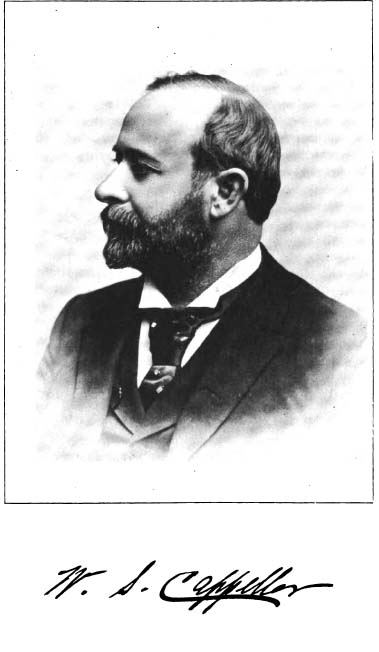
A. S. Cappeller |
|
| |
JOHN CHAPMAN. A
monument to the memory of John Chapman—who was
commonly called Johnny Appleseed—was unveiled at
the Sherman-Heineman Park,
Mansfield, Ohio, Nov. 8, 1900. It was the gift of the
Hon. M. B. Bushnell. The ceremonies of the occasion
were held under the auspices of the Richland County Historical
Society, and the historical address was made by its secretary,
A. Baughman.
“Johnny” was the pioneer nurseryman of Richland
county, and his real name was John Chapman,—not
Jonathan, as some have claimed. The monuments of his
estate show that his name was John. He had a half
brother named Jonathan, who was a deaf-mute. “Johnny”
was born at Springfield, Massachusetts, in 1775, and came west
in the beginning of the nineteenth century. Little was
known of his early life, but there were traditions among the
pioneers of Ohio of a romance in which a woman scorned the young
man's love. He began his apple mission in Pennsylvania in
1802 or 1803, but soon transferred his field to Ohio. He
made frequent visits to the Keystone state for apple seeds, and
on his return selected favorable spots for his pioneer
nurseries. He sought fertile soil and sheltered places,
and often made clearings to give his tender shoots protection
from wind and blizzard. As one section of the state became
supplied with trees he moved to another. The early
settlers were too busy in wrestling a livelihood from
nature and in fighting Indians to engage in the slow process of
raising apple trees from seed, and Chapman, full of faith
in the virtue of the fruit, took upon himself the duty of
supplying the need. Usually a man of few words, he became
eloquent when speaking of apples, and his fine flow of language
gave the impression that he had been well educated.
Living upon the bounty of field and forest, eating
fruits and nuts like the beasts and birds, never harming an
animal for fur or food, Johnny Appleseed led a
life of supreme simplicity. Sometimes he replenished his
scanty wardrobe by bartering young trees for old clothes or
cast-oft’ boots. More often he gave freely of his trees,
and thus started many a pioneer orchard. He carried on
this work in Ohio for twenty years or more. For the
greater part of this time he made his home in Richland county,
and then he followed
the star of empire westward to continue his mission in the newer
field of Indiana, where he died in 1845.
For his tramps in the woods he carried a saucepan on
his head and cooked such vegetable foods as he could find.
Living much in the forests, he became an adept in woodcraft and
wandered at will. He never carried a weapon and was never
molested, even the wild animals appearing to understand that he
was their friend. The Indians respected him, and regarded him as
a great “medicine man.”
“Johnny” regarded all animals as God's
creatures, and he would suffer himself rather than harm one of
the least of them. One chilly night in the woods he built
a fire to warm himself, but when he saw the insects attracted to
his blaze fall into the flames he extinguished the fire rather
than have the death of a bug on his conscience! On another
occasion he crawled into a log to sleep, but finding it already
occupied by a squirrel and her little ones he was worried by the
chattering of the frightened mother and backed out to
sleep in the snow!
“Appleseed Johnny” was a hero, too.
During the war of 1812 Mansfield was frightened by rumors of a
hostile attack. The nearest soldiers were at Mount Vernon,
thirty miles away, where Captain Douglass had a
troop. When a call was made for a volunteer to carry a
message to Mount Vernon “Johnny” stepped forward and said
“I'll go.” He was bareheaded, barefooted and unarmed.
The journey had to be made at night over a new road that was but
little better than a trail and through a country swarming with
bloodthirsty Indians. The unarmed apostle of apples sped
through the woods like a runner and came back in the morning
with a squad of soldiers. It was an incident worthy of a
poem, but has been almost forgotten.
The death of this strange missionary was in keeping
with his life work. The latter years of his life were
spent near Fort Wayne, where, although seventy years old, he
continued to grow and scatter apple trees. He learned that
some cattle had broken down the brushwood fence of a nursery he
had planted. It was winter and the nursery was twenty
miles away, but the brave old crusader started out on foot to
save his beloved trees. He worked for hours in cold and
snow, repairing the fence, and started to walk back home, but
became ill and sought refuge in the cabin of a Mr.
Worth, who had lived in Richland county when a boy, and,
when he learned his caller was “Johnny Appleseed”
gave him a friendly welcome. In the morning it was
discovered that pneumonia had developed during the night.
The physician who was called stated that “Johnny” was
beyond medical aid, and‘ inquired particularly about his
religious belief, remarking that he had never seen a dying man
so perfectly calm, for upon his wan face there was an expression
of happiness, and upon his pale lips there was a smile of joy,
as though he was communing with loved ones who had come to meet
and comfort him in his dying moments.
John Chapman was buried in David
Archer's graveyard, two and one half miles north of Fort
Wayne, Indiana, and the monument now erected at his grave is
well deserved. The monument erected to his memory is a
fitting memorial to the man in whom there dwelt a comprehensive
love that reaches downward to the lowest form of life, and
upward to the Divine.
“Johnny Appleseed” believed in the
doctrine taught by Emanuel Swedenborg and took
pleasure in distributing Swedenborgian tracts among the
settlers. He led a blameless Christian life, and at the
age of seventy-two years he passed into death as beautifully as
the apple-seeds of his planting had grown into trees, had budded
into blossoms and ripened into fruit.
Source: A Centennial Biographical History of Richland Co., Ohio
- Publ: Mansfield by A. A., Graham & Co. - 1901 - Page 570 |
| |
SAMUEL
C. CLARK. In this publication, which has to do with
those who have been in the past or are to-day prominently
concerned in the business, professional, political and social
life of Richland county, we are gratified to give a specific
consideration to Samuel C. Clark, of Mansfield, for his
life has been one of activity and he is widely known throughout
the county.
Mt. Clark is a native on of the Buckeye state,
having been born in Mount Gilead, Morrow county, July 14, 1850,
the son of George Northrup Clark. The latter's
father was Samuel Clark, one of the pioneers of Ohio.
He was a native of the state of Connecticut, whence he came to
Ohio in the early days, locating at Boardman, Mahoning county,
where he was one of the first settlers, becoming one of the
influential men of that section of the state. He married a
Miss Northrup, of the well known old New England family
of that name, and they reared two sons and three daughters.
His son, George N., the father of the immediate subject
of this review, removed from Mahoning to Morrow county, settling
in South Woodbury, where he was engaged in the dry-goods
business for many years, being very successful in his endeavors.
He was a man of strong intellectuality and inflexible integrity
and his prominence and influence in Morrow county were umistakable,
as shown in the fact that he served two consecutive terms in
that state legislature, being the first representative that the
town of Woodbury had ever had in the general assembly.
At the outbreak of the war of the Rebellion George
N. Clark, signalized his patriotism and loyalty by enlisting
for service, as a member of the Ninety-sixth Regiment of Ohio
Volunteer Infantry, in which he held the office of adjutant.
At the close of the war he was elected county auditor, which led
to his removal to the county-seat, Mt. Gilead, in 1865, and
there he passed the residue of his life, passing away in 1893,
at an advanced age and secure in the esteem of all who knew him.
He married Mary Lowrey and had five children, of whom
three survive: Samuel C., of this sketch; Cyrus
C. who is engaged in the crude-oil business in Findlay,
Ohio; and Alice C., the wife of Charles Miller who
is a clerk in the freight office of the Pittsburg, Akron &
Western Railroad, at Akron.
Samuel C. Clark came to Mansfield in the year
1869. For some twelve or thirteen years he was employed by
the S. N. Ford Lumber Company, and then for a period of
eleven years he was a railway postal clerk; later was in charge
of the Fulton Truck & Foundry Company's business for about two
years; for abut one year he was the superintendent of the
Mansfield water works, and on the 1st of May, 1899, he received
from Mayor Brown the appointment to the important
and exacting office of chief of the police department of
Mansfield, and this position he held till September, 1900.
He engaged in the fire and life insurance business in February,
1901, in which he is meeting with success.
Mr. Clark was one of the charter
members of Mansfield Lodge, No. 56, B. P. O. E., and is also a
member of Madison Lodge, No. 26, Knights of Pythias, maintaining
a likely interest in these fraternities. In his political
adherency he has always given a stanch allegiance to the
Republican party and its principles.
Turning in conclusion to the more purely domestic
chapter in the career of Mr. Clark, we record that on
February 26, 1880, was solemnized his marriage to Miss Carrie
M. Day, a daughter of Sylvanus B. Day, a well-known
residence of Mansfield. Mrs. Clark has two
brothers, - Lieutenant Willis B. Day, of the United
States Navy, who is at present stationed in the government navy
yards at Brooklyn, New York; and Benjamin F. Day, who is
connected with the wholesale confectionary establishment of
Voegele & Demming, of Mansfield.
Mrs. Clark's grandfather in the agnate line was
Benjamin F. Day, who was a native of the historic old
state of New Jersey and who came from Chatham, Morris county,
that state, to Ohio, about the year 1838, becoming one of the
pioneers of the Buckeye state. Of his children we offer
the following brief record: Sylvanus B. is the father of
Mrs. Clark, as has been already noted. Rear
Admiral B. F. Day, of the United States Navy, has the
distinction of being the youngest man to occupy that important
office in the navy department of our government. He
resides on a plantation near Glasgow, Virginia, about three
miles from the famous Natural Bridge. Calvin Day, a
resident of Kansas City, Missouri, is the city passenger agent
of the Santa Fe Railroad. Maria became the wife of
John Blymeyer, a retired manufacturer of Mansfield.
Matilda is the widow of D. A. Beekman and resides
at Plymouth, Ohio. Harriet is the wife of Wells
Rogers, a retired shoe merchant of Plymouth, this state.
Source: A Centennial Biographical History of Richland Co., Ohio
- Publ: Mansfield by A. A., Graham & Co. - 1901
- Page 497 |
| |
FRANK
M. CLINE, an agriculturist living on section 3, Franklin
township, was born July 15, 1863, on the old Cline homestead
which was entered from the government by his great-grandfather,
William Foulks, at an early period in the
development of Ohio. William Foulks was born
in Pennsylvania, a native of Beaver county. When he was
only ten years of age he and his younger sister were captured by
the Indians, who at the same time killed their elder brother.
He was held captive by the red men until he was twenty-one years
of age, when he finally made his escape. They allowed him
many privileges, permitting him to hunt, and on one such
occasion he stole away, rowed over a stream in a stolen canoe,
and on the other side met a young lady who assisted him to
escape. His romantic history was further heightened by his
marriage to the young lady some time afterward. On coming
to Ohio he secured wild land on the Indian trail between
Sandusky and Pittsburg. It was situated near Hilton, half
a mile below the camping ground of the Indians. He
afterward took up a claim which he had seen in Ohio when he was
with the red men as a captive.
Jacob Cline, the paternal grandfather of
our subject, was born in Maryland, near Hagerstown, and married
Elizabeth Foulks, the daughter of William
Foulks, thus mentioned. About 1815 they came to
Richland county. They had eleven children: George F.,
William, Alfred, Charlotte, Henry,
Eli, Standard, Louisa, Pressley,
Catherine and Elizabeth. Henry Cline,
the father of our subject, was born on the old family homestead
in Richland county Sep. 4, 1826, and became a general farmer.
His death occurred Feb. 5, 1900. He married Harriet
Miller, who was born in Dauphin county, Pennsylvania,
Oct. 29, 1830. They had five children: Neotia, born
in November, 1855, became the wife of W. H. Morris, of
Shelby, and unto them were born five children.— Ada J.,
wife of William D. Turner, of Shelby; Jeffra C.,
who married Sarah Roberts and lives in Shelby; Pearl
H., Wade H. and Jack S.; George F., the
second of the family, died at the age of two years; Carrie O.,
born July 2, 186I. became the wife of Charles Black, and
they had one child, Roy C., who was drowned about three
years ago, at the age of thirteen; Mrs. Black
resides with her mother in Shenandoah, Ohio; Frank M. is
the next of the family; and Judson J., the youngest, born
Oct. 12, 1869. resides in Franklin township. He married
Ella Zehner, who was born in Mifflin township, Ashland
county, Sept. 6, 1872. They had one child, Martha
Lucilla.
Frank M. Cline, whose name introduces this
review, obtained his education in the common schools and in
Bethany (Virginia) College where he pursued his studies for one
term. He also spent one term in the Geneva (Ohio) Normal
School, and after putting aside his text-books he entered upon
his business career, engaging in the grain trade in Shelby in
connection with his brother-in-law, W. H. Morris, for
nearly three years. On the expiration of that period he
turned his attention to farming and has since resided on the old
homestead on section 3, Franklin township, where he carries on
agricultural pursuits in a very successful manner. As a
companion and helpmeet oil life's journey he chose Miss Anna
Lodema Urich, who was born in Weller township Oct. 16, 1863.
They now have an interesting little son. Hugh L.,
who was born Jan. 3, 1890. Mr. and Mrs. Cline are
widely known in the county of their nativity and enjoy the warm
regard of their many friends.
Source: A Centennial Biographical History of Richland Co., Ohio
- Publ: Mansfield by A. A., Graham & Co. - 1901 - Page 663 |
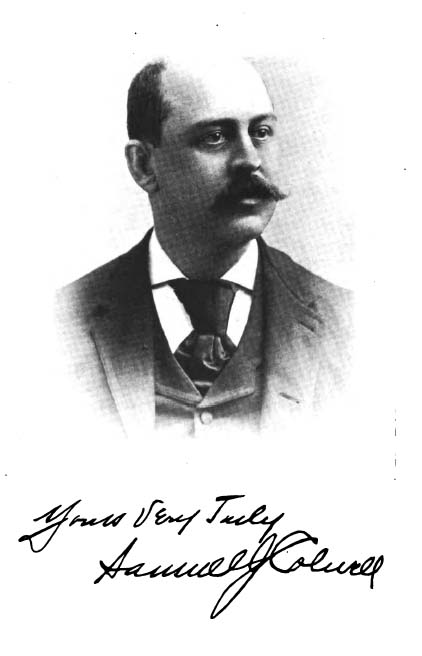
Samuel J. Colwell |
|
| |
CARTER L. COOK. The
natural advantages of this section attracted at an early day a
superior class of settlers, thrifty, industrious, progressive
and law-abiding. whose influence gave permanent direction to the
development of the new locality. Among the worthy pioneers
of Richland county the Cook family holds a
prominent place.
Carter L. Cook was born upon his present farm in
Troy township, Oct. 3, 1823. and is a son of Jacob
Cook, who was born in Washington county, Pennsylvania, in
1781. His paternal grandfather was Noah Cook,
who was a soldier of the war of 1812, and was twice married.
As early as 1811 the father came to Ohio with his brother,
John, and first located in Knox county, taking up land near
Fredericktown. where he lived until 1817, and then came to
Richland county. Here he entered one hundred and sixty
acres of government land, but for six years he was engaged in
the hotel business in Lexington. In the meantime he
made some improvements upon his land, including the erection of
a log cabin, and in 1825 located upon his farm, devoting the
remainder of his life to agricultural pursuits. There he
died in 1848. He was twice married, his first wife being
Miss Priscilla Carter, who died leaving no
children, and for his second wife he married Miss Mary Lee,
a daughter of Solomon Lee, who was one of the
early settlers of Richland county, his home being in Washington
township. By the last marriage there were nine children,
namely: Priscilla, who died in infancy; Nancy, the
wife of Smith Douglas; Eleanor, the wife of
Thomas Brown; Emeline, who died at the age
of twelve years; Carter L., our subject: Susan,
the wife of James Force; Lois, the wife of
James Reed; James, a resident of Los
Angeles county, California; and Amy J., who died in 1899.
Amid pioneer scenes Carter L. Cook grew to
manhood, his education being obtained in the public schools of
this county. His entire life has been spent upon the old
homestead in Troy township, and he early became familiar with
every detail of farm work, so that in the operation of the farm
since his father's death he has met with excellent success.
Here he has one hundred and sixty acres, and also owns another
tract of forty acres, both of which places are well improved and
under good cultivation.
On the 2d of October, 1849, Mr. Cook was united
in marriage with Miss Mary A. R. Rusk, a native of Morgan
county, Ohio, and a daughter of John and Sarah (Donaldson)
Rusk, who were born in Pennsylvania and came to this state
in 1824, locating in Morgan county. When Mrs. Cook
was five years old they came to Richland county and settled in
Washington township, where Mr. Rusk purchased a
farm, making it his home until 1871, when he took up his
residence in Lexington. There he died in 1873. aged
seventy-seven years. and his wife departed this life in 1880. at
the age of seventy-eight. In the family of this worthy
couple were eight children, namely: William. a resident
of Lexington; Margaret J., the wife of Elihu Mathews.
of Hardin county, Ohio; Mary A. R., the wife of our
subject; Isabelle R., the wife of Samuel Moore, of
Peoria county, Illinois; John D., who died at the age of
ten years; Andrew, a resident of Morrow county, Ohio:
Joseph, deceased: and Sarah, the wife of Wesley
Emerson, of Kansas. Seven children were born
to Mr. and Mrs. Cook, as follows: Emma, the wife
of Albert C. Stewart, of Lexington: Lora A., who
died at the age of six years; Ella F., the wife of D.
T. Barnett, of Troy township, Richland county; Archie C.,
of Kansas: Orville L., who lives on the home farm;
John D., of Warren, Ohio; and Frank R., of Kansas.
In his political views Mr. Cook is a
stanch Republican, and has materially aided in the advancement
of all social, moral and educational interests in the community
in which he lives. He and his wife are earnest and
consistent members of the Congregational church, in which he has
served as deacon since 1846, and has ever taken an active and
prominent part in its work.
Source: A Centennial Biographical History of Richland Co., Ohio
- Publ: Mansfield by A. A., Graham & Co. - 1901 - Page 399 |
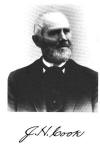
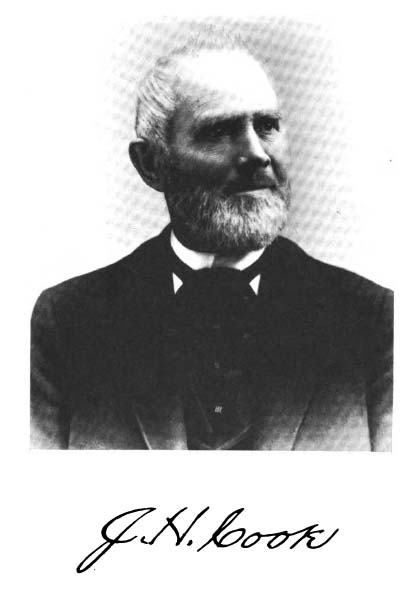
J. H. Cook |
JAMES HERVEY COOK,
an honored and upright citizen of Mansfield whose entire life
was spent in Madison township, died Dec. 2, 1897, at his
home in Mansfield, Ohio. He took to his bed November 23,
having had a slight stroke of paralysis the day before, but
retained consciousness until his death. He had been
identified with Mansfield's interests for many years.
Mr. Cook was born on a farm two and a half miles
south of Mansfield, Sept. 3, 1816, a son of Jabez and Hannah
Cook and a twin brother of Dr. Thomas McCurdy Cook,
who died at his home in Sandusky, Mar. 14, 1896. The
family lineage is traced to Francis Cooke of the
Mayflower, the deceased being the eighth generation from him.
The following article, from the Mansfield News at the time of
his death, gives succinctly his history and shows the prominence
he occupied in our community:
“The Cooks trace their lineage back to
the twelfth century, when Walter and Richard
Cok served in the wars in the Holy Land, in 1191. In 1462
a Cook was the lord mayor of London. Later
William Henry Cooke was the recorder of
Oxford, judge of the county courts and a historian of note. In
1543 Sir Anthony Cooke was a tutor to
King Edward VI. In 1612 a Cooke was the
chancellor of the Irish exchequer. (The name, whether
spelled Cok, Cooke or Cook, refers to the
same family.) Sir Thomas Cook, of
Worchestershire, founded Worchester College at Oxford; and
Sir Thomas Cook, of Middlesex, was the
governor of the East India Company. The History of Essex,
England, contains favorable mention of the Cook family—men
of influence by birth and marriage—filling positions in the
army, the navy, the church, in literature and in learned
professions.
The founder of the Cook family in America
was Francis Cooke, who came over in the Mayflower,
and was the seventeenth signer of the Mayflower compact.
It is supposed that the ancestors of the Cooks were
Romanists; and there are no data to show when Francis
Cooke espoused the doctrine of the Separatists; but his name
was in the list of those designated as exiles from Scrooby,
joining Brewer and Bradford in worship there, and
going with them to Leyden and on to their haven of rest on Cape
Cod.
Francis Cooke was born in I 577, and was
about forty years old when he came to America in the Mayflower.
He died in 1663, aged eighty-six years. His wife survived
him several years. The position Francis Cooke
occupied in the Plymouth colony is attested by the fact that he
held positions of trust and honor, and his social standing was
high, his home being on Leyden street and adjoining the
residence of Edward Winslow and Isaac
Allerton.
Of his lineal descendants we note his son (2) Jacob
Cooke, who was born in 1618; (3) Jacob Cooke,
born in 1653; (4) Jacob Cooke, born in 1691; (5)
Jacob Cooke, born in 1725; (6) Noah Cook,
born in 1758: (7) Jabez Cook, born in 1792; (8) James
Hervey Cook, born in 1816; and (9) James M.
Cook, born in 1859.
Jacob Cooke, of the fifth generation from
Francis Cooke. born in 1725, in Plymouth county,
Massachusetts, removed with his father's family to Morris
county, New Jersey, in 1744, and emigrated with his family to
Washington county, Pennsylvania, in 1767, and died there in
1808. He was the father of Noah Cook, who
came to Richland county, Ohio, in 1814, and died in Lexington in
1834.
Jabez Cook, the son of Noah Cook, was
born in Washington county, Pennsylvania, July 11, 1792; came to
Ohio in 1815, and died Feb. 6, 1875. His wife's maiden
name was Hannah Pierson. Jabez and
Hannah Cook were the parents of the following children:
James Hervey and Thomas McCurdy, twins,
born Sept. 3, 1816; Alice, Jan. 13, 1819; Abba Ellen,
Aug. 7, 1821; Emily, Dec. 22, 1823; William
Mortimer. Sept. 15, 1826; Elizabeth, July 19, 1828;
Willis Merriman, Aug. 5, 1830; and Lydia
Jane, Nov. 20, 1832.
Noah Cook served several terms of
enlistment in the war of the Revolution, and was also with
Colonel Crawford in his march and defeat. His
pension certificate was dated Oct. 30, 1832. He did much
to promote the religious interests of Troy township. He
announced a meeting for a religious service at a schoolhouse.
but at the appointed hour “Uncle Noah“ was the
only one there; but he held the service! Some passers-by heard
him singing and stopped to listen; then he prayed and read and
preached as though the benches were listeners with ears to hear
and souls to save! The report of this service was noised
abroad, with the result of good congregations of people at
subsequent services.
Hannah (Pierson) Cook, the wife of Jabez
Cook and the mother of James Hervey Cook,
was a daughter of John and Sarah (Van
Dyke) Pierson. John Pierson we trace back to
Thomas Pierson, of Bonwicke, Yorkshire, England, a
relative of Rev. Abram Pierson, the founder
of Newark, New Jersey, in 1666, and one of the promoters of Yale
College. John Pierson served eight years in
the war of the Revolution. Through the Van Dykes
the Cook family is related by marriage to the
Schencks, of the same family as General Robert C.
Schenck, one of Ohio's statesmen and warriors.
In taking up the personal history of James Hervey
Cook, we note that his elementary education was secured at
the Sandy Hill schoolhouse. after which he continued his studies
at Granville. He worked on the farm in the summer months
and taught school for several winters. In the winter of
1840 he came to Mansfield and has lived here continuously since.
He taught school at the corner of Fourth and Mulberry streets in
a little red school house. In the spring of 1849 he took
possession of the Wiler House and was engaged in
the hotel business there continuously for ten years . He then
sold out, but later was again the proprietor of the Wiler
House, from 1864 to 1869. He was one of the first
conductors on the Sandusky, Mansfield & Newark Railroad, after
that road was constructed.
Until within very recent years Mr. Cook
was remarkably alert, both mentally and physically. During
his years as a septuagenarian it was a matter of comment that he
was one of Mansfield's very youngest old men. His
constitution was a hardy one. His early life developed a
perfect physical organism which in after years he retained by a
regularity of habits seldom followed. Always punctual as
to his hours of labor and of rest, and methodical in all his
ways, he carefully conserved his strength and energy. He
was seldom
seen to wear an overcoat, as his splendid vitality needed none:
but he was always carefully gloved. None knew him but to
admire him. He was ever generous and charitable, but
always without ostentation. His hearty, cheering “How do
you do, sir?” with a marked accent on the “sir,“ will be
remembered by all, and his greeting to the humble toiler was
ever as cordial as to the man of wealth. His attitude toward his
fellow men was ever that of one who felt
“The
rank is but the guinea's stamp;
The man's the gowd for a' that.”
Mr. Cook was an
officer of the Richland Mutual Insurance Company for about
thirty years, being for ‘many years its president. He was
also the president of the cemetery association for nearly that
length of time. Besides four children, Mr. Cook
left seven grandchildren.
On the 27th of March, 1842, James Hervey Cook
was united in marriage to Miss Mary Ann
Wiler, a daughter of John and Margaret Wiler.
Her father was born in Herisau, Appenzell county, Switzerland,
June 4, 1780, and was the eldest of a large family of children.
When very young he learned the weaver's trade in his native
town. While yet in his teens he concluded to see something
of the world and for a number of years traveled through Europe,
working at his trade as a journeyman weaver. During the
campaign of Napoleon I in Austria Mr. Wiler
enlisted in the Swiss army for duty on the frontier.
Having concluded to seek his fortune in the new world, he sailed
for America from Amsterdam on the 19th of May, 1817, and landed
at Philadelphia on the 26th of August, after a voyage of
ninety-nine days. Of the five hundred passengers on board
the vessel, one hundred and five died of ship fever during the
voyage. Selecting Ohio for his home Mr. Wiler
resided for one year in New Lancaster and one year in Columbus,
after which he located permanently in Mansfield, where he
engaged in business and built the Wiler House,
which still bears his name. He was married Apr. 25, 1819,
to Margaret Steyer. The couple lived happily
together and prospered and left to their children a competence
and an untarnished name. John Wiler died
Aug. 1, 1881, and his wife passed away May 25. 1868.
The death of J. H. Cook removes another citizen
whose life was well nigh coextensive with that of the city.
Nor was he one who simply aged with the city. His was an
active, honorable business life. He did his full share to
ward the development of the city and his duty toward his fellow
men. His life was a useful one and he leaves an unsullied
name and an influence for good that will ever be of fragrant
memory.
Source: A Centennial Biographical History of Richland Co., Ohio
- Publ: Mansfield by A. A., Graham & Co. - 1901 - Page 520 |
| |
GEORGE AND HANNAH COX.
Mr. George Cox and his noble wife, whose maiden name was
Hannah Funk, are one of the most highly respected and
venerable couples of Richland county, he being ninety years of
age and she was eighty-five. They are living a retired
life on their small farm in section 20, Sharon township,
Richland county, Ohio, their postoffice being Shelby.
Mr. Cox was born in Brooke county, Virginia, Feb. 25, 1810,
and came to Ohio in 1827, driving through with a team of horses,
thirty sheep and two cows. He came with his father,
stepmother and six other children. His father was
Joseph Cox, whose first wife, though named Jane Cox
before her marriage as well as afterward, was not a relative.
She died in Virginia, leaving one daughter, who later was
married in that state. Joseph Cox was afterward
married twice, and has three other children. He managed
his father's farm, that father being George Cox, who was
a spy in the war against the Indians, and received from the
government one hundred and sixty acres of land, by what was
known as the 'tomahawk right," wild land, upon which he settled.
George Cox, the subject of this sketch, received
a fair common-school education but in what was then known as a
subscription school, conducted in a log schoolhouse. From
his early youth he was for many years the main stay of the
family. His father bought one-half a section of land of a
Mr. McGuire's administrator, who made entry of the land
and soon afterward died. Joseph Cox settled on his
farm when there were but three houses and an old horse-mill in
Shelby. This farm was just south of where the subject of
this sketch now lives, and on the east side of the road.
All his life the subject of this sketch has been a great worker.
having not only chopped and logged all his own timber but has
also used the sickle in the wheat, before such an implement as a
reaper was known, or even a cradle for cutting the grain,
working many a day in the harvest field for half a dollar per
day. He was married Sept. 8, 1836, to Hannah
Funk, who was born in Pennsylvania July 3, 1815, and who is
a granddaughter of the Rev. William John Webber,
whose funeral she attended when but ten days old. being carried
thereto on horseback in her mother's arms. Rev. Mr.
Webber was a Hollander by birth, and was the first minister
of the gospel to preach in Pittsburg, riding a circuit of fifty
miles in extent, carrying his saddlebags on his horse. But
he began life in that then new country as a teacher of youth,
finishing his life work as a teacher of men.
David Funk, the father of Mrs. Cox, was a
man of unusual intelligence. He married Catherine
Webber, who was born in Pennsylvania Apr. 12, 1795. David
and Catherine Funk were the parents of
eight children, five sons and three daughters, one of the sons
dying in infancy. William Webber, the father
of Catherine Webber, was born in Holland in 1735,
was a preacher of the gospel until he was about eighty years old
and died at the age of ninety. A book of psalms and hymns
in the German language hearing the date of 1807 is one of the
precious possessions of the family. David Funk died
in Shelby Feb. 17, 1868, and his widow died Aug. 15, 1874, in
her eightieth year, he being seventy-seven at the time of his
death. Of their children three are still living, Mrs.
Cox being the oldest of the three. Upon her
marriage to Mr. Cox they settled at once in the
woods, occupying a hewed-log house, 18x20 feet in size, she
doing her cooking over a fire in a huge fireplace, using a large
crane from which to suspend her pots and kettles.
Mr. and Mrs. Cox are the parents of eight
children—three sons and five daughters, as follows: Joseph O.,
who was a member of the Fourth Ohio Cavalry and died of disease
during the late war of the Rebellion, at the age of twenty-five;
he never married and was a great student and fine scholar;
Catherine M., born in 1839, and now the wife of Dr.
Kochenderfer, of Galion; she is the mother of two sons;
the third child died in infancy; Margaret, who died at
the age of five months; David. who was born in 1845, and
who served as a soldier in the Fifteenth Ohio Volunteer Infantry
during the years 1864 and 1865, and who was an epileptic for
many years, dying at the age of thirty-three years-and ten
months; Charles M., born in 1847, who was twice married
and died at the age of fifty, leaving seven children:
Elizabeth, who was born June 19, 1850, and has remained at
home; and Narcissa, born Mar. 12, 1852, and now the wife
of William R. Crall, a farmer living in the immediate
neighborhood.
Mrs. Cox has one brother, David W.
Funk, living in Los Angeles, aged seventy-eight. and one
sister, Elizabeth. the widow Rayl, living in San
Diego, California, who was born Dec. 2, 1824. She was
married, in April, 1849, to Henry Rayl, at
Bucyrus, Ohio, he dying Dec. 3, 1853, the age of thirty-one.
Mr. Rayl was a farmer, and his widow is one of the
best preserved women of her age, both physically and mentally.
Both Mrs. Cox and Mrs. Rayl
have excellent memories and much more than ordinary
intelligence. Mrs. Cox, though somewhat
feeble and bowed down with her four-score years and five, yet is
still bright intellectually and her faculties remain sound and
strong. Death has no terrors for this noble old lady, and
she awaits the summons from the grim reaper with a sublime faith
that enables her to approach the grave like one who wraps the
drapery of his couch about him and lies down to pleasant dreams.
Source: A Centennial Biographical History of Richland Co., Ohio
- Publ: Mansfield by A. A., Graham & Co. - 1901 - Page 413 |
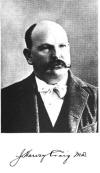
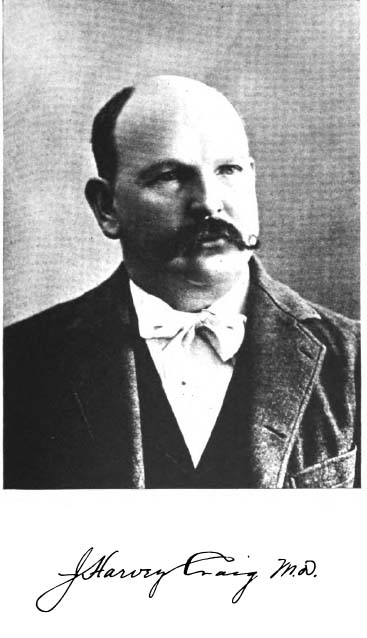
J. Harvey Craig, M.D. |
J. HARVEY CRAIG
Source: A Centennial Biographical History of Richland Co., Ohio
- Publ: Mansfield by A. A., Graham & Co. - 1901 - Page 280 |
| |
DAVID CRALL.
David Crall, one of the foremost and most
successful farmers of Richland county, Ohio. whose farm is
situated in section 19, Sharon township, and whose postoffice is
Vernon Junction, was born at Harrisburg, Pennsylvania in 1821,
on the 25th of November. He is a son of Henry
Crall, who was born at the same place in 1779. and died in
Crawford county, Ohio, when in his eighty-fourth year. His
father also was named Henry. The maiden name of the
grandmother of the subject of this sketch was Schopp.
The Crall family came originally from Switzerland
and settled in Lebanon county, Pennsylvania, in 1740, and in
this county one of the descendants still lives and owns a farm.
The maiden name of the mother of the subject was Elizabeth
Henshaw, who was born near Harrisburg, Pennsylvania.
She married Mr. Crall in 1809. They were
well-to-do and prominent farmers and sold their Pennsylvania
farm in 1845 to the state.
David Crall first came to Ohio in 1844.
riding across the Alleghany mountains on horseback ad consuming
nine days in making the journey to Ohio. After
purchasing an eighty-acre farm. upon which had been erected a
log house and barn, he returned in the fall of the same year to
his old home in Pennsylvania, returning to his Ohio farm in the
spring of 1845. This farm cost him in cash thirteen
hundred dollars and upon it some clearing had been done and
there were a good many girdled trees. Upon his
return in the spring of 1845 he was accompanied by his eldest
brother Simon, who was married and brought his wife with
him to this then new country. They all three lived in the
log house one year, and in the spring of 1846 the subject was
married to Miss Maria Stentz, of
Harrisburg. Pennsylvania, and a daughter of John and
Sophia (Hentz) Stentz, they being also of
Harrisburg, and having settled in the dense forest in that
vicinity in 1834. They were industrious. honest and
well-to-do farmers, owning two good farms and having a family of
two sons and eight daughters. Mr. Stenz died
at the age of sixty-eight, and his widow at the age of
eighty-two. Both rest from their labors in Oakland
cemetery. a beautiful city of the dead.
Mr. and Mrs. Crall began their domestic life in
a hewed-log house and hewed out a home in the woods, when
wild game was plentiful and neighbors few and far between.
To the eighty-acre farm originally purchased in 1844 they have
added from time to time other acres. until his landed
possessions amount to two hundred and ninety acres, or did
amount to that number of acres before the construction of the
railroads through this part of the county. Then Mr.
Crall laid out the village of Junction City, the plat of
which contained about ten acres. and this, together with what
has since been occupied by the railroad, reduced the size of his
farm. He and his wife are the parents of nine children,
three sons and six daughters, as follows: Elizabeth, the
wife of Ezra Kochenderfer. a sawmill owner of
Richland county; they have one son and five daughters: John,
who occupies and manages the old farm and who married Mattie
Sipe; Sophronia, the wife of William
Hollengbaugh, of Plymouth township; William
Rhinehardt. a farmer living in the vicinity, who has a wife,
two sons and one daughter: Susannah, the wife of John
Shrock, of Shelby: Mary Sophia, the wife of
Willis Hershiser, a farmer of Plymouth township, who
has a wife, two sons and two daughters: Emily Alice.
the wife of George Sprague. a farmer of
Springfield township, who has a wife, three sons and five
daughters: Henry Nelson, a machinist of Shelby,
who is married and has one son and one daughter: and Anna
Eliza, living at home. All of the above-named
children have been well educated at the common school, and four
of the daughters have taught school. All are unusually
intelligent and of unimpeachable morals and habits of life.
using neither tobacco nor intoxicating liquors.
Mr. Crall. the father of this interesting
family, was the youngest of his father's family, which consisted
of six children—four sons and two daughters. Simon,
born about the year 1810, and who died in Crawford county in his
seventy-fourth year, having reared nine children: John,
who died at Bucyrus about 1882, leaving six children living, two
or three others having died; Elizabeth, who married
William Crumb and who died at Harrisburg,
Pennsylvania, leaving eight children; Susannah, who
married, first, John Ely and after his death
John Fortney: she reared six children, and died in
Van Wert county, at the age of fifty-eight; Henry, who
died in Crawford county, at the age of eighty-two; and David,
the subject of this sketch. The parents died while all of
their children were living, the mother about six months before
the father.
David Crall is a member of the United
Brethren church, of which his wife was a most efficient member.
In politics he is a Republican. He has held the office of
township trustee several terms, besides having been a school
director and road master. His present fine, large brick
house he erected in 1854, and the large evergreen trees which
stand as sentinels around his residence, and which attract the
admiring attention of all passers-by, were planted by his own
hands and will continue to live and remind his relatives and
friends of him long after he has moldered into dust. His
son's residence is an excellent frame structure, erected in 1887
on the farm. Mr. Crall is a man of unusually
strong body and mind, and has a most retentive memory; and, as
his father died before any of his children, so it is altogether
probable, notwithstanding his firm health, that he will do the
same, they being, like him, of unusual bodily health and
strength. When he passes away the beautiful poem “The Old
Farmer's Elegy“ would be a fitting tribute to his memory, and
might almost be regarded as having been written to commemorate
his life and virtues. All that know him know him but to
honor him for the honorable career he has made for himself and
the noble character he has always maintained.
Source: A Centennial Biographical History of Richland Co., Ohio
- Publ: Mansfield by A. A., Graham & Co. - 1901 - Page 356 |
| |
JOHN CRALL,
who is engaged in farming and stock-raising on seciton 34,
Franklin township, was born Nov. 5, 1853, on the farm which is
still his home. His father, Joshua Crall, was a
native of Pennsylvania, born about 1820. He wedded
Hetty Terman, and they became the parents of five children:
Samuel, who was the owner of one of the farms now the
property of his brother John, and died Apr. 10, 1898;
Mary C., who became the wife of Charles Nail, by whom
she has one living child, and for her second husband, Albert
Toukel, who is connected with the Water Works at Shelby;
William B., who died in infancy; John, of this
review; and Susan, the wife of Thomas B. Werts, a
resident of Madison township, Richland county, by whom she has
two children.
In the public schools near his home John Crall
pursued his education. Through the summer months he aided
in the labors of the farm from the time he was old enough to
handle a plow, and at the age of twenty-five he began farming
and stock-raising on his own account. It was in 1878 that
he took up his abode on the old Whistler farm, which he
operated for five years, when, with the capital he had acquired
through his industry and economy, he purchased a part of the
farm upon which he now resides from his father's estate.
He has brought it up to a very high state of productiveness.
In his business he has been very successful and now owns the
quarter section of land which is his home place, and eight years
on section 33, in Franklin township. His property is under
a system of high cultivation, the rich fields yielding to him a
golden tribute in return for the care and labor he bestows upon
them.
Mr. Crall was married on the 17th of January,
1878, to Miss Cora Alice Finical who became his wife.
They now have four children: Maurice J., who was born
Nov. 1, 1878; William, born July 23, 1882; Vertie May,
born Sept. 12, 1883; and Rhea, born Oct. 28, 1898.
The children are still under the parental roof and the family
circle remains unbroken.
Source: A Centennial Biographical History of Richland Co., Ohio
- Publ: Mansfield by A. A., Graham & Co. - 1901 - Page 693 |
| |
SETH G. CUMMINGS. The
subject of this sketch, who has attained distinction as one of
the able members of the Mansfield bar, is now a member of the
well known firm of Cummings & McBride. In this
profession probably more than any other success depends upon
individual merit, upon a thorough understanding of the
principles of jurisprudence, a power of keen analysis, and the
ability to present clearly, concisely and forcibly the strong
points in his cause. Possessing these necessary
qualifications, Mr. Cummings is accorded a foremost place
in the ranks of the profession in Richland county, and stands
to-day one of the esteemed members of the Mansfield bar.
He was born in Crawford county, Ohio, Oct. 31, 1839, a
son of Isaac and Sylvia (Reed) Cummings, both natives of
Maine, of which state his ancestors were early settlers.
His paternal great-grandfather moved from Massachusetts to Main
at a very early day, establishing the family in Kennebeck
county, where he was subsequently killed by the Indians.
He was one of the defenders of the colonists in the
Revolutionary war. The grandfather and his eldest son were
soldiers of the war of 1812, and both died at Sackett's Harbor,
New York, from disease contracted while in the service of that
war. The Reed family, as represented by the mother
of our subject, was early established in Oxford county, Maine.
In tracing Mr. Cummings' genealogy we find that his
ancestors were of scotch and Irish descent and were residents of
Massachusetts in the early part of the seventeenth century.
His parents were married in Richland (now Crawford) county,
Ohio, where the father cleared and developed a farm, making it
his home from 1824 until his death, which occurred Dec. 16,
1880. The mother died in February, 1865, leaving two sons,
of whom our subject is the elder. Samuel is still
living on the old home farm.
Mr. Cummings received a good common school
education, and at the age of twenty-two years commenced the
study of law in Mansfield, being admitted to the bar in 1864.
From April of that year until November, 1866, he was engaged in
the mining business in Montana, and in 1867 took up the practice
of his chosen profession in Galion, Ohio, where he remained
until coming to Mansfield in October, 1884. Here he formed
a partnership with Hon. C. E. McBride, which still
exists, he being the office lawyer of this well known and
successful firm. Since 1887 he has conducted at his office
a thorough system of abstracting, having a complete set of
abstract books of Richland county, and giving employment to two
or three men in this department, which has become a profitable
branch of his business. The firm have the largest and best
selected law library in Mansfield, and do an extensive business
as commercial lawyers and collectors, doing extensive trial
business in various courts.
On the 24th of January, 1867, Mr. Cummiongs was
united in marriage with Miss Sarah G. Ruhl, a daughter of
Jacob and Sarah Ruhl of Galion, where she was born,
reared and educated. One son was born of this union,
Glenn M., now a young man of twenty-seven years, who is
employed in his father's business. He attended the public
schools of Galion and Mansfield, and was graduated at Wittenberg
College, Springfield, Ohio. In June, 1899, he was admitted
to the bar as an attorney. He married Miss Almena
Gotwald of Springfield.
Politically Mr. Cummings is a Democrat, and has
always taken an active interest in political affairs.
While a resident of Crawford county, he served as prosecuting
attorney two terms. Socially he is a member of the Masonic
order, being a Master Mason, and religiously is a member of the
English Lutheran church, to which his family also belong.
Source: A Centennial Biographical History of Richland Co., Ohio
- Publ: Mansfield by A. A., Graham & Co. - 1901 - Page206 |
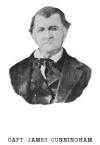
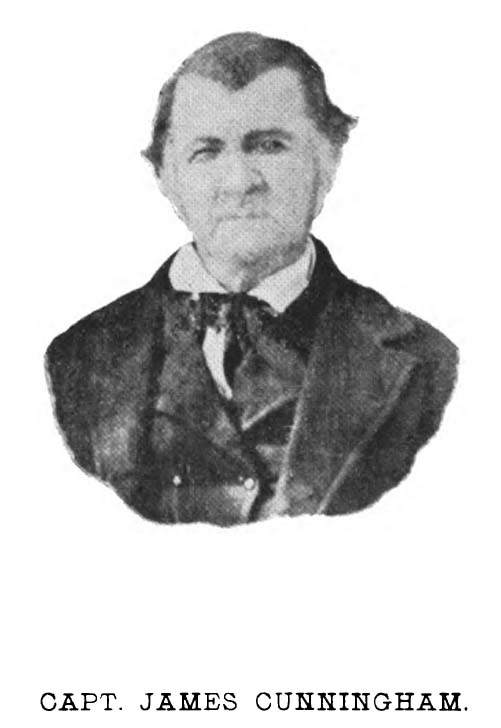
Capt. James Cunningham |
|
|
|
CLICK HERE to
RETURN to
RICHLAND COUNTY, OHIO |
CLICK HERE
to RETURN to
OHIO GENEALOGY EXPRESS |
|
FREE GENEALOGY RESEARCH is My MISSION
GENEALOGY EXPRESS
This Webpage has been created by Sharon Wick exclusively for Genealogy
Express ©2008
Submitters retain all copyrights |
|