|
OHIO GENEALOGY EXPRESS

A Part of Genealogy
Express
|
Welcome to
Richland County,
Ohio
History & Genealogy
|

BIOGRAPHIES
Source:
History of Richland Co., Ohio -
from 1808 to 1908
Vol. I & II
by A. J. Baughman -
Chicago: The J. S. Clarke Publishing Co.
1908
<
CLICK HERE TO RETURN
TO 1908 BIOGRAPHICAL INDEX >
< CLICK HERE TO RETURN
TO LIST OF BIOGRAPHIUCAL INDEXES >
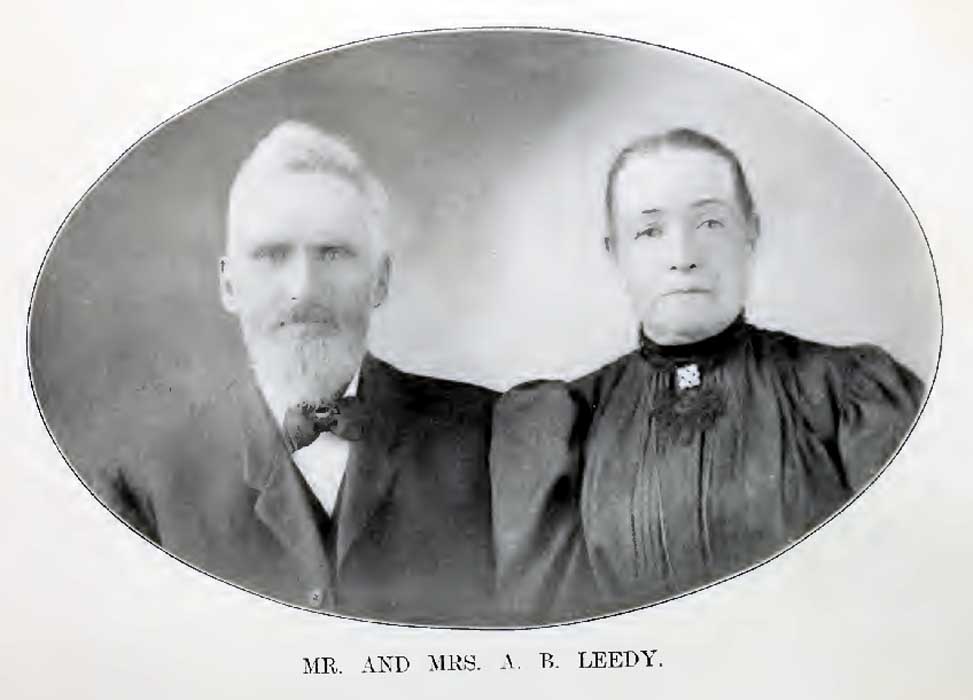
Mr. & Mrs.
A. B. Leedy |
A. B.
LEEDY. Farming has
constituted the life work of A. B. Leedy, who is now the owner
of a good tract comprising one hundred and nineteen acres,
situated in Jefferson township, Richland county. He was
born on a farm in this county, Oct. 18, 1840, a son of Daniel
and Saloma (Brown) Leedy, the former in Bedford county,
Pennsylvania, in 1796, while the mother's birth occurred near
Canton, in Stark county, Ohio. The father had been
previously married, this union being with Susanna Hulsinger,
also of the Keystone state, and by that union there were five
children, all of whom are now deceased. The father came to
Richland county in 1821 and here entered land from the
government and removed his family to this tract in September,
1824. Upon this tract he built a log cabin in which he
lived until 1859 and here engaged in agricultural pursuits
throughout his remaining days, or until his death, which
occurred Jan. 16, 1873.
A. B. Leedy, whose name introduces this review,
is one of a family of ten children born of the father’s second
marriage, but only two of the number survive, his brother being
Levi Leedy, a farmer residing near Fremont. Mr.
Leedy was reared in the usual manner of farm lads, working
in the fields during the summer season, while during the winter
months he attended the common schools, wherein he mastered the
branches of learning taught in the schools at that early day.
He remained with his father until the latter’s death, when he
came into possession of one hundred and nineteen acres of land,
which he has improved and on which he has since made his home.
He has placed the land under a good state of cultivation, so
that each year it returns to him golden harvests as a result of
the care and labor bestowed upon the fields.
It was on the 11th of August, 1862, that Mr.
Leedy put aside all business and personal considerations and
offered his services to the government in defense of the Union,
becoming a member of Company E, One Hundred and Second Ohio
Volunteers. He participated in many hotly contested
engagements, among these being Athens and Pulaski. He
served for a period of three years and at the time of his
discharge was serving as corporal.
Mr. Leedy chose as a companion and
helpmate for the journey of life Miss Mary
Oldfield, to whom he was married on the 24th of March, 1867,
and to this union were born the following children: One who
died in infancy; Elma, the wife of George
Steckler; Silas, at home; Lientellas,
deceased; Melvin, who has served as assessor of Jefferson
township and is at home; Lewis, who has also passed away;
Walter, deceased; Noah, who is engaged in
railroading; Elmina; and two who died in infancy.
Mr. Leedy is in accord with the
principles of the republican party, but is not bound by party
ties, voting rather for men and measures than for party.
He is identified with the Grand Army of the Republic and with
Jefferson Grange. His life has been one of continuous
activity, in which has been accorded due recognition of labor,
and today he is numbered among the substantial citizens of
Richland county.
Source: History of Richland Co., Ohio -
Vol. II - A. A., Graham & Co., Publishers. 1807 - 1880 - Page
580 |
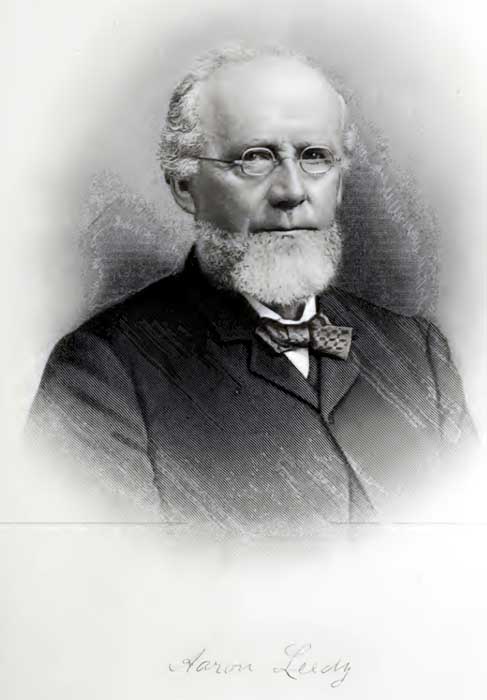
Aaron Leedy |
AARON
LEEDY. Aaron Leedy
was one of the honored pioneers of Richland County, Ohio, a man
respected and honored wherever known and most of all where he
was best known. He was born Apr. 21, 1832, and was
the youngest son of Abraham and Elizabeth (Zook) Leedy.
His life record covered seventy-five years, six months and seven
days, and he passed away Oct. 28, 1907. His early
youth was spent upon a farm near Ankenytown, Ohio, and
throughout the greater part of his life he successfully followed
the occupation of farming, although to some extent, especially
early in his life, he worked at the carpenter’s trade.
On the 13th of March, 1856, Mr. Leedy was
married to Elizabeth Garber and for about a year they
lived upon her father’s farm, after which they removed to a farm
in Berlin township, Knox county, Ohio. In 1860 they took
up their abode about three miles east of Bellville, and in 1863
in company with his brother-in-law,
David L.
Garber, Aaron Leedy purchased a farm that had
formerly been the property of his father-in-law,
Samuel Garber. While he made the tilling of the soil his
chief life work he possessed much natural mechanical ability and
could do almost anything with tools. He worked at the
carpenter’s trade, operated a water mill and afterward a steam
sawmill, also operated threshing machines and did other work
along mechanical lines. He led a busy and useful life and
he won a fair measure of success, so that for many years he was
enabled not only to enjoy the necessities but also the comforts
of life.
Unto Mr. and Mrs. Aaron Leedy there were born
six sons and three daughters: Byron, born Mar. 11, 1857;
Elmina who was born June, 28, 1859, and died in 1866 at
the age of seven years; Eugene R., born Feb. 16, 1861;
Clement, born July 5, 1863; Albert, Feb. 7, 1867;
Bertha, Mar. 30, 1871; Alfred, June 2, 1873; and
Herbert; and Maude. All are now married with
the exception of Bertha and Herbert.
In 1866 Mr. Leedy united with the
Universalist church of Bellville and remained one of its
faithful and helpful members throughout the remainder of his
life. He contributed liberally to its support and he spent
much of two years as the active member of the building committee
while erecting the house of worship at Bellville. He also
was a charter member of Jefferson Grange and served as its first
master following its organization, Oct. 9, 1873, while later at
different times he again served as master. His greatest
interest aside from his business and his church was in the
Grange. He was prsident president of the
Patrons Mutual Relief Association from June 4, 1844, until Jan.
12, 1899. Very fond of music, he taught singing schools in
the early days and was an active member of the Grange Band for
years. He was always interested in young people and "the
boys” were ever welcome at his home. They would frequently
gather there in the evenings and he would sit and sing with them
for several hours at a time. While he was never a great
talker, he was a most hospitable man and his wife shared with
him in extending the hospitality of their home to their
relatives and many friends. He believed in the religion of
living rather than of creed and he earnestly put forth effort to
encourage the good that he believed was in every individual.
His life was fraught with many good deeds and characterized by
kindly purposes and honorable motives. He passed the
Psalmist’s allotted span of three score years and ten and at his
death left the memory of an upright life and a noble example
which is well worthy of emulation.
Source: History of Richland Co., Ohio -
Vol. II - A. A., Graham & Co., Publishers. 1807 - 1880 - Page
858 |
|
|
JAMES ABRAHAM
LEONARD.
James Abraham Leonard, superintendent of the Ohio State
Reformatory at Mansfield, was born on a farm in Black Log
valley, near Huntingdon, Pennsylvania, Sept. 12, 1854, and is of
English and Scotch-Irish parentage. His father, Captain
Leonard, was born Stroudsburg, Pennsylvania, in 1832, and
was of English descent. Upon reaching manhood he engaged
in the iron and steel industry, with which the family had been
connected through many generations. At the outbreak of the
civil war he entered the army as a member of the organization
known as the Bucktails and served as captain until the close of
hostilities. The last year was spent in special service in
the west under General Thomas. His service was
often of the most arduous nature but he never faltered when duty
called and throughout his entire life has manifested the same
loyalty in citizenship. After the war he again engaged in
the iron and steel business but on the opening of Oklahoma he
went to that territory as one of its first settlers and took an
active interest in the development of the new town of Edmond,
serving as its mayor during the entire period of his residence
there. He was also one of the founders of the State Normal
School at Edmond and in fact was largely instrumental in
securing its location there. Later he removed to Detroit,
Michigan, where he is now living retired, at the age of
seventy-six years. His wife, who bore the maiden name of
Elizabeth Wallace White, was born near Londonderry,
Ireland, and came to America about 1850 with an aunt who located
at Three Springs, Huntingdon county, Pennsylvania. Her
parents were of sturdy Scotch-Irish stock and Mrs.
Leonard was a woman of extraordinary strength of character,
strongly influential among her children, her sons especially
having the greatest respect for her opinions. She left her
impress for good upon the lives of the many with whom she came
in contact, and her death was therefore the occasion of deep
regret when she passed away, at Detroit, Michigan, in December,
1907.
James A. Leonard is the eldest in the family of
four sons and three daughters, of whom six are still living, and
he is the only one of the brothers who is not connected with the
steel and iron industry. The second son, W. R. Leonard,
of Youngstown, Ohio, is president of the Wilkins-Leonard
Hardware Company of that place, also engages in banking and for
two years was county auditor; S. C., of Detroit,
Michigan, is now general manager of the iron and steel
department for the American Bar & Foundry Company, also
president of the American Bar Iron Association and is prominent
in educational work, being president of the school board of
Detroit; John D., of St. Louis, Missouri, is general
manager of the Helmbacher Iron & Steel Company and very
prominent in Masonic circles; Mary A. is the widow of
S. B. Lantz, of Detroit; and Frances J. is the wife
of Millard Walker, general manager of the
Foster Lumber Company at Norton, Kansas.
James A. Leonard spent his boyhood to the age of
fifteen years upon a farm, and his earliest recollections have
to do with events of the Civil war, in which he took deep
interest. His grandfather was a great admirer of Abraham
Lincoln and had named our subject in his honor. On the third day
of the battle of Gettysburg he took his grandson to a point near
their home, where they sat and listened to the heavy firing. He
received his early education in the country schools and there
learned the self-reliance to which he accredits his success in
life. He afterward pursued a course in a private normal at
Worthington, Ohio, and subsequently was a student in a private
business college. In keeping with the traditions of the family,
he was required to enter the mills after he left school and
learn the iron and steel business. When he had mastered it,
however, he turned his attention to educational work, to which
he devoted the succeeding twenty-five years of his life, in the
mean time receiving the degree of A.M. from Mount Union College,
in 1885. He proved a capable educator, teaching in the district,
township and city schools of the state, giving twenty years of
active service along educational lines in Youngstown. During
that period Mr. Leonard was also county examiner for nine years
and served as principal of ward schools and the normal training
department for several terms. A year after his arrival in
Mansfield he was tendered the office of superintendent of
schools at Youngstown, which offer appealed to him very
strongly, because it came as a unanimous expression from the
city in which he had spent his early manhood. However, his sense
of right would not permit him to leave the reformatory in which
he had be come intensely interested. His work here had won the
hearty approbation of the governor and board of trustees and he
felt that it was his duty to remain where his service was
proving a benefit to the state at large.
Previous to his arrival in Mansfield Mr. Leonard
served for three years in the United States Interior department
with Secretary Noble, and his labors were a helpful and
influential factor in the establishment of schools of letters
and industrial training schools for the Indians. In 1897
President McKinley tendered him the superintendency of Indian
schools but he declined because the faithful discharge of the
duties of the position would necessitate his almost continuous
absence from home. He has delivered lectures before teachers’
institutes throughout the middle west and his last educational
work, before entering the reformatory, was in the normal
training school of Youngstown, Ohio. In 1901 he was appointed
superintendent of the Ohio State Reformatory. He immediately
entered upon his work there and during the succeeding seven
years his labors have given the utmost satisfaction to all
concerned. The reformatory farm comprises five hundred .acres of
land and has been a source of revenue to the state as well as a
means of discipline and training for the prison population. In
the year 1906 the farm netted a profit of ten thousand dollars. In this connection
Mr. Leonard said, “While it is very
gratifying to learn that the farming operations are valuable
from an economic point of view, this, after all, is a minor
consideration when compared with the value of the farm as a
means of discipline and training. A study of the farm report
will reveal the fact that we have endeavored to produce
everything which it is possible to raise in this region, and it
is needless to say to those experienced in agriculture that such
returns from two hundred and fifty acres of land, actually
available, would be impossible if intensive methods were not employed. While the trusty system has rendered our farming
operations much more profitable from an economic sense, and much
more valuable for purposes of education and training, the moral
gain alone justifies the system. The self restraint necessary
for these young men to resist the temptation to run away, and
the moral stimulus that comes by imposing upon them
responsibility in assignment of duties, results in the
development of a degree of moral stamina that justifies an early
parole and increases very appreciably the number of young men
from this institution who become good citizens."
The reformatory idea originated nearly a century
ago in Europe, but it made little progress until quite recently.
Its highest development in the United States is seen in such
institutions as that at Mansfield, Ohio, and Elmira, New York. In some respects the former is unique, and work is there being
done which has brought to it the attention of all interested in
the introduction of humanitarian and progressive principles in
such institutions. The system employed at Mansfield is largely
the creation of the present superintendent. That system is builded upon the conviction that while there are, many among a
prison population who are outside the zone of corrective
influence, there are still greater numbers who can be improved
or reclaimed by the personal interest and encouragement of
officials and the application of wise reformative regulations.
Mr. Leonard is the apostle of hopefulness in prison management. He has an abiding faith in humanity. He believes that in most
offenders against the law there is a preponderance of good and
that in the worst criminal some wholesome quality may be
discovered. To repress the evil inclination and develop the
manhood, self-respect and self-reliance of the unfortunates
committed to his care is the policy along which Mr. Leonard
has been working for several years.
For thirty-three years Mr. Leonard has
been in the public service. Nearly all of his work has
been of an educative character and has had to do with the
physical, mental and moral development of those who have come
under his care. The influence of his work and the results
of his labors are immeasurable, but, as Browning puts it,
he ‘‘has been awakening the little seeds of good asleep
throughout the world.’’ While not a practical politician
in the sense of being a worker in organized political ranks or
in an untiring search for office, he has nevertheless taken a
great interest in public affairs and is a stalwart champion of
republican principles. He is a member of the Prison
Congress and National Association of Charities and Correction.
He gives deep and earnest thought and most careful consideration
to, and he has written and read before the public, many papers
on reform work which have been widely published both in this
country and abroad.
On the 29th of July, 1885, in Youngstown, Ohio, Mr.
Leonard was married to Elizabeth Annette
Treat, a representative of the Treat family of
Connecticut and later prominent among the early settlers of the
Western Reserve. She is a direct descendant of Robert
Treat, who for forty years was governor of Connecticut,
and also of George Clinton, the first governor of
New York and twice vice president of the United States.
Mr. and Mrs. Leonard have two daughters and two sons:
Elizabeth and Laura Annette, who are students
in Oberlin College; and James A., and George Todd,
who are students in the Mansfield high school.
In his fraternal relations Mr. Leonard is
connected with Masonry and has attained the Knight Templar
degree. From the age of fifteen years he has been a member
of the Methodist church and is serving on the official board of
the First Methodist Episcopal church in Mansfield. His
religion is of the most practical character and is manifested in
his untiring, devoted and consecrated effort for his fellowmen.
He possesses a hopeful optimism, for he believes that good is in
each individual and that proper environment and encouragement
will bring it out. Thus he is working steadily toward
making the world better.
Source: History of Richland Co., Ohio - Vol. II - A. A., Graham
& Co., Publishers. 1807 - 1880 - Pages 951-954 |
|
|
WILLIAM
L. LEONARD.
William L. Leonard, occupying an enviable position in
business circles in Mansfield, was born at Mason, Warren county,
Ohio, Apr. 16, 1854. The family is descended from old
colonial New England stock. John Leonard
emigrated from Addison county, Vermont, to Warren county, Ohio,
in the last years of the eighteenth century and purchased land
of the government. His sons were Lucas, Joshua
and John, and the first named was the grandfather of
William L. Leonard of this review and the father of
Francis and William Leonard, late of Warren county,
Ohio. Lucas Leonard was united in marriage
to Maria Mason, a daughter of Major
William Mason, the founder of the village which bears
his name. He is mentioned prominently in Howe’s History of
Ohio.
Francis Leonard, father of William L.
Leonard, was a substantial farmer and a man of great energy
and force of character. He died in 1865. His sons
are; W. L. Leonard, of Mansfield; Dr. W. W. Leonard,
of Akron, Ohio; and Commander J. C. Leonard, of the
United States navy. Another son, Charles, died in
early manhood.
William L. Leonard was educated in the schools
of his native county and when still quite young went to
Cincinnati to complete his education in a business college.
On the 1st of January, 1876, he arrived in Mansfield and has
since been one of the best known residents of the city. He
was first connected with the passenger business of the Erie
Railroad, and later he became a partner in the firm of Mills
& Ellsworth, shaft manufacturers. When this
enterprise had grown to large proportions, a stock company was
formed, and for two years Mr. Leonard filled the
office of its president. He is still a director and a
large stockholder in this prosperous company, which has become
one of the important productive industries of the city.
In addition to Mr. Leonard’s present
interests in manufacturing, he is also engaged in the
real-estate business, being the senior member of the well known
real-estate firm of Leonard & Bowers.
Personally he owns considerable real estate in Mansfield and
during his long residence in this city has always been an alive,
energetic and up-to-date business man. While promoting
individual affairs he has never been neglectful of his duties of
citizenship and has cooperated in many movements for the general
good. While he has never been a politician in the sense of
office seeking, nor has he desired positions of political
preferment, he was nevertheless elected to serve for two terms
in the city council and has always been a champion of those
measures and movements which are a matter of civic virtue and
civic pride.
In 1877 occurred the marriage of Mr. Leonard
and Miss Etta Taylor, a daughter of
Johnston Taylor, one of Mansfield’s pioneer
residents. Mr. Leonard has one son,
Wellington T. Leonard, the well-known newspaper man, and one
grandson, Wellington Calvin Leonard.
Mansfield has been helpful to Mr. Leonard,
for he has here prospered and acquired wealth, since he cast his
lot with her people, and in reciprocation he has been equally
helpful to Mansfield, doing much to promote the city’s growth
and improvement in various ways.
Source: History of Richland Co., Ohio -
Vol. II - A. A., Graham & Co., Publishers. 1807 - 1880 - Page
1127-1128 |
|
|
CLICK HERE to
RETURN to
RICHLAND COUNTY, OHIO |
CLICK HERE
to RETURN to
OHIO GENEALOGY EXPRESS |
|
FREE GENEALOGY RESEARCH is My MISSION
GENEALOGY EXPRESS
This Webpage has been created by Sharon Wick exclusively for Genealogy
Express ©2008
Submitters retain all copyrights |
|