|
OHIO GENEALOGY EXPRESS

A Part of Genealogy
Express
|
Welcome to
Richland County,
Ohio
History & Genealogy
|

BIOGRAPHIES
Source:
History of Richland Co., Ohio -
from 1808 to 1908
Vol. I & II
by A. J. Baughman -
Chicago: The J. S. Clarke Publishing Co.
1908
<
CLICK HERE TO
RETURN TO 1908 BIOGRAPHICAL INDEX >
< CLICK HERE TO RETURN
TO LIST OF BIOGRAPHIUCAL INDEXES >
|
|
J. B. BALLIET
was born upon the farm and in the same house which he now
occupies, his natal day being Mar. 9, 1842. This is
the old homestead farm of Steven Balliet and his
wife, who bore the maiden name of Catharine Haferman.
The parents were both natives of Carbon county,
Pennsylvania, and were born in the year 1813. They
became residents of Richland county, Ohio, during the
pioneer epoch in its history, settling here in 1837.
Their children were three in number: George W., a
resident of Mansfield; J. B., whose name introduces
this review; and Joseph L, also of Mansfield.
When Steven Balliet arrived in Richland county more
than seven decades ago he purchased the farm which is now
the home of his son, J. B. Balliet, and with
characteristic energy began its cultivation and improvement,
making his home thereon until his death and becoming
recognized as one of the substantial and respected
agriculturists of the community.
As boy and youth J. B. Balliet worked upon the
home farm, giving his father the benefit of his services
until he was twenty-one years of age. He then started
out in life on his own account and made investment in a farm
of ninety-two acres in Wyandot county, Ohio. Taking up
his abode upon that property he lived there for seven years,
after which he sold out and removed to Nevada, where he was
engaged in the hardware business for ten years. On the
expiration of that period he sold his store and turned his
attention to the livery business, which he also conducted in
the same town in Nevada for a period of twelve years.
On disposing of his livery barn he returned to Richland
county and took up his abode upon the farm which he now owns
and occupies, comprising eighty-five acres of productive
land on section23, Madison township. The soil is
naturally rich and productive and returns golden harvests to
him in reward for the care and labor he bestows upon the
fields.
In 1863 Mr. Balliet was married to Miss Ellen
Schultz, a native of Richland county and one of a family
of eight children. Unto Mr. and Mrs. Balliet
were born two daughters and a son, as follows: Emma,
the wife of Abe Balliet of Richland county; and
Calvin and Margaret, both of whom are deceased.
The wife and mother passed away in 1870 and in 1872 Mr.
Balliet again married, his second union being with
Miss Mary J. Moran, a daughter of John and Catharine
(Oaks) Moran, who were natives of Ireland and came to
America at an early day. Her father died in 1862 and
her mother passed away in 190. They were the parents
of six children. By the second marriage of Mr.
Balliet there were born three children but two of the
number died in infancy, the surviving daughter being
Catharine, the wife of A. L. Lober of Cleveland,
Ohio.
Mr. Balliet votes with the democratic party but
has never sought nor desired office, preferring to
concentrate his ___g__s upon his business affairs.
Throughout his entire life he has been a man of industry and
enterprise, carefully conducting his business interests, and
the success he has achieved is attributable entirely to his
own labors and careful management.
Source: History of Richland Co., Ohio - from 1808 to 1908 by
A. J. Baughman - Chicago: The J. S. Clarke Publishing Co.
1908 - Vol. II - Pg. 892 |
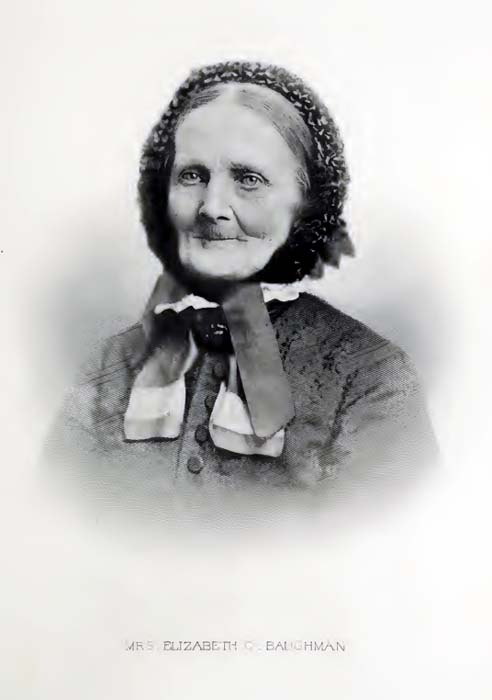
Mrs. Elizabeth C. Baughman |
ELIZABETH BAUGHMAN
Source: History of Richland Co., Ohio -
from 1808 to 1908 by A. J. Baughman - Chicago: The J. S.
Clarke Publishing Co. 1908 - Vol. II - Pg.514- 518 |
|
|
ALLEN
E. BELL.
Allen E. Bell, postmaster
at Butler, was born Aug. 13, 1867, in
Worthington township, Richland county. His parents are
Robert W. and Rosanna (Reeder) Bell. The father
was born in Troy township, Sept. 2, 1825, his parents having
been pioneer settlers of Richland county, coming from
Pennsylvania to Ohio in 1820. They made the journey in
a wagon after the primative manner of travel in those
days. They found here an almost unbroken wilderness.
Over large areas the timber had not been cut and only here
and there had a little clearing been made to indicate that
the work of civilization was being carried forward. On
reaching this county the grandparents settled in Troy
township and a year later moved to Worthington township,
where Mr. Bell first purchased eighty acres of
land on section fifteen. It was covered with a native
growth of forest trees, and with characteristic energy he
began to clear the property preparatory to utilizing the
land for general farming purposes. In the midst of the
forest he built a log house and the family lived in true
pioneer style. There were bears, wolves and other wild
animals in the forest, while wild game of all kinds was
plentiful. It was amidst the scenes and environments
of frontier life that Robert W. Bell was reared, and
in his youth he aided in the arduous task of developing a
new farm. Having arrived at years of maturity, he was
married in 1866 to Miss Rosanna Reeder and began
farming on a tract of forty acres, which he increased and
developed until he had a fine farm of one hundred and eight
acres under a high state of cultivation.
In September, 1861, Mr. Bell enlisted for
service as a soldier of the Civil war, joining Company H of
the One Hundred and Twentieth Ohio Volunteer Infantry.
He served for three years and reenlisted as a member of
Company E, One Hundred and Fourteenth Ohio Infantry, thus
serving until the close of the war. He was then
mustered out in July, 1865, at Houston, Texas, having in the
meantime participated in a number of hotly contested
engagements which were effective forces in bringing about
the final result of the war. In days of peace Mr.
Bell was equally loyal in his citizenship and
cooperated in many movements for the public welfare.
His religious faith was that of the Presbyterian church and
in politics he was a lifelong republican, always supporting
the party until his life’s labors were ended in February,
1906. He continued to reside on the farm in
Worthington township until his death, and was a respected
agriculturist of the community.
Allen E. Bell, only son and child of his
parents’ marriage, was reared on the home farm and acquired
his education through the medium of the public schools.
He was a young man of about twenty years when in 1887 he
took up newspaper work, running the Butler Enterprise, and
was connected with that journal for about seventeen years.
He also spent one year in connection with the Daily News at
New Philadelphia, Ohio, worked for two years on the
Mansfield News and is now its Butler correspondent. On
the 1st of September, 1904, Mr. Bell was
appointed postmaster of Butler, which position he is now
filling. He yet owns the old homestead of one hundred
and eight acres in Worthington township, together with a
nice property in Butler.
On the 6th of January, 1892, Mr. Bell was
married to Miss Essie R. Farst, who was horn in
Worthington township, this county, July 25, 1873, and is a
daughter of Jacob and Rebecca (Rummell) Farst.
The father was born in Hagerstown, Maryland, in 1827, and
his life record cohered the intervening eighty years to the
1st of October, 1907. The mother was born in Richland
county and died in 1893 at the age of fifty-nine years.
They were the parents of eleven children, nine of whom
survive, namely: Izaiah, a resident of Worthington
township; Mrs. H. C. Secrist, who is living in
Jefferson township; Mrs. J. W. Coe, whose home is in
Worthington township; Mrs. A. W. Swindle and J. E.,
residents of Mansfield; Luthera I., of Toledo, Ohio;
Luther R., of Troy township; Mrs. S. K. Stake,
of Worthington township, and Mrs. Bell. Unto
Mr. and Mrs. Bell have been born a daughter and son,
Estella C. and Kenneth L. The parents are
both members of the Evangelical church, and Mr. Bell
belongs to Lucullas Lodge, No. 121, K. of P., and to the
Modern Woodmen. The fact that he is now serving as
postmaster at Butler indicates his adherence to the
republican party. Since age conferred upon him the
right of franchise he has been a supporter of its principles
and has done what he could to secure their adoption.
He is well known in the county and this part of the state
and is popular with a host of friends.
Source: History of Richland Co., Ohio - from 1808 to 1908
by A. J. Baughman - Chicago: The J. S. Clarke Publishing Co.
1908 - Vol. II - Pg. 736 |
|
|
HUBBERT
E. BELL.
Hubbert E. Bell, who for
twenty-seven years has been an active member of the Richland
county bar, was born in Franklin township, near Mansfield,
on the 30th of June, 1857. His father, Samuel
Bell, was a farmer and a native of Washington county,
Maryland, of Pennsylvania Dutch lineage. He came to
Ohio in 1844, settling on a farm where the birth of his son,
Hubbert, occurred, and after successfully following
agricultural pursuits for many years he removed to Mansfield
and retired from active life. The next twenty years
was spent in well-earned ease, and on the 31st of January,
1906, he passed away. He was the moving spirit in the
pioneer singing society and also of the historical society
of the county, being most active in both organizations.
Although he attained the venerable age of eighty-three
years, he retained all of his faculties unimpaired to a
remarkable degree until he passed from this life. In
1847 he married Martha M. Gates, a native of this
county, who is still living at the age of eighty-two years.
They have three sons and three daughters.
Hubbert E. Bell, the eldest son, was reared to
farm life, early becoming familiar with the duties incident
to the development of the fields and the care of the crops.
He supplemented a common-school course by study in the Ada
(Ohio) Normal school, now the Northwestern Ohio University,
one of the strongest educational institutions in the
country. He taught school for a number of years in
Richland county and devoted the hours which are usually
termed leisure to the study of law, under the direction of
Thomas Y. McCray, and on the 8th of June, 1881, he
was admitted to the bar and entered at once upon active
practice, forming a partnership with Mr. McCray.
This relation was maintained for three years, or until the
election of Mr. Bell as county prosecutor in 1886.
He received public endorsement of his first term of service
in reelection in 1889, and he served for two terms or for
six years. In 1892 he was appointed by President Cleveland
as postmaster of Mansfield, continuing in the position for
four years. In 1887 he formed a
law partnership with George Brinkerhoff, with whom he was
associated in general practice until 1904, since which time
he has been alone. No one better knows the necessity
for thorough preparation and no one more industriously
prepares his cases than Mr. Bell. His
course in the court room is characterized by a calmness and
dignity that indicate reserve strength. He is always
courteous and deferential toward the court, kind and
forbearing toward his adversaries, his handling of the case
is always full, comprehensive and accurate; his analyzation
of the facts is clear and exhaustive. He sees without
effort the relation and dependence of the facts and so
groups them is to enable him to throw their combined force
upon the point they tend to prove.
On the 13th of October, 1881, Mr. Bell
was married in Shelby to Miss Valletta E. Skiles, a
daughter of John G. Skiles, of Shelby. They are
well known socially, the hospitality of the best homes of
this city being freely accorded them. Mr.
Bell is a Lutheran in religious faith and has been a
mast active and helpful worker in the church, serving as
deacon and as Sunday school teacher for many years. He
votes with the democracy and his opinions carry weight in
party counsels. He has been identified with city,
county and state politics and has served on the state and
county central committees. Fraternally he is connected
with the Knights of Pythias and the Elks, in both of which
he has held office, and in more specifically professional
lines his membership extends to the County and State Bar
Associations.
Source: History of Richland Co., Ohio - from 1808 to 1908
by A. J. Baughman - Chicago: The J. S. Clarke Publishing Co.
1908 - Vol. II - Pg. 638 |
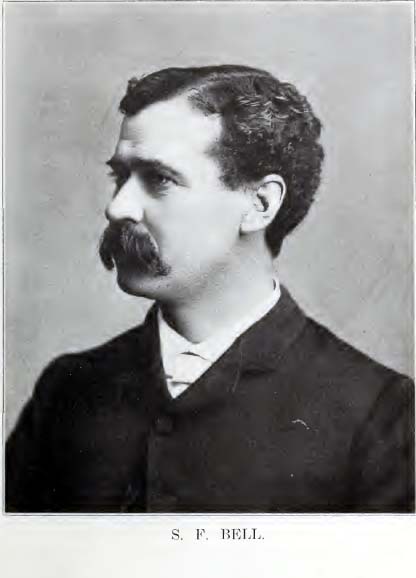
S. F. Bell |
S. FINN BELL.
S. Finn Bell, president of the board of public
service in Mansfield and a
veteran of the Civil War, is today as loyal to the welfare
of his home locality and his country as when he followed the
stars and stripes on southern battlefields. He was
born in Washington township, near Lexington, Richland
county, Ohio, Jan. 31, 1847. His grandfather,
Robert Bell, and his great-grandfather, who also
bore the name of Robert Bell, came to Richland
county from Washington county, Pennsylvania, in 1821, and
located on what is now the old homestead farm. It was
upon that farm that Robert Bell, the father,
and S. Finn Bell, the subject of this review, were
likewise born. There Robert Bell, the
father, continued to engage in farming throughout his entire
life and made the old homestead his place of residence until
his death in 1898. He married Sarah Pollock,
who was a native of Madison township, Richland county, her
parents being also pioneers of this part of the state, her
father dying here at the venerable age of ninety-two years.
Mrs. Bell passed away in 1855, when her son S. F.
Bell was but eight years of age. He was the second
in a family of three children, all of whom are yet living,
his elder brother being Robert P. Bell, of Milton,
Iowa, while the younger brother is J. Franklin Bell.
He also has one half-brother, Thomas M., who was
corporal in Company M, Eighth Ohio Regiment, in the
Spanish-American war, and who lives in Mansfield, being a
guard at the reformatory.
No event of special importance occurred to vary the
routine of farm life for S. F. Bell in his boyhood
and youth. He attended the public schools in the
winter months and through the summer seasons worked in the
fields, remaining upon the home farm until he enlisted as a
member of Company F, Eighty-seventh Ohio Volunteer Infantry,
when but fifteen years of age. He served with that
command for three months and then became a member of Company
E, Thirty-second Ohio Volunteer Infantry, with which he
served
throughout the war, being mustered out with the rank of
corporal on the 26th of July, 1865. He participated in
the battle of Thompson Hill, Raymond, Jackson,
Champion Hill, Baker’s Creek and the entire
siege of Vicksburg, in which he was under fire for
forty-five days. He was wounded at that place and also
at Baker’s Creek. He afterward engaged in the battle
of Kennesaw Mountain and Atlanta and went on the celebrated
march from Atlanta to the sea, under Sherman, while
later he took part in the battle at Savannah, Georgia.
After the capture of that place the command to which Mr.
Bell was attached proceeded by boat to Buford, South
Carolina, and from that point took up the line of march
through the Carolinas on to Richmond and thence to
Washington, where he participated in the grand review, which
was the most celebrated military pageant ever seen on the
western continent. From the capital city the troops
went to Louisville, Kentucky, and thence were ordered to
Columbus, Ohio, where they were honorably discharged.
Thus Mr. Bell had done valiant service for his
country for three years and with the most creditable
military record returned to his home, although he was then
only about eighteen years of age.
Locating in Mansfield Mr. Bell spent
twenty-eight years as a traveling salesman, continuing in
that line of business until he was elected a member of the
board of public service in 1895. That he discharged
his duties to the satisfaction of his constituents and the
general public is indicated by the fact that he was
reelected in 1907, and on the 1st of January, 1908, was
chosen president of the board, in which position he still
continues.
Mr. Bell was married at Bryan, Ohio, to
Miss Jennie Keegan, a daughter of John
Keegan, of Cleveland, and they have two sons: Harry
F., thirty years of age, who is an attorney here; and
Frank W., who is a traveling salesman for the National
Biscuit Company, of Chicago. Mr. Bell owns some
real estate in the city and county, including his home at
No. 272 Marion avenue, and a farm of one hundred and
thirty-five acres five miles south of Mansfield. The
supervision of the latter is a matter of interest to him and
brings him recreation from the cares of office.
In politics he has been a republican since age
conferred upon him the right of franchise and has been an
earnest worker in the local ranks of the party. He
belongs to the McLaughlin Post, No. 131, G. A. R.; to the
Elks Lodge, No. 56; and to the United Commercial Travelers,
No. 13, of which he is a past senior councilor. He
also belongs to the Congregational church. He is a
typical American in that he is never too busy to be cordial
and never too cordial to be busy.
Source: History of Richland Co., Ohio - from 1808 to 1908 by
A. J. Baughman - Chicago: The J. S. Clarke Publishing Co.
1908 - Vol. I - Pg. 542 |
|
|
FRANK B. BLACK, who has been prominently
identified with Mansfield's business interests, is a native of
this city, born June 10, 1865. His father, Moses Black,
was born in Remelton, in the north of Ireland, and came to
America in 1855, settling at Zanesville, Ohio, whence he removed
to Mansfield in 1859. He became a prominent factor in
commercial circles of the latter city, conducting a dry-goods
establishment until 1892, when he retired from active business.
He married Elizabeth Blymyer, a native of Shellsburg,
Pennsylvania and a daughter of Benjamin Blymyer, who came
to Mansfield.
Frank B. Black acquired his
education in the public schools of Mansfield and was graduated
from the high school in 1885. He then pursued a commercial
course in Eastman Business College at Poughkeepsie, New York,
and upon finishing there he entered the employ of the Barnet
Brass Company, of Mansfield, as bookkeeper where he remained for
two years. In 1888 he organized the Ohio Brass Company
with a paid in capital of five thousand dollars. This
company, of which he is president, ahs grown to be one of the
principal industries of Mansfield, with a paid up capital and
surplus of over one million dollars, employing between five and
six hundred workmen and doing a business of nearly two million
dollars annually.
Mr. Black, aside from the
presidency of the Ohio Brass Company, is vice president of the
Baxter Stove Company and a director of Citizens National Bank,
the Seneca Chain Company and the Humphryes Manufacturing
Company.
On the 5th of October, 1892, Mr.
Black was united in marriage to Miss Jessie M. Baxter,
and they have four children: John, Robert, Donald and
Roger.
Source: History of Richland Co., Ohio - from 1808 to 1908 by
A. J. Baughman - Chicago: The J. S. Clarke Publishing Co.
1908 - Vol. II - Pg. 1070 |
|
|
GEORGE
WILEY BLYMYER.
Few men are more prominent or
more widely known in the enterprising city of Mansfield than
George W. Blymyer, president of the Blymyer Brothers
Company, Hardware. He was born on the 31st of October,
1839, in Schellburg, Bedford county, Pennsylvania, and is a
son of Benjamin Blymyer, a native of Shippensburg,
that state. The father made his home in Schellburg for
several years, all of his children being born there, and in
1843 bought his family to Ohio, locating in Mansfield where
he embarked in the hardware business, which has been
continued by his sons and grandsons up to the present day.
Theirs is the oldest established business in the city and
has occupied the same location since 1849. The father
conducted a retail store until 1854, when his sons,
William H. and Benjamin F., succeeded him under the name
of Blymyer & Brother, and embarked in the wholesale
business, theirs being the first wholesale house started in
Mansfield to do a jobbing business throughout a large
section of this state. The jobbing houses of the city
up to this time had confined themselves to their immediate
locality. After a useful and well spent life the
father died in December, 1860, at the age of fifty-eight
years. He was a true type of the old fashioned
gentleman, courteous, thoroughly reliable and ever true to
his convictions. He was known by nearly everyone
throughout Richland county and was held in the highest
respect.
In 1858 Blymyer & Brother began the manufacture
of a machine invented by D. M. Cook, a farmer of this
county, to make sugar from sorghum, it being the first
successful invention for that purpose. Up to this time
sorghum had been raised in this country only experimentally,
but upon the introduction of this machine they began a
series of systematic demonstrations at the county and state
fairs throughout the country and induced the farmers to
plant sorghum extensively, they importing the seed from
China and Japan. The growing of sorghum developed very
rapidly and at the outbreak of the Civil war, when the price
of sugar became exorbitant, the use of this machine proved a
Godsend to the country, and it is to these enterprising
citizens of Mansfield that the credit is due for the
prevention of a famine in that necessity. This branch
of their business grew so rapidly that it became necessary
to organize for it a separate concern and the firm of
Blymyer, Bates & Day was formed, taking in J. S.
Blymyer, A. T. Bates and Mathias Day, Jr.
This firm was later succeeded by Blymyer, Day &
Company, incorporated.
This broadening of their operations necessitated more
help and in 1859 George W. Blymyer became bookkeeper
and assistant manager for the firm of The Blymyer
Brothers Company, this being the beginning of a continuous
service in the business at the same location extending over
fifty years. In 1863 he purchased the interest of his
brother B. F. and since that time has been the
active head of the business, which has had a continuous
growth from the beginning. They enjoy a large
wholesale as well as retail trade. G. W. Blymyer
has continued his interests alone to this business with the
exception of having invested to a large extent n Mansfield
real estate. Among his holdings are the business house
at No. 17 North Main street; The Blymyer, a
fashionable boarding house on Park avenue West and Mulberry
street; and a modern flat building on Sturges avenue.
His residence is on Blymyer avenue in the Blymyer
and Black addition, named in honor of his father, a part
of the addition being a piece of his property and later
coming into possession of Moses Black and B. F.
Blymyer's heirs, who laid out the addition. Our
subject has a winter home at Daytona, Florida, where he
spends the winter months, that town having been laid out by
Mathias Day, of Mansfield.
Mr. Blymyer was only four years old when he
accompanied his parents on their removal to Mansfield and he
began his education in an old log school house by the Big
Spring on East Fourth street. One of his most pleasant
recollections of that period is the annual sled ride given
by Levi Zimmerman and James H. Cook, directors
of the school, to its pupils. Mr. Zimmerman
attended private school conducted by Mr. Hurty in an
old two-story frame building where the Young Men's Christian
Association building now stands. He was afterward a
pupil at the academy on Mulberry street, which later became
the Catholic church, this being taught by Rev. Mr.
Rowland; Mr. Johnston, who afterward became congressman;
and Mr. John Ogden. He was next under the
instruction of Mr. Mills, who taught in a two-story
brick building, where the Catholic church now stands, and
upon the adoption of the present school system and the
establishment of the first high school on the east side of
South Main street near First street, he became one of its
original pupils. Later the high school was removed to
the present location of the Catholic church and there he
completed his education, being one of the three members of
the highest class during his last year, that of 1856-7.
The classes had not been systematized for graduation at that
time. After leaving school Mr. Blymyer entered
the dry goods store of Avery & askew, next door to
Blymyer& Brother, remaining as a clerk in their employ
for two years, when he entered upon his present business
career.
On the 15th of June, 1864, Mr. Blymyer was
married in Mansfield to Miss Caroline S. Cook, a
daughter of James H. and Mary (Wiler) Cook, and a
granddaughter of Jabez Cook and John Wiler, two of
the oldest citizens of Mansfield, having settled here prior
to 1815. As an enterprising and public spirited man,
her father probably did as much toward the upbuilding and
development of the city than any other person in its
history. He is now deceased, but Mr. Cook is
still living at the advanced age of eighty-seven years, her
father, John Wiler, being a centenarian at the time
of his death. Mrs. Blymyer passed away on the
29th of June, 1902. She was the mother of three
children: William H., now an attorney of New York
city; Mary E., who is at home with her father;
and George W., Jr., who is now practically at the
head of the Blymyer Brothers Company.
Mr. Blymyer is quite prominent socially, being a
member of the Elks; one of the organizers of the Mohican
Club, of Mansfield; and a member of the Westbrook Country
Club. He also belongs to the Florida East Coast
Automobile Club and the Halifax River Yacht Club, of
Daytona, of which he has had the honor of being the
commodore. Since casting his first presidential vote
for Abraham Lincoln he has been a stanch supporter of
the republican party and has taken an active interest in
local politics, serving on the city council in the early
'80s, when the present sewer and park system of streets was
inaugurated, and became foremost in those movements.
He takes a just pride in having forced the street railway to
move their poles back into the grass plots from the street
where they had been previously planted along the curb,
making a very unsightly street.
For many years Mr. Blymyer was prominent in
musical circles, serving as director of the choir of the
First Congregational church without salary, and was one of
the founders of the Philharmonic Society, for many years the
leading musical organization of the city. He always
served wherever needed and often as a director. He was
a trustee and treasurer of the First Congregational church
for some years and while the church had previously been
deficit every year, he left the office with a good sum in
the treasury, having inaugurated a new system of collecting.
His life is exemplary in all respects and he has ever
supported those interests which are calculated to uplift and
benefit humanity, while his own high moral worth is
deserving of the highest commendation. Unassuming in
manner, he is genial but dignified and has a host of friends
throughout Richland county, while wherever known he is held
in the highest regard by his associates.
Source: History of Richland Co., Ohio - from 1808 to 1908 by
A. J. Baughman - Chicago: The J. S. Clarke Publishing Co.
1908 - Vol. II - Pg. 775 |
|
|
WILLIAM
GAYLORD BLYMYER, who throughout his active business
life was connected with journalistic interests, was born
Aug. 31, 1840, and was the fourth in order of birth in the
family of six children born until John and Sarah (Alstadt)
Blymyer. The father's birth occurred in 1808 and
that of his wife in 1810. When sixteen years of age
William Gaylord Blymyer accompanied his father on his
removal to Missouri, but after four years returned to
Mansfield, where for a few years he was employed in the
office of the Herald. Returning to Missouri, he
remained in that state for several years and subsequently
resided in Madison, Indiana, for a short time, when he again
came to Mansfield and was married. Soon after that important
event in his life he purchased the Fostoria News, which he
disposed of shortly afterward and then bought an interest in
the Tiffin Tribune, which he likewise sold a few years
later. Purchasing the Defiance Democrat, published in
Defiance, he there continued for about twenty years, and so
the expiration of that period sold the paper and removed to
Coshocton. In 1902 he took up his abode in Mansfield
and interested himself in the Mansfield Printing Company,
which his son-in-law, Charles Glover, ahs continued
since his death. Mr. Blymyer gained a large
measure of success in his journalistic interests and was
well known for his excellent qualifications along this line.
On the 21st of December, 1864, Mr. Blymyer was
united in marriage to Miss Susan A. Sheets, and thy
had one son, George Sheets Blymyer, now deceased, and
one daughter, Olive, now Mrs. Charles Glover.
The latter has a daughter, Olive, now Mrs. Charles
Glover. The latter ahs a daughter, born in 1894.
George W. Sheets, the father of Mrs. Blymyer,
came to Mansfield in his boyhood days and worked as a brick
mason. On attaining his majority he began business for
himself and became a very prominent contractor, his skill
and ability in this department of activity being widely
acknowledged. He was born in the year 1818, and in
1838 was married to Miss Sarah Jane White, whose
birth occurred in 1820. Their two children were:
Dolly, now Mrs. L. F. Harrington, and Mrs.
Blymyer. In his fraternal relations Mr. Sheets
was a mason, climbing upward in the order of degrees to that
of Knight Templar, and exemplified in his life the
beneficent teachings of the craft, being a man of very
generous and helpful disposition. He lived to attain
the age of seventy-six years, and his demise was the
occasion of sincere regret throughout the entire community.
Mr. Blymyer gave his political allegiance to the
republican party, while his religious faith was indicated by
his membership in the Methodist church. Mrs.
Blymyer still makes her home in Mansfield and is a lady
of culture and refinement, who has gained an extensive
circle of war friends in this city.
Source: History of Richland Co., Ohio - from 1808 to 1908 by
A. J. Baughman - Chicago: The J. S. Clarke Publishing Co.
1908 - Vol. II - Pg. 756 |
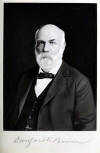
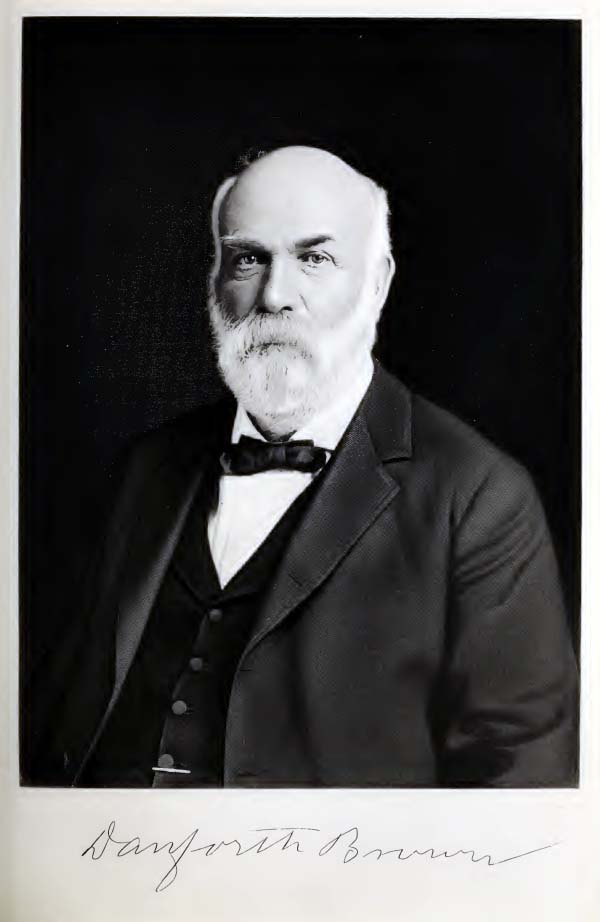
Danforth Brown |
DANFORTH
BROWN.
Danforth Brown, who
owns and occupies an excellent farm on section 7, Sharon
township, has now reached the seventy-ninth milestone on the
journey of life, his birth having occurred 'at Wellsburg,
Virginia, May 7, 1829. He was six years of age when
brought to Shelby by his parents, James and Jane
(McGuire) Brown, who were natives of Boston,
Massachusetts. The original American ancestor of the
family came to this country on the Mayflower.
Captain Oliver Brown, grandfather of our
subject, was born at Lexington, Massachusetts,, which was
afterward to be the scene of the opening events of the
Revolutionary war. He became a member of the American
army and participated in ten different engagements. He
was personally acquainted with George Washington.
His son, James Brown, was born in Boston, Feb.
19, 1794, and in 1835 came to Ohio. He conducted a
hotel at Shelby, was also proprietor of a drug store and
later carried on a dry-goods store in connection with
Thomas Mickey. In fact, he figured
prominently in business circles of the city at an early day
and was one whose efforts contributed in substantial measure
to the growth and development of the locality as well as to
his own success. He was married in 1814 to Miss
Jane McGuire and they became the parents of
three sons and seven daughters, but only two are now living,
Danforth and Mrs. Martha
Agerter, of Lima, Ohio.
In taking up the personal history of Danforth
Brown we present to our readers the life record of one
who has long been a resident of the county and is familiar
with many interesting incidents of the early days.
When he was but a boy his father would send him on horseback
to Mansfield nearly every Saturday for the mail. It
was at a time when letters were received without prepaid
postage and from twelve to twenty-five cents would be due on
each letter. The family experienced many of the
hardships and privations of pioneer life and also enjoyed
many pleasures incident to the settlement of a locality.
In early manhood he taught school through six winter terms
in the vicinity of his home and also conducted some night
schools.
On coming to Ohio the family resided at Plymouth for a
short time and then removed to the farm in Plymouth
township, which is now the property of Danforth
Brown and is located about a mile north of his present
home. Later they took up their abode in the village of
Shelby, where they lived for six or eight years and then
returned to the farm, whereon they spent their remaining
days. Danforth Brown has been a resident
of this part of the state from the age of six years and
continued on the old homestead until about thirty years of
age.
He had been married, however, at the age of
twenty-seven years, the lady of his choice being Miss
Emeline Cornwall, whom he wedded Feb. 6, 1856.
She was born in Richland county, near Mansfield, on the farm
which is now occupied by the state penitentiary. Her
birth occurred in 1881 and she was a daughter of Francis
and Martha (Carr) Cornwall, who removed from New Jersey
to Mansfield at a very early day. Later they went to
Crestline and Mr. Cornwall and John
Sherman started to lay out the town there but withdrew,
owing to the objections of the railroad. Later Mr.
Cornwall went to Iowa, where his death occurred.
He was associated with Tingley and Ferson in
the operation of the woolen mill at Mansfield and engaged in
the manufacture of cloth for a number of years people
bringing their wool from long distances to this mill to be
woven.
About three years after his marriage Mr.
Brown left the home farm and took up his abode upon the
farm which has since been his place of residence. Me
bought the property at the time of Morgan’s raid as a
speculation. He did not expect to remain here but has
continued to do so, and throughout his entire life has
engaged in general farming and stock-raising. His home
farm comprises one hundred and twenty-three and a half
acres, constituting the northeast quarter of section 1,
Sherman township, and in 1885 he erected here his present
prick residence and has made many other substantial
improvements. The home farm in Plymouth township
comprises one hundred and twenty acres of land and he also
has two hundred acres near Pomeroy, West Virginia, which he
has owned since 1862. Recently he has sold the coal
rights upon that place for twenty dollars per acre. In
all his business affairs he lies displayed keen discernment
and careful management and for many years he has been a
director and stockholder of the First National Bank of
Shelby.
Unto Mr. and Mrs. Brown were born four children,
namely; Robin, who died at the age of two and a half
years; Heber R., who is proprietor of a wholesale and
retail grocery business at Dodge City, Kansas; William A.,
a coal dealer living at Cleveland; and Edwin C., who
is engaged in the coal business with his brother.
William Brown was an extensive horse shipper for
a number of years, in which business he was associated with
Mr. Kinman, of Delaware, they shipping over
one hundred and fifty carloads of horses. Mr.
and Mrs. Brown traveled life’s journey
together for more than a half century but were separated by
the death of the wife July 31, 1907. She was a lady of
many good trails of heart and mind and her death was the
occasion of deep regret not only to her immediate family but
also to many friends.
In his political views Mr. Brown has
always been a stalwart republican since the organization of
the party and has been more or less active in public
affairs. He voted for Fremont in 1856 and for
each presidential candidate of the party since that time.
He enrolled in the militia during the war, served as
assessor of the township for a number of terms and has also
filled other others, the duties of which he has ever
discharged with promptness and fidelity. In the
evening of life he is most comfortably situated, his income
being sufficient to supply him with all of the necessities
and many of the luxuries of life. In his youth he
learned the value of economy and persistent energy and along
these lines he has made his progress in the business world.
In all his relations with his fellowmen he has been strictly
honorable and straightforward and no one is more worthy of
representation in this volume than Danforth Brown,
who for seventy-three years has lived within its borders and
has always upheld its best interests.
Source: History of Richland Co., Ohio - from 1808 to 1908
by A. J. Baughman - Chicago: The J. S. Clarke Publishing Co.
1908 - Vol. II - Pg. 642 |
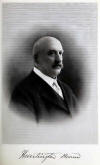
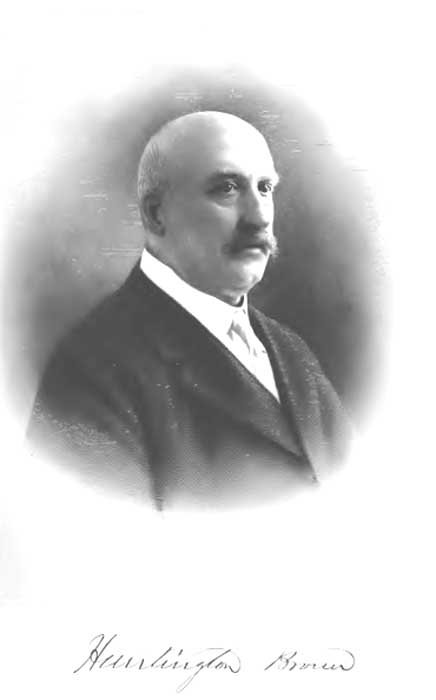
Huntington Brown |
HUNTINGTON
BROWN.
The commercial and financial
interests of Mansfield find a worthy representative in
Huntington Brown, whose business discernment and
enterprise have secured him positions of leadership in
industrial and financial circles. While he is not
connected at the present time with the active management of
business affairs, he is still a stockholder in various
interests upon which rest the material prosperity of the
city, and is today most closely associated with municipal
affairs as the chief executive of affairs of Mansfield.
His entire life has been passed in Ohio and he possesses
that spirit of enterprise and progress which has been the
dominant factor in the rapid upbuilding of this portion of
the state.
His birth occurred in Trumbull county, Ohio, in 1849.
He is a son of James Monroe and Mary (Hicks) Brown,
and a grandson of the Hon. Ephraim Brown, the
original proprietor of Bloomfield township, Trumbull county,
and the coadjutor of those early anti-slavery men of the
Western Reserve. He represented his district in the
lower house of the general assembly in 1824 and left his
impress upon the legislature enacted during that period.
During his childhood days Huntington Brown
accompanied his parents on their removal to Massillon, Ohio,
where he became a pupil in the public schools, while later
he attended Nazareth Hall, a Moravian academy,
in Pennsylvania. A year or two after his father’s
death, which occurred in 18'37, he removed to Mansfield and
was identified with mercantile interests here in connection
with Hon. M. D. Harter. He celebrated his
majority by touring Europe and thereby gained that broad
culture and experience which only travel can bring.
Following his return to his native land he entered the
employ of the Aultman-Taylor Company, a widely
known and very extensive manufacturing establishment.
There his fidelity, ability and laudable ambition won him
recognition in successive promotions until he became
superintendent of the business in 1879. He served in
that capacity for ten years and then passed on to other
positions of executive control, becoming manager of the
Hicks-Brown Company, operating one of the largest
flouring mills in the west.
In 1887, when a franchise was about to be granted for
the establishing of a street car line in Mansfield, Mr.
Brown interested himself with some capitalists from
New York city, securing a franchise from the city council
for an electrical street car line, which was erected and
which was the first electric street car line erected and
operated in the state of Ohio. Mr. Brown
had the honor of being the vice president of this company.
Later Mr. Brown retired permanently from
active management of business affairs, but in the meantime
had made judicious investments in various enterprises which
constitute valuable income paying property. He is now
the president of the Western Strawboard Company and also a
director of the Mansfield Savings Bank. The importance
of these enterprises is proof of his high standing in
commercial and financial circles. Throughout his
business career his course was marked by irreproachable
integrity as well as unfaltering enterprise and keen
discernment. He not only maintained justice in his
relations with his employes but showed to them marked
consideration and encouraged them to put forth their best
efforts that their individual success might be promoted
thereby.
In his political views Mr. Brown is a
stalwart republican and a recognized champion of the
interests of the party in Mansfield and Richland county.
In 1899 he was elected to the mayoralty and gave a
businesslike public administration, watching over the
municipal interests with the same fidelity which he
displayed in the control of his private business affairs.
He is now serving his third term. During his first
term' as mayor the “Dowieites” under instruction of their
leader, John Alexander Dowie, invaded
Mansfield and caused a great internal trouble among the
citizens of Mansfield, resulting in turmoil during the
entire summer of 1899. During this period the streets
of the city were often the scene of mob violence. In
handling this condition of things, Mr. Brown
showed his ability as the chief conservator of the peace and
his keen perception of the situation. While looking
after the interests of the citizens of Mansfield at the same
time he protected the lives of those who were the cause of
all of the trouble. Mr. Brown desired to
stop the unlawful actions of some of the citizens of
Mansfield, who were inclined to take the law in their own
hands and do violence, and in this he succeeded to the
satisfaction of the citizens of Mansfield, and after three
months of excitement and mob violence he finally brought
‘‘order out of chaos,” and that, too, without the loss of
life or property, resulting in the withdrawal of the
“Dowieites” from Mansfield, from which time nothing has been
heard of them or their cult.
In speaking of his official record a Contemporary
biographer said: ‘‘His fearless courage and consciousness of
right have made him a model mayor. Bringing to the
performance of his official duties a high appreciation of
the importance of his trust, he has executed the laws of
state and city with a determination and excellency which
have marked him a strong man and gained for him the
admiration of all good citizens. In his court he
administers the law with the utmost justice, tempered always
with that mercy which
befits a humane magistrate. During his official term
his careful and intelligent management of the city
government has added manifold to its revenues from police
control, and his untiring zeal in solving the sewage problem
entitles him to the highest commendation. No city in
Ohio possesses a citizen at the head of its government
uniting more of the elements which go to make up a man
possessing the qualities of a gentleman everywhere than does
Mansfield in the person of Huntington Brown,
and his life’s record is filled with honor and the gratitude
of the people.
Mr. Brown is prominent in Masonry, having
attained the thirty-third degree. In 1892 he served as
grand commander of the Grand Commandery of Ohio Knights
Templar, and is a life member of the Ohio consistory and an
honorary member of the Supreme Council of Scottish Rite
Masonry of the thirty-third and last degree. To Mr.
Brown is due the fact that the Masonic bodies of
Mansfield have secured a prominent home. This idea
originated with him and he organized a Temple Company, of
which he was chosen president, carrying forward its purposes
until the Masonic Temple was erected and dedicated. He
still remains its president and is its directing spirit.
When an act was passed by the general assembly to erect the
Soldiers’ and Sailors’ Memorial Library building, the court,
recognizing his business fitness, appointed him a. member of
the first board of trustees, which position he has
continuously occupied with great credit and eminent
satisfaction. His life has been one of activity,
reaching out to various interests in its social, political,
fraternal and commercial relations, and all of these have
profited by his cooperation and keen discernment manifested
in positions of executive control. He possesses the
qualities essential in leadership and he has done much to
mold public thought and action. Easily approachable,
he is always ready to extend to any the courtesy of an
interview, and he judges an individual not by his
possessions but by his character. He is frank and
fearless in conduct, a believer in justice and truth, and an
opponent of hypocrisy and cant. Viewed in a personal
light he is a strong man, strong in his ability to plan and
perform, strong in his honor and good name.
Source: History of Richland Co., Ohio - from 1808 to 1908 by
A. J. Baughman - Chicago: The J. S. Clarke Publishing Co.
1908 - Vol. II - Pg. 618 |
|
|
JAMES
EPHRAIM BROWN.
James Ephraim
Brown, of Mansfield, is one of the upbuilders of what
is today among the most extensive and best equipped plants
of the kind in the country, for he is president of the
Aultman-Taylor Machinery Company, one of the most
important industrial concerns of Mansfield. He has
displayed in his business career such fertility of resource,
marked enterprise and well defined plans as to deserve
classification with the “captains of industry” who are
controlling the trade relations of the country. He was
born at North Bloomfield in Trumbull county, Ohio, Mar. 21,
1846. His father, James Monroe Brown,
was also a native of North Bloomfield, born Apr. 2, 1818.
He was engaged in the wool business in Massillon, Ohio, and
later in the manufacture of agricultural implements there.
He wedded Mary E. Hicks, a daughter of Samuel
Hicks, of New Hartford, New York, and his death
occurred in 1869, while his wife survived until 1893.
In tracing back the ancestral history of the family it
is found that the grandfather of James Ephraim Brown
was a native of England and on coming to America located in
Westmoreland, New Hampshire. He was connected with the
Huntington family, which included Samuel Huntington,
one of the signers of the Declaration of Independence, while
General Hezekiah Huntington was the first to take a
regiment to Philadelphia and was the first man in the United
States to engage in the manufacture of firearms. In
the family of James Monroe and Mary E. Brown there
were six children, three of whom are living, including
Huntington Brown, the present mayor of Mansfield, and
Mrs. M. D. Harter, whose husband was the congressman
from the fourteenth district of Ohio. He was twice
elected from a district which formerly gave a republican
majority of two thousand and he ran about four thousand
votes ahead of his ticket.
James E. Brown was educated in a private school
of Bloomfield and in the high school at Massillon, Ohio,
from which he was graduated in 1864. He then pursued a
course in Eastman’s Business College at Poughkeepsie, New
York, and on its completion went to New York city, where he
was engaged in the wool business for about three years.
The succeeding three years were spent in a similar manner in
Boston, Massachusetts, and in 1871 he returned to Massillon,
where he purchased a hardware business, which he conducted
until 1878. In October of that year he came to
Mansfield and entered the employ of the Aultman-Taylor
Company as assistant to M. D. Harter, who was then
manager. In 1881 Mr. Brown was elected
secretary of the Aultman-Taylor Company, which
position he filled until 1891, when the Aultman-Taylor
Company sold to the Aultman-Taylor Machinery
Company, since which time Mr. Brown has been its
president. This company is capitalized for one million
dollars and is engaged in building traction engines,
threshing machinery and sawmills, doing a business that
amounts to a million and a half dollars yearly and employs
between five and six hundred people. It is the largest
single industry in the city and through its pay roll two
hundred and fifty thousand dollars are annually distributed
here. Mr. Brown is also vice president
and director of the Mansfield Savings Bank and he has land
and coal interests in West Virginia that are of considerable
importance, comprising the Galligo Land & Coal Company and
the Ohio Timber Company.
On the 24th of April, 1872, Mr. Brown was
married at Massillon, Ohio, to Miss Isabella
Hurxthal, a daughter of Louis Hurxthal,
a banker of Massillon. Of this marriage one son was
born, James Monroe Brown, who is now
assistant manager of the Casey Hedges Company of
Chattanooga, Tennessee. Mrs. Isabella Brown
died July 7, 1891. On the 3d of January, 1901, Mr.
Brown was married at Mansfield to Miss
Katherine Holway, a daughter of William
Holway, a retired merchant of this city. Their
children are: Ephraim Holway, born May 18,
1902; and Mary Katherine, born Dec. 13, 1903.
In his political views Mr. Brown is a
republican and has always taken a general interest in local
political affairs. He is a member of Mansfield Lodge,
No. 28, A. F. & A. M.; Mansfield Chapter, R. A. M., and also
the council and commandery and Dayton consistory of the
Scottish Rite. He was worshipful master of Mansfield
lodge for one year, high priest of Mansfield chapter for ten
years and captain general of Mansfield commandery for
twenty-five years, while for one year he was its eminent
commander. He also belongs to the Mystic Club and to
the Our Club, the latter of which he has been president for
twenty-five years, and is a member and director of the West
Brook Country Club. He likewise belongs to Grace
Episcopal church, in which he has been senior warden and lay
reader for a quarter of a century. He is a patron of
music, much interested in literature and possesses one of
Mansfield’s most complete libraries of standard works.
Both Mr. and Mrs. Brown are quite active and
prominent in social circles. Mrs. Brown is an accomplished
musician, who has sung a great deal in public, having been
leading soprano of the Congregational church for a number of
years prior to her marriage, and she is still much
interested in church and charitable work. Such in
brief is the life history of one who has gained recognition
as a most prominent citizen here. Not so abnormally
developed in any direction as to be called a genius, he has,
however, been one of the most active men of Mansfield,
identified for many years with its business interests and
public concerns. He has given tangible proof of his
devotion to the plans and measures which are promulgated for
the public weal, and his life record proves that there is no
discordant element between success and honesty.
Source: History of Richland Co., Ohio - from 1808 to 1908 by
A. J. Baughman - Chicago: The J. S. Clarke Publishing Co.
1908 - Vol. II - Pg. 583 |
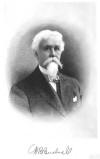
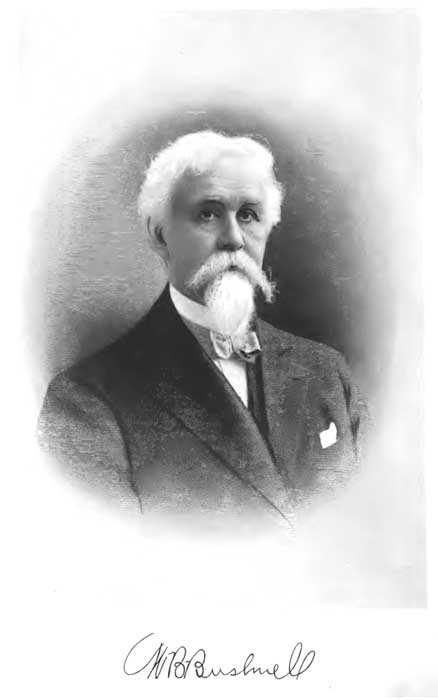
M. B. Bushnell |
MARTIN B. BUSHNELL
Source: History of Richland Co., Ohio -
from 1808 to 1908 by A. J. Baughman - Chicago: The J. S.
Clarke Publishing Co. 1908 - Vol. II - Pg. 595
|
|
|
CLICK HERE to
RETURN to
RICHLAND COUNTY, OHIO |
CLICK HERE
to RETURN to
OHIO GENEALOGY EXPRESS |
|
FREE GENEALOGY RESEARCH is My MISSION
GENEALOGY EXPRESS
This Webpage has been created by Sharon Wick exclusively for Genealogy
Express ©2008
Submitters retain all copyrights |
|