|
MONROE TOWNSHIP
Monroe township
is six miles square and was organized Feb. 11, 1817. The
surface is broken, but the land is generally fertile, productive
of crops upon uplands and valleys. The township has
abundant water supply, both of running streams and flowing
springs. The Clearfork of the Mohican flows across the
southeast corner; the Blackfork across the northeast part; the
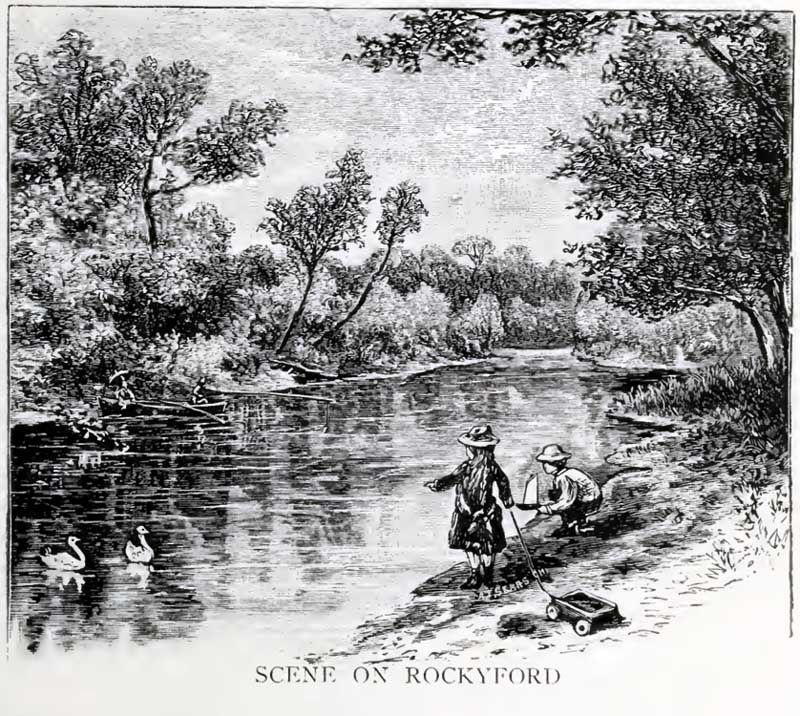
Rockyfork through the northern part, and Switzer’s run
diagonally through the southwest part of the township. Of
the gushing springs, Schrack’s, on the northeast quarter
of section 34, and the Sheehy spring on the southeast
quarter of section 22, have the greatest outputs. A few of
those of less flow are:
Pg. 313 -
Pg. 315 -
Switzer’s, on the southeast quarter of section 34;
Douglass’, at Green Gables, and the Kinment’s, on the
southwest quarter of section 22.
The first settler was David Hill, who built the
first cabin in the township. This site of this cabin is on
the southwest quarter of section 9, where Silas Rummel
now lives.
The following is a partial list of the early settlers.
David Hill, section 9; Frederick Bonenberg,
section 10; John G. Peterson, section 1; John
Lambright, section 2; Mordecai Williams, section 35;
Abraham Baughman, section 25; Adam Wolfe section
19; Frederick Switzer, section 13; Robert and William
Stewart, William Ray, William McLaughlin, Thomas Rigdon, William
Ferguson and Thomas McBride, on section 8;
Jeremiah Smart, section 4; Thomas Pope
and Daniel Balliett, section 9; Andrew Richey, Michael
Huffman and Ebenezer Smith, section 6; John Iler,
Melzer Coulter, section 19; David and Charles
Schrack, section 34; David Ellis, section 17;
Frederick Cromer and David Crawford,
section 26; Christian Good, section 3; John
Douglass, section 28; Solomon Gladden, section 23;
William McDaniel, section 26.
Adam Wolfe settled in Monroe township in
1816. He had been a soldier in the war of the American
Revolution. He died Apr. 24, 1845, aged eighty-five years.
Adam Wolfe was the grandfather of Judge N. M.
Wolfe, of Mansfield.
Joseph Reed came to Richland county, Ohio, in 1829,
and settled on the northwest quarter of section 23, in Monroe
township where he resided until his death Oct. 3, 1874. He
was the father of J. M. Reed, of this city, and the
grandfather of Verner Z. Reed of Colorado.
Solomon Gladden came in 1816, but did not
settled permanently until 1817. He had served in the war
of 1812, was a justice of the peace and a member of the
legislature. ’Squire Gladden was the
grandfather of the Hon. W. S. Kerr, Mansfield’s
ex-congressman.
Samuel Douglass came to Richland county in 1829
and settled in Monroe township in 1831. He was the
grandfather of the Hon. A. A. Douglass and Judge S. M.
Douglass, of Mansfield. The Douglass farm
contains over two hundred acres, and has been in the possession
of the family over seventy years.
Abraham Baughman had been the first
settler in the vicinity of Green town, but during the war of
1812 removed to Monroe township and entered the southwest
quarter of section 25, where he located and resided until his
death, in January, 1821. Abraham Baughman
and wife and three of their sons Abraham, Jacob
and George - are buried at Perrysville.
Among the early school teachers were Captain James
Cunningham, John Clark, John Tucker, William Wigton and
Joseph Wolfe.
The first election in the township was held in 1817,
and resulted in the election of J. G. Peterson, William
McLaughlin and David Ellis as trustees and Andrew
Richey as lister. Ten votes were cast.
The first grist mill was erected in 1820 by Peter
Zerby. This was the Octorora mills, and was situate near
where the Pennsylvania railroad crosses the Rockyfork.
Pg. 316 -
Another grist mill was erected on the Rockyfork;
between Zerby mill and Lucas in 1830, by Reinhart
Oldfield. This mill is still being operated. The LaRue
mill, west of Lucas, was also built in 1830. Is not now
running. Another early grist mill was that of
Charles Schrack’s, on Switzer’s run, known
some years since as the Rose Mills. A number of saw
mills were erected on the Rockyfork and on Switzer’s run.
A woolen factory was built in about 1846 on the Rockyfork, a
mile and a half below Lucas, and was operated for several years.
In 1819 the following names appear on the tax duplicate
of Monroe township: James and George Archer,
Abraham Baughman, Stephen Brady, Jacob
Baughman, George Baughman, Frederick
Boneberger, James Church, Frederick
Cramer, John Douglass, David Ellis,
William Furgeson, Benjamin Forbey,
Benjamin Gatton, Christian Good,
Solomon Gladden, Henry Huffman,
Rebecca Hensel, James Irwin, John
ller, Peter Kenney, Lawrence King,
John Lambright, William McLaughlin,
Amerine Marshall, Thomas and Alexander
McBride, Jr., Jacob Oler, John G.
Peterson, William Bay, Andrew Richey,
Jacob Switzer, Frederick Switzer,
William Slater, Thomas Summerman,
Samuel Stewart, David Shrack,
Ebenezer Smith, M. Shinnebarger,
Jeremiah Smart, Jacob and Mordecai
Williams, William Wilson, Adam
Wininger, Samuel White, Adam and
Robert Wolfe and Peter Zerby.
One of the first religious societies organized in
Monroe was of the Swedeborgian faith, under the teachings of “Johnny
Appleseed,” and of its members were John Tucker,
David Crawford, Joseph Applegate, et
al., men who led blameless lives and had the respect of the
community in which they lived.
The Lutheran is the prevailing religious denomination
in Monroe. The Baptist, the Reformed and the United
Presbyterian denominations each had a church and an
organization. All are now numbered with the things that
were but are not. There are now seven churches in Monroe -
five Lutheran, one Congregational and one Disciple.
St. John’s Lutheran church is situate at the north side
of the Darling valley, about half way between Newville and
Perrysville. The congregation was organized in 1838.
“Saint John’s” is used as a synecdochical term, meaning the
church, the locality or both. In the ’50s the late Rev.
W. A. G. Emerson preached at St. John’s. He was one of
the most talented ministers of his day, with a perfect command
of the English language, never hesitating for a term to
felicitously express his thoughts. He threw such
persuasive power and convincing force into his sermons that he
swayed his audience at his will. He dwelt more upon the love of
the Father than upon the terrors of the law, and his word
pictures were beautifully drawn. Mrs. J. M. Condon,
of Sherman avenue, Mansfield, is a niece of the Rev. Mr.
Emerson.
Mohawk Hill, near the center of the township, is an
elevation of natural as well as historical interest. Its
northwest side, being too steep and rocky for cultivation, is
still covered with its native forest. The road winds
around to lessen the grade, and at the top of the hill there is
a rolling surface of table land, with a dip to the east
overlooking the Rockyfork valley. The hill takes
Pg. 317 -
its name from the fact that Mohawk Indians were buried there
during the occupancy of Helltown, which was evacuated in 1783.
Pipe’s Cliffs, near Green Gables in Pleasant valley, is
also a place of both geological and historical interest.
Historically, it is named for Captain Pipe, a
chief of the Monsey branch of the Delaware tribe. Round
Head, an Indian warrior (who married Captain Pipe’s
sister), with his wife and child and other Indians, were fleeing
in 1781 from the punishment which justly awaited them in the
Muskingum valley, had encamped upon the summit of these cliffs,
and seeing a squad of pursuing soldiers coming up the valley,
the Indians opened fire upon them. The soldiers returned
the fire, aiming at the part of the cliff from which the smoke
came through the thick foliage of the densely forest covered
hill, and Onalaska - Round Head’s wife - who was standing near
to the edge of one of the rocks with her child in her arms, was
struck by a bullet, fell to the base of the cliff, where their
bodies were buried. Two Indian warriors were also wounded
or killed by the soldiers. Sentimentality must be far-spun out
to censure the troops for returning the fire of their ambushed
foes.
The late Rev. Richard Gailey founded “Monroe
Seminary,” in the south western part of Monroe township, in May,
1851, and after successfully conducting the same for about ten
years, removed to Lexington, where he continued in the same
pursuit until his death, in 1875. Captain I. N.
Thompson and wife now own and occupy the Gailey
residence of the Monroe academy days.
Of the three attempts at town building in Monroe
township, only one Lucas - succeeded. Octororo was started
with fine prospects, but was outrivalled by Lucas, and many
people of Monroe today scarcely know it ever existed. Six
Corners - commonly called “Pinhook” - still contains a few
buildings. Pinhook is situate at the intersection
of the Newville-Mifflin and the Lucas Perrysville roads, with
the section line road running east and west through the center
of the township. Pinhook was at the height of its
prosperity in 1852, and at that time contained several business
buildings, a number of dwellings, a schoolhouse and a Masonic
hall. William B. Miller was the postmaster and
merchant at the place.
MICHAEL HOGAN
was born in Ireland. Received a classical education. Also
graduated in medicine and surgery. Then took a military
course. Came to America and located in New York. Was
given a commission as major in the regular army, where he served
five years. Came to Ohio in 1818, and engaged in the
mercantile business at Newville. In 1827 he bought the
northwest quarter of section 35 in Monroe township, upon which
he removed and resided until his death, Jan. 17, 1875.
Buried in the Catholic cemetery, Mansfield. Major
Hogan was one the best classical scholars in Ohio.
He could read the history of several countries of Europe in the
language of each. The old homestead is still in the
possession of the family.
JAMES STOUT, a New Jerseyman by
birth and a Hollander by descent, entered the west half of the
southwest quarter of section 22, upon which he located in 1829,
and upon which lived until his death, Aug. 30, 1864. There
were but few settlers in that part of the township at that time.
There were heavy forests, and wild cats, deer and wild turkeys
were numerous, and bears
Pg. 318 -
were frequently seen. Mr. Stout was fond of
hunting, and his wife could shoot squirrels and other small game
equally well with her husband. The Stouts were
industrious people and good neighbors. Hiram
Stout, the survivor of the family lives at the old home.
He is eighty-four years old and a bachelor.
MICHAEL SWIGART who was a
drum-major in the war of 1812, settled in Monroe township in
1832. One of his sons, Leonard Swigart, was
a commissioner of Richland county, 1860-66. “Aunt
Betsey” Chew, of Monroe township, and Jesse L.
Swigart, of Lucas, are children of the late Michael
Swigart.
JOHN SWIGART, the father of
Luther M. Swigart, of Mansfield, was a Monroe township
pioneer. He also served in the war of 1812. He
settled in Monroe in 1821.
WILLIAM DARLING,
another soldier of the war of 1812, settled in Monroe in 1817.
He acquired by purchase 1,185 acres of land in one body, and
also owned a number of other farms not connected with that
tract. This land lies along the Clearfork, below Newville,
and is very fertile. This valley is often called the
Darling settlement or the Darling valley. The
following is a copy of an appendix to William Darling’s
will:
“Having been one of the pioneers of this part of Ohio,
the maker of this will, having emigrated from Hardy county,
Virginia, in the year 1806, in company with his father and
family, to Muskingum county, Ohio, and endured all the
hardships, trials and privations incident to the settling and
improving of a new country, I do give and bequeath my love,
respect and good will to all my old associates, and hope that,
by the intelligence, energy and untiring industry of growing
posterity, the prosperity of my beloved country may continue to
increase as surely and rapidly as though we pioneers were still
here to look after our country’s welfare; for, next to my love
for my God and my family, is my love for my country —these
blessed United States. May prosperity and peace be the lot of
our happy, happy land.”
In one of the charming little valleys
of Monroe township are two phenomena more pronounced and
peculiar than exist in any other part of Richland county. These
phenomena are a pillar of cloud by day and a cloud of light by
night in the same locality.
Upon the eastern side of the valley, traversed
by a stream that empties into the Clearfork of the Mohican in
the vicinity of Saint John’s, is a primi tive forest, over a
section of which a cloud of misty vapor hovers over the tree
tops, as it has in the years gone by, for ages untold.
This phenomenon has never been explained, but
many speculative the ories have been advanced in attempted
explanation of the mystery. Some have opined that there is a
mineral deposit in the earth in that locality, although unable
to give philosophical or pedantic reasons for such conclusions.
Others suppose there is a subterranean hot spring from
which steam issues through some invisible crevice, forming a
vapor mist that hangs over the trees like a cloud.
This pillar of cloud causes day dreamers to muse, not
upon the cause of the phenomenon, but upon the pictures
presented in the form-like shapes one can see, or fancy they see
in the cloud. From the other side of the valley, looking over
the broad meadows at the wooded slope, with its low-hanging
cloud, the
Pg. 319 -
Pg. 320 -
MIFFLIN TOWNSHIP
Vermillion township was
originally eighteen miles long from north to south, and twelve
miles wide from east to west. In 1814 this territory was
cut into two parts, and the west have was called Mifflin.
In 1816 Mifflin was
Pg. 321 -
divided, and the portion lying directly east of and adjoining
Madison, six miles square, retained the name and organization of
Mifflin township. A number of settlers there came from
Mifflin township, Allegheny county, Pennsylvania - hence the
name.
When Ashland county was created in 1846, Mifflin was
again divided by the county line, which follows the general
course of the Blackfork. The territory on each side of the
line retains the name of Mifflin, one being in Ashland, the
other in Richland county.
The surface of Mifflin along the Blackfork is generally
hilly, but the western part of the township is more level, and
some of the most productive farms in the county are along the
Blackfork valley, and the farmers are generally well and
comfortably situated.
Long before Mifflin was settled by white men it was a
favorite hunting ground for the Indians, as all kinds of game
abounded in its primeval forests. Samuel and
David Hill and Archibald Gardner
were the first white settlers in Mifflin, locating there either
late in 1809 or early in 1810. Samuel Hill
settled on the northeast quarter of section 33, north of Lucas.
Archibald Gardner located near Windsor.
The settlement and history of Mifflin have been similar
to that of the other townships of the county. In the
beginning there were dangers from savages and from the climatic
diseases of a new country. The Mifflin pioneers, like
those of other localities, lived in log cabins, cleared their
lands, worked early and late, and their bill-of-fare consisted,
principally, of corn bread, fish and game. As the
population increased, there were shooting matches and militia
musters. The men were robust and brave and the women were
fit mothers for the generations that were to follow. Time
passed and Mifflin grew and improved and prospered, keeping step
with her sister townships, and will soon be traversed by trolley
lines, bringing the people in touch with the county seat and
country towns and pleasure resorts.
Before churches or schoolhouses were built, religious
services were held and schools were taught in the cabins of the
pioneers. In time, fine churches were erected for
religious and educational purposes, and today the churches and
schoolhouses of that township are evidences of the high
character and attainments of the people.
ROBERT BENTLY settled upon the
southwest quarter of section 10 in 1815. The family camped
in their wagons until their cabin was built and in which they
lived until 1828 when they moved out of the old cabin into a
fine brick residence - the first brick dwelling erected in
Richland county. Mr. Bentley was for seven years an
associate judge of the court of common pleas, and served two
terms in the state senate. He was a major general of the
Ohio militia, and was a prominent man in business, as well as in
civic and military affairs. He died in Mansfield in 1862.
Two grandchildren of General Bentley reside in Mansfield
- the Hon. M. B. Bushnell and the wife of Gen.
Brinkerhoff.
PETER
HOUT was born upon the farm on which he now resides Nov. 17,
1821, and has, therefore, been a resident of this township for
eighty-two years. He attended school in one of the log
schoolhouses common at the time. He can relate many
interesting incidents of pioneer life, when the land was all
Pg. 322 -
wild and unimproved and when wild game was plentiful in that
region. Mr. Hout has held several township
offices, and also served his county as infirmary director two
terms. As an honored pioneer and representative man of
Mifflin he is worthy the high regard in which he is held.
The Houts are both numerous and prosperous. One
rural mail carrier from Mansfield delivers mail to a dozen
Hout families.
The late
ISAAC ABY settled in Mifflin in 1826.
In 1854 he married Sarah Clugston, sister of George A.
Clugston, of this city.
Mr. Aby was a California "forty-niner," and what he
accumulated in the Golden State gave him a good financial start
upon his return, and as the years came he bought farm after farm
and was quite wealthy at the time of his death. His son -
Byron J. Aby - is one of the wealthy and prominent
farmers of Mifflin today.
The BALLIETS are both
numerous and prosperous. Mifflin does not contain all of
them, for Washington and other townships have many families of
them. Whenever you pass a Balliett farm you see a
place that is well improved.
There are a number of
BOALS FAMILIES, all well situated,
and the late David Boals was a county commissioner.
JAMES
CHEW located in Mifflin in 1817. His sons were
Andrew, William, Aaron and Cephias. James Chew
died in 1839. The Chews have been prominent people
in Richland county since its early settlement.
DANIEL HOOVER was one of the
early settlers in Mifflin township, and through his industry and
frugality accumulated considerable property. He was
married to Sarah Sheller. They were the parents of
eight children, of whom Joseph, born in 1824, was the
eldest. The others were Mary, Henry, Aaron, Christian,
Alfred, Elizabeth and Daniel. Mr. Hoover was a
Baptist, and frequently had preaching at his house.
DANIEL KOHLER, Sr.,
was born in Pennsylvania in 1814. Came to Ohio at an early
day and was married to Nancy Brubaker. The
Kohlers, the Kagys, the Cotters, the Coles
and Hershes are related by marriage.
DUNCAN McBRIDE was born in
Virginia in 1807, came with his parents to Richland county in
1817, and settled one mile north of Lucas, in a log cabin, which
for a time had no floor but the earth; later a puncheon floor
was laid and a quilt was hung up for a door. In those days
they put bells on their horses and on their cows, which were
turned out to browse in the woods, which were the only
fields of pasture then. In hunting for them they were apt
to encounter almost any kind of wild animals from bears to
porcupines. When the dogs attacked the latter their mouths
would get filled with the quills of the porcupines, and then
their yelling and howling was terrible. Their master would
have to pull the quills out of their mouths, to which the dogs
would submit intelligently. In 1829 Duncan McBride
bought a farm at the foot of the Mohawk hill in Monroe township,
upon which he resided until his death, in 1862. Duncan
McBride was a justice of the peace for many years, and
during the period justices of the peace. One of these was
the notable "California case," which was tried before Justice
McBride, and in which the Hon. John Sherman and the
Hon. George W. Geddes were
Pg. 323 -
opposing counsel. This was before Sherman went to
Congress, and before Geddes was elected a judge in the
common pleas court.
SOLOMON ABY is a successful farmer. He is a
great-grandson of the late Rev. James Copus, who was
killed by the Indians in the Copus battle, Sept. 15,
1812.
SQUIRE FREEMAN OSBUN owns
farms in both Mifflin and Weller townships. He was a
soldier in the War of the Rebellion, being a member of Company
D, One Hundred and Second O. V. I. He is of a pioneer
family, and is a justice of the peace, as his father was before
him.
Of other prominent
people in Mifflin, past and present, the familiar names of a
number are recalled: N. S. Henry, E. N. Ernsberger, the
Hales, Au, Bell, Barr, Cole, Hoover, Kaufman, Kaylor, Van Cleaf,
Miller, Sattler, Snyder, Wolfe, Woodhouse, Yeaman, Swoveland,
McNaull, McCready, Walters, Haverfield, Sunkel, Amsbaugh,
Sturgeon, Tucker, Hunt, Reyher, Simpson, Hostetler, Culler,
Gongwer, McCormick, Zook, Niesley, Sites, Koogle, and
Cook.
Peter Hout
was in Mansfield Saturday and in conversation with some friends
on the Sturges corner, told in an interesting way of the pioneer
days, when he was a boy - three-fourths of a century ago, and of
the change made by
"The inaudible and noiseless foot of time."
With the network of
telephone wires now strung over the country, every man is in
communication with his neighbors, even to the remotest parts.
How different from the slow intercourse of that of bygone years.
This is realized as much in receiving election returns as in any
other way. Years ago post riders were frequently sent to
the outlying townships to bring in the returns. Upon one
occasion the contest between two candidates was very close, and
when the returns had been received from all the precincts except
one, the interest became intense, as the vote was so close that
it was conceded that the township to hear from would decide
which of the two candidates would be chosen. The suspense
became more and more intensified as time passed. Finally
the messenger appeared, riding at a furious speed, and halting
where the crowd had gathered, his panting horse flecked with
foam, exclaimed, “Seven of a majority.” “For whom?” yelled
the anxious crowd. “I don’t know for whom, but I do know,
gentlemen, that this hoss’ is a speeder.”
It was the custom in the pioneer days, when a man
killed a calf or pig to divide it among his neighbors. One
who had often received the benefit of this generous custom, but
was rather noted for his parsimony, had, in his turn, killed a
pig, and meeting a friend, informed him of the circumstance and
expressed to him his fear that he would not have meat sufficient
to distribute among his neighbors and retain what he considered
necessary for his own use. His friend, after considering
the case, proposed that he could relieve himself of his dilemma
by permitting the pig to remain suspended outdoors where it had
been dressed, during the night, and before daylight take it in
and conceal it in his house, and then to give out that it had
been
Pg. 324 -|
stolen during the night. The suggestion received the
approval of the pig owner; and on the next morning he met his
friend, and, with a. rueful countenance, informed him that, sure
enough, his pork had been stolen. The friend complimented
the pig man upon his skill in lying, and told him that he had
only to repeat the story with the same skill to all whom he
would meet and there would be no doubt that the he would be
successful. The other swore that his tale was neither a
lie nor a joke, but that his pig had indeed been stolen.
In response to his vehement protestations, his friend would the
more compliment his skill in playing off, and urge him to put on
a bold front and maintain his position in the face of everybody.
The truth of the matter was, that the disinterested and
facetious “friend” who had advised the plan, had taken the pig.
There has been a tendency to unearth ancient graves in
the interest, as it is claimed, of historical research, but
often, perhaps, to gratify curiosity, or to hunt for supposed
trinkets and treasures. The meanest kind of a thief is a
grave robber. There are two kinds of ancient graves in
Richland county - one of the pre-historic people who inhabited
this locality eight or ten centuries ago. The other, those
of Indians of the pre-pioneer per iod. Many people confound the
Indians with the pre-historic race of mound builders, who were
not Indians. A different people may have inhabited this
part of the country at a period between its occupancy by the
mound builders and by the Indians. Why desecrate those ancient
graves in a fruitless attempt to roll back the centuries of the
past, for the search light of investigation reveals but little
of “the night of time.
An old-time poet wrote:
"Oh, Mound! consecrated
before
The white man's foot e'er trod the shore.
To battle's strife and valour's grave
Spare, oh, spare, the buried brave."A thousand
winters passed away
And yet demolished not the clay.
Which on yon hillock held in trust
The quiet of the warrior's dust.
"The Indian came and went again;
He hunted through the lengthened plain;
And from the mound he oft beheld
The present silent battlefield.
"But did the Indian e'er presume,
To violate that ancient tomb?
Ah, no, he had the soldier's grace
Which spares the soldier's resting place. |
Pg. 325 -
"It is alone for Christian hand
To sever that sepulchral band,
Which ever to the view is spread,
to bind the living to the dead." |
MADISON TOWNSHIP
Pg. 326 -
Pg. 327 -
Pg. 328 -
Pg. 329 -
Pg. 330 -
Pg. 331 -
Pg. 332 -
Pg. 333 -
Pg. 334 -
Pg. 335 -
Pg. 336 -
Pg. 337 -
Pg. 338 -
PERRY TOWNSHIP
Leipsic township
was organized in 1818 and embraced the territory of the present
Perry and a part of Congress township, the latter now in Morrow
county. The first officers of the new township were
sworn into office Sept. 28, 1816, as follows: Trustees, John
Cook, James Huntsman and John Coon; clerk,
Jonathan Huntsman; supervisors, Philip Stealts and
Benjamin Hart; overseers of the poor, George Goss and
Lawrence Lamb; fence viewers, Henry Sams and
Caleb Selby.
On Oct. 11, 1816, the name of the township was changed
from Leipsic to Perry. As it had formerly been allied with
Jefferson and there was an indebtedness of $54.94, each township
assumed one-half the amount, $27.47. The administration of
public affairs was not expensive in those years. Hart,
for his pay as supervisor of the west half of the township,
received 75 cents for his services.
Perry retained the boundary given it in 1816 until June
5, 1825, when it was reduced to six miles square - the original
survey - and the western thirty-six sections received the name
of Congress.
Pg. 339 -
Morrow county was created (in part out of Richland) in 1848, and
Perry was again divided and reduced to its present limits - six
miles long and three miles wide - and contains eighteen sections
of its original territory. The central part of the
township is rolling tableland, with an elevation that makes a
watershed divide between the Clearford of the Mohican on the
north and Owl creek (the Kokosing) on the south.
A considerable portion of Perry township is a
beech-wood country, and when first settled the land was covered
with decayed vegetable accumulation that made the surface look
invitingly fertile. All the ordinary crops are
successfully grown, but upon the upland where the soil is
argillaceous, care must be taken to maintain its fertility.
Perry township has a very interesting history; some of
the events and incidents may be mentioned in this connection.
The first house in the township was built on section 11, in
1809, by John Frederick Herring, who also built a grist
mill at the same place, the second mill put in operation in
Richland county. This mill was on the south branch of the
Clearfork, four miles west of Bellville, where the
Lexington-Fredericktown and the Bellville Johnsville roads
cross. It was known for fifty years as the Hanawalt
mill, but after serving well its day and purpose for about
three-fourths of a century, it is now no more.
The Eby mill was built in 1837, was operated
thirty-seven years, and stood farther up the stream.
Frame’s woolen factory was run successfully for many years, and
a grist mill was formerly operated at the same locality, where
the Walters bridge spans the south branch. A number
of both grist arid saw mills were erected in the township and
did a flourishing business for years, but the shrinkage of the
streams lessened the water power with which the mills were
operated, and, with the change in business affairs and in
operating methods, country mills of all kinds generally went out
of business.
The people of Perry have always been abreast of the
times in their religious matters, and the Christian, Methodist,
Lutheran, Evangelical, United Brethren and perhaps other
denominations have congregations and places of worship. In
about 1840 quite a religious revival was had in the western part
of the township. One man, being “almost persuaded,” prayed
that a sign might be given him, and one night while in bed he
heard a noise and, arising to ascertain the cause, discovered
that the family Bible had fallen from a shelf to the floor.
He picked it up and opened at the passage: “He brought me up
also out of a horrible pit.” He sent messengers out to his
neighbors, with “speed, Malise, speed,” messages that a sign had
been given him, with the request that they gather at his house.
“Instant the time; speed, Malise, speed,” and his neighbors came
that same hour of the night 1 and held services of prayer and
praise until noon the next day, and many were “converted.”
Darlington, the only town in the township, was formerly
called Hagerstown, after Christopher Hager, the first
settler on the land where the village stands.
Pg. 340 -
The Lost Run region, in
the southwest part of Perry township, is one of the most
picturesque and attractive of the many interesting localities in
Richland county. Lost Run is a north tributary of the
Kokosing, and cuts diagonally across the southwest corner of the
township, from the northwest to the southeast, a distance of
about two miles. Its waters were of sufficient volume in
the olden time to furnish water power to operate the Hosack
mill. A “feeder” comes into the run from the Follin
spring, on the northeast quarter of section 27. The Lost
Run distillery has been operated a number of years and is
situate a short distance north of the county line.
Lost Run got its name in this way: A man on a
prospecting tour to locate lands became lost in the wilderness
and, coming to this stream, followed it down to a settlement in
Knox county. The locality inspires a desire for rural
domesticity. It is a region where the milkmaids can sing
their evening songs in the quiet valley with refrains answering
in echoes from the surrounding hills. Of Perry township
people, past and present, the names of the following families
are prominent: Hosack, Bigbee, Sagar, Bisel, Mann, Ewers,
Toben, Painter, Follin, Culp,
McFerren, McDonald, Hardman, Poorman, Baughman,
Walters, Eckert, Craven, Olin, Coursen, Kochheiser, Daily, Ruhl,
Lantz, Baker, Steel, Hiskey, and others. Jacob
Algire settled in Perry township in 1827. David
Buckingham came in 1823. Bickley Craven was
born in Perry township. Jackson and Samuel Eby came
from Pennsylvania in 1831 and built a sawmill in 1836 and a
grist mill in 1837, on the Clearfork, called “The Perry Mills,”
and operated the same for thirty-seven years. Jacob
Erow came from Green county in 1857 and served in the Union
army during the war of the rebellion. John Garver
came from Pennsylvania with his parents in 1834. John
Hanawalt was born in Baltimore in 1803. He came to
Ohio at an early day and purchased the Herring mills, which he
operated for many years. Jonathan Huntsman
came in 1816. The Huntsman family is one of
the most numerous in the township, and are well-to-do people.
The Lantz family came in 1833. Samuel
Lantz married Leah Brubaker.
Alexander McKinley settled in Perry in 1864.
His wife’s maiden name was Jerush Runyan.
The Olins came from Vermont. Gideon Olin,
father of Nathaniel Olin, was a major in the war
of the rebellion, was a judge of the court and a member of
congress. Nathaniel Olin was the grandfather
of Olin M. Farber, of Mansfield. The Painter
family came in 1813 and located in the southeast part of the
township. In 1827 Robert Parker came from
Baltimore in a one-horse wagon and located in Perry township.
Thomas Phillips settled in Perry in 1814.
Mr. Phillips was, in his day, one of the most
prominent men in the township. His son William was
a member of the Sixty-fourth O. V. I., and was killed at the
battle of Stone river, Dec. 31, 1862. The Ruhl
family have been prominent and prosperous for several
generations. John Steel was born in Perry township
in 1818 and Steel run in the eastern part of the township
was named for him.
At Painters, west of Bangorville, a government
meteorological station is maintained. The leading
“institutions” of Perry township are farm homes,
Pg. 341 -
country schools and churches. The people are industrious
and prosperous and, being removed from the marts of trade and
commerce, are but little affected over strikes, trusts or
political agitations. “Home,” to the people of Perry
township, is a dear word, as it should be to all, for it is the
place where the tired toiler finds rest at eventide. It is
the place where love is not only fraternal but divine, and where
joy permeates the very air and prayer trembles into its most
solemn and earnest importunities and where sorrow drops its
bitterest tear.
WASHINGTON TOWNSHIP.
Washington township was
organized Mar. 4, 1816. It is six miles square and
contains thirty-six sections. The surface is broken, but
is generally fertile, and the number of rich little valleys lie
between its rugged hills. Richland county is noted for its
springs of cool, pure water and Washington township has its full
share of them.
Considerable land in the central part of Washington
township was not entered during the earlier period of the
settlement of the county, because that locality was hilly and
the land rough. But when the Germans came they settled
there, not, perhaps, from choice as much as from necessity, for
the better lands had previously been taken. Predictions
were made at the time that the Germans could not make a living
out of that rough region. But they cut and grubbed and
digged and cleared, and succeeded in changing a rough wilderness
into remunerative farms, arid by dint of application, industry,
perseverance and economy - traits for which the Germans are
noted success was achieved and the people of that settlement are
as prosperous today as are those of other localities. As a
class, the Germans are industrious and frugal and make good
citizens.
The question has been asked why so many Germans leave
their much beloved Fatherland and seek homes in America.
They began to emigrate to this country early in the eighteenth
century, and for the reason that their fields of grain had been
trampled under foot by the armies of Europe. In many cases
their stock and grain had been taken and their homes burned.
Added to these misfortunes, the severely cold winter of 1708
froze their wine and destroyed their vineyards. William
Penn had visited them in their affliction and told them
of his fertile lands in America. Then the hegira to the
new world began. Thousands settled in Pennsylvania, whose
descendants became known as the “Pennsylvania Dutch.” For
many years later the contending armies of Europe rendered German
industries insecure and the local controversies made a military
enrollment necessary that interfered with business plans and
pursuits of young men who were able for military service.
The only town in the township is Washington, situate
about six miles from Mansfield on the Newville road. Town
and township were named for the “Father of His Country.” A
good start to begin with. The Clearfork of the Mohican
courses across the southwest corner of the township and into
this empties Toby's run. In the north part of the township
the Bentley run in former years furnished water power for a
number of mills, and of these Wickert’s is still in operation.
Slater’s run rises in the glades upon
Pg. 342 -
Pg. 343 -
Pg. 344 -
Pg. 345 -
Pg. 346 -
Pg. 347 -
Pg. 348 -
Pg. 349 -
obtained of Gold valley to Bellville and to Durbin hill beyond.
The landscape picture there presented is not grand nor majestic,
but enhancing and sublime.
FRANKLIN
TOWNSHIP.
Franklin township was
created June 4, 1816, and was at that time six miles square.
Upon the creation of Ashland county, two tiers of sections from
the east part of Franklin went toward creating the township of
Weller, which was named in honor of the Hon. John Weller,
a former Ohio boy who was then governor of California. By
this elimination Franklin township was reduced to its present
size - six miles in length from north to south, and four miles
in width from east to west.
But meager data can be obtained of the early settlement
of Franklin township. There is a record that Peter
Pittinger, George Wolford, and the Rev. John Clingan
organized a Methodist society of twelve members in Franklin
township in 1815. This would indicate that a settlement
had been made there at an earlier date. The Methodist
society, however, may have been composed partly of members from
other townships.
Henry and Peter
Pittenger settled on section 21 before 1820. Samuel
Harvey, Samuel Gossage, Mr. Arbuckle, and the Armstrongs
settled on school land at an early day. Section "16" of
every township the state had reserved as school land, the
proceeds of which, when sold, were to go to the school funds.
The fund thus created was a material factor in establishing the
free school system of Ohio.
Pg. 350 -
Pg. 351 -
Pg. 352 -
Pg. 353 -
Pg. 354 -
Pg. 355 -
THE FLORA GHOST.
Quite early in the
settlement of the locality a family of the name of Flora
settled on the big road, south of where the Myers nursery
was afterward established Flora was a man gifted
with a remarkable power of imagination, which he indulged
without restriction or regard for truth. One Trucks,
the founder of Trucksville, and Flora appear to have been
hail fellows whenever they met where the cheap whisky of the
time was served with generous hand. Having met at one
time, they were indulging in rehearsing incredible tales about
happenings and strange occurrences within the limits of their
wonderful individual observation. Flora went on to
tell of a wonderful storm that he had witnessed and of its
strange doings, telling how it swept the limbs
Pg. 356 -
and bark off the trees and left the 'bare poles standing in the
woods in strange ghastliness. Trucks at once, as
Flora reached this part of his invented story, came to the
confirmation of Flora’s statements, remarking that he
knew that his account of that storm was true, because the bark
and brush were blown clear over the mountains in Pennsylvania to
where he lived and stuck on the dead trees standing in the
fields, so that the dead oak trees again lived and bore acorns.
But Flora was suspicioned of evil deeds. A
story ran about a peddler that had stopped for the night at
Flora’s cabin and was never afterward seen. But a
ghost was often seen in the road and other places about or near
the Flora home.
About 1838 an honest, industrious family by the name of
Wolf moved into the neighborhood from eastern
Pennsylvania and bought and settled on a thirty-five-acre farm
that was afterward merged by Alanson Martin into
his fine farm home. In the family there were a number of
boys that the industrious father, a weaver by trade, trained to
habits of honest industry. With one of the younger sons,
Dan, our story has to do.
When the family moved into the neighborhood Dan
was a boy of about sixteen. He was full of ghostly ideas
and a firm believer in spook notions. Some of the older
brothers had learned the cooper trade, and weaving and coopering
was followed by the boys through the winter to the exclusion of
educational opportunities. As Dan verged into
manhood his associations were with the German-speaking families
around and west of the old Zeiter church. There was a
chopping and quilting at some house west of that old log church,
and it was followed by a dance which kept the company together
well toward morning.
A group of young people, among them our friend Dan
with his girl, on their way home had to pass the Flora
home. The old man years before had passed to that
country where there are no peddlers. But as the company
neared the Flora place the matter of the ghost and
the probabilities of a visit from the spook were mentioned.
Dan made profuse protestations of what he would do with
that ghost if it appeared to trouble them. Nearing the
house, some wag of the party exclaimed: “There is the ghost!”
Dan at once threw his ax from his shoulder and broke from
that company and place with as near a two-ten gait as he could
get up. It was the last appearance of that ghost of which
we hear, but it was some time before our friend Dan heard
the last of his marvelous run, made at the mention of its
appearance.
<
CLICK HERE TO RETURN TO TABLE OF CONTENTS >
 |