|
THE CENTURY IN RICHLAND COUNTY.
pgs 1 - 11
Standing upon the threshold of another
century in the history of Mansfield, a retrospective glance at
the progress made in Richland county in the hundred years past,
reveals achievements of which the first settlers never dreamed.
We are blessed with natural resources, with a healthful climate
and a fertile soil, which combined with the industry and
activity of an enterprising people, made our success and
prosperity so steadily forward. It is a surprising fact
this beautiful city of Mansfield - Richland's county seat - with
a population of nearly twenty-five thousand - less than a
century ago had neither habitation nor name, and its site was
part of that vast, unexplored territory, whose western boundary
was supposed to be lost in the golden twilight of the setting
sun, and whose wild domain seemed destined to remain forever
hushed in the silence of its solitude, save then awakened to
remain forever hushed in the silence of its solitude, save the
awakened here and there by the dismal howl of the wolf, or the
fearful whoop of the savage.
Into the depth of the vast forest came the Richland
county pioneers, and their advent marked a period in American
history of absorbing interest alike to old and young. It
is proper that it should be so. These hardy pioneers
coupled virtue with courage, humanity and love of country with
the stern duties and hard battles of frontier life, and the
example of their lives not only interests but strengthens our
faith and admiration in human courage and unselfish purpose.
A large portion of the first settlers of Richland
county came from Pennsylvania, but no matter where they came
from, they were a superior class of men who first traversed our
hills and valleys by dimly marked and winding paths. The
first settlements were largely made along the branches of the
Mohican. None can now correctly imagine nor portray the
features of this wild country at the time the first cabins were
built. Then there were dangers to be encountered and
numerous difficulties to overcome. The gigantic forest had
to be cleared, and the work was so enormous that only the
strongest, the bravest and the most courageous dared to attempt
to accomplish it. But the pioneers transformed the dense
woodlands into fertile fields, and made the waste places blossom
as the rose.
It required men of thought, enterprise, resolution and
strong purpose, to break up the old associations of life and
brave the hardships and priva-
Pg. 2 -
tions of a new
settlement in the wild woods of the West. Such qualities the
early settlers of Richland county possessed. They were men
of intelligence and strength who led the way over the
Alleghenies to the borders of our beautiful streams. And
they were neither ignorant nor uncultured, for they had been
brought up in a land of schools and churches.
Pg. 3 -
Pg. 4 -
Pg. 5 -
Pg. 6 -
Pg. 7 -
Pg. 8 -
Pg. 9 -
Pg. 10 -
Pg. 11 -
schoolhouses only remain as a memory, and have been replaced by
fine temples of learning.
Richland county has achieved much, accomplished much.
In times of peace she has contributed her share of the honored
statesmen of the country; in times of war, her sons have shown
their patriotism and valor upon many a hard-fought field of
battle. In the professions, in the arts, and in the
sciences, many Richland county boys have attained distinction
and honor.
OHIO MICHIGAN BOUNDARY LINE DISPUTE.
Pg. 12 -
Pg. 13 -
THE ANCESTRY OF THE OHIOAN
pp. 13 - 15
A. M. Courtney, D. D., in an
address at Zanesville gave an interesting account of the
ancestry of the Ohioan, from which, in part, this resume is
taken. At a notable assembly in one of Ohio's
Universities, the Rev. Bishop paid tribute to the
greatness of the state, which he ascribed to its New England
origin. This he did without qualification, as a
compliment, in a confidence as have and undoubting as emphatic.
No axiom could be carved in harder outline. He evidently
believed that Ohio was, in the major part, peopled from New
England, and that if there were among its settlers a few
stragglers from less favored regions, they were obscure,
insignificant, and soon dominated by he persuasive Yankee
notions.
We have also been told by others that Ohio was settled
by Pennsylvanians - Pennsylvania Dutch, in local vernacular.
The latter claim, is not so generally held as is the former.
We have been accustomed to hear and read assertions from our
Down-East brethren to the effect that everything good and great
in our civilization comes from Plymouth Rock.
Dr. Courtenay did not question the potency of
Puritan ideas, or the
Pg. 14 -
vigor and moral value of hte Pilgrims.
The contribution by New England to the growth of the American
Republic is a fact so far beyond dispute that her sons supererogate in constant affirmation. We all cheerfully
admit that our Yankee brother has enriched the National life
with every good element - except modesty. Yet he had no
option on all the virtues and valor.
A few "first things" may here be stated and considered:
The first legislative assembly of white men on the American
continent was at Jamestown, Virginia; the first ordinance of
religious liberty was in Maryland; the first declaration of
independence was made at Mecklenburg, in the Carolinas, the
first ten thrown overboard was from the "Peggy Steward," in
Annapolis harbor; the first steamboat floated on the Potomac,
and the first railroad was at Baltimore. Of course, this
only means that each section of the country may have an Oliver
to the others' Roland. In the case of Ohio, one may enter
a bill of exceptions, to-wit. that the marvelous development of
this most typical of American states is due, not alone, nor even
chiefly, to its New England blood, but to that mingling of vital
currents which he has made strong the heart of the Commonwealth.
After the Indians had suffered defeat at the battle of
Fallen Timbers in 1794, they never rallied, and Ohio was thus
left comparatively free for the settlement of the white man, and
thus the new Canaan which had long lured the tribes of our
Israel, as an exceedingly good land were open in part to
settlement, yet the white man was withheld for some years later
from entering and possessing it by fear of the "sons of Anak."
When, however, the sword of the Lord and of General Wayne
hewed the way, population poured into the land like
floods, gathering to and radiating from different centers.
Despite, however, minor differences, which entered into
the settlement of the state, Ohio has attained social
solidarity, and uniformity of educational system, of legal
procedure, of political aspiration. through the weaving
process of ceaseless interchange of business, literary and
religious interests. This has tended to the obliteration of
individuality in the sections, but marks of the original
variations distinguish each: for example, Southern Ohio from
Northern, as clearly as the New England of today from those
Commonwealths known formerly as the Border States.
It is the mingling of these diverse elements into a new
compound which has enriched Ohio. And it is to be noted
that here first occurred the blend of native blood, which has
since continued throughout the West. Up to the close of
the eighteenth century the colonies on the Atlantic coast were
separate. Their people mingled little. They were as
diverse as the English, Scotch, Dutch and Irish. But from
all of them poured steams of people into that fair land which
lies between Lake Erie and the Ohio river, and the children of
the Puritan and Cavalier, Hollander and Huguenot, Teuton and
Scotch-Irish, married and begot a new race.
No one section can claim a monopoly or even a
controlling interest in Ohio's greatness. This is the more
apparent when we examine the scroll of her famous men. It
will be found that they have arisen from all quarters and
conditions. Of the thirty-three governors of Ohio, up to
1890, twelve
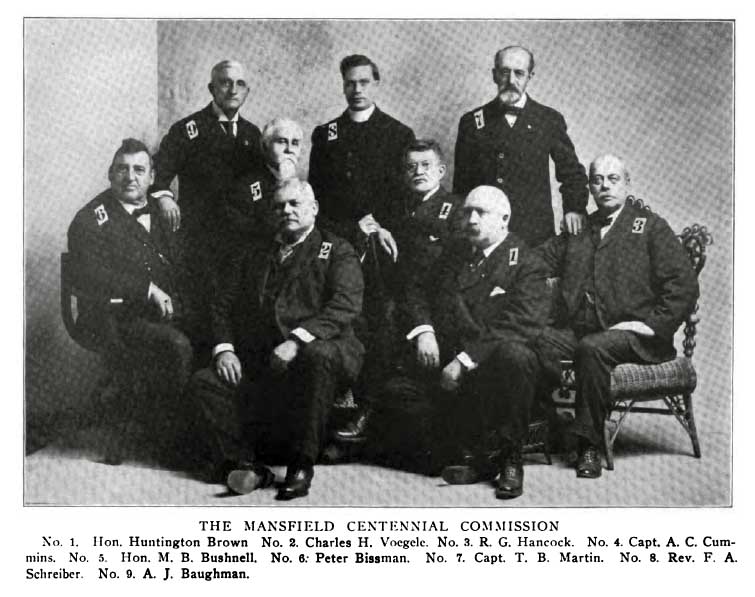
THE MANSFIELD COMMISSION.
| No. 1. Hon. Huntington Brown |
No. 2. Charles H. Voegele |
No. 3. R. G. Hancock |
| No. 4. Capt. A. C. Cummins |
No. 5. Hon. M. B. Bushnell |
No. 6. Peter Bissman |
| No. 7. Capt. T. B. Martin |
No. 8. Rev. F. A. Schreiber |
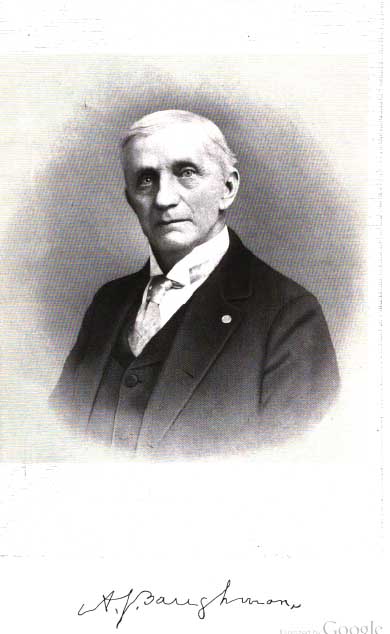
No. 9. A. J. Baughman.. |
came
from the South, twelve from New England, three from Pennsylvania
and six were born in Ohio of Scotch-Irish ancestry.
Further, it can not be established that any section produced the
great men of any particular profession or pursuit. Which
disproves Howell's generalization that "The South gave Ohio
perhaps her foremost place in war and politics; but her
enlightenment in other things was from the North."
Rawlinson has claimed "that it is admitted by
ethnologists that the mingled races are superior to the pure
ones." This is perhaps true with the qualifications that
the law acts within the limits of a similar origin, as in the
case of the Greeks, the Romans, the British, and above all hte
Americans. Thus Tennyson sings, "Saxon and
Norman and Dane are we," and he might have added,
Celt and Gaul, French, Huguenot and German. One of our own
poets recited, on the Nation's century, these elements of our
new type: Scottish thrift, Irish humor, German steadfastness,
Scandinavian patience and English moral worth.
A writer has put the case thus: "Southern men of
the old regime were not given to the writing of books," and when
the man of New England stove forward, pen in hand, and nominated
himself custodian of our National archives and began to compile
the record nobody seriously contested the office. Thus it
happened that New England got handsome treatment in our National
histories. She deserved good treatment. Her record
is one of glory. No patriotic American would detract from
her merit, but her history is not the history of the whole
country, and it may be added that her point of view is not the
only vision for estimate.
In the early settlement of Richland county different
parts were settled by people from certain places in the East,
for instance the Big Hill locality in Weller township was
settled principally by English people; the southwestern part of
Jefferson township was settled by Yankees from Maine; a certain
locality in Washington township and another in Sharon were
settled by Germans. But those distinctions are now matters
of the past and we have but one people, one country, under one
flag.
THE ORIGINAL MAN FROM OHIO
For the past fifteen
years many expeditions and elaborate investigations in various
parts of the world have been made in search of possible or
probable proof of the location of the cradle or birthplace of
the human race. From reports made of such expeditions and
investigations of the problem of how the red man got here
(America) and where he came from are elaborately treated of.
A brief resume of the conclusions arrived at in these reports
appeared recently in the Cosmopolitan magazine. The result
is, says the magazine writer, “that the evidence shows that the
first American was not an Asiatic emigrant,” and that from the
study of both ethnological and archaeological conditions in
Northwestern America and in Northeastern Asia, it seems most
probable that man did not come from Asia, but that he crossed
over into Asia from America. We can not even give a resume
of the facts and reasons put forth by the distinguished scholars
who for years have given
Pg. 16 -
their time and-thought to this intensely interesting question.
Can only state that their conclusions are a reversal of the
theory, so universally accepted heretofore, that Asia was the
birth place of the race that later found its way into the
American Continent. Granted that the original American was
‘‘native and to the manor born,” and not an importation, the
logic is that, barring the ice man, who may or not have existed
first, the Mound Builder was the first to put in an appearance,
at least so far as any remaining evidences show. It is
generally conceded that the Mound Builder, whether the ancestor
of the Indian or of a distinct race, antedated the Indians,
so-called. In other words, whoever he was and whatever his
antecedents were, he, the Mound Builder, was the oldest
inhabitant, and may be called the original American. The
Mound Builders’ domain was largely in the territory now called
Ohio, and some of their works are within the limits of Richland
county. May not then Ohio and possibly Richland county
have been the Mound Builders’ primitive birth place as well as
his habitat. May not the original Adam and
Eve along the banks of one of Ohio’s rivers, rather than
on the banks of the Euphrates, had their Eden.
The Rev. Landon West, a prominent and widely
known minister of the Baptist church, has given much study and
thought to the Serpent Mound in Adams county, Ohio, and advances
the theory that it marks the site of the Garden of Eden, and
with this a number of the “higher critics,” the Egyptologists
and Biblical students agree. They state that nowhere does
the Bible claim that the Garden of Eden was in Asia, as has been
generally believed. The Rev. Mr. West believes that
the Serpent Mound is purely symbolical and has no significance
relative to the religion or worship of any race of men, but that
it was intended to teach the fall of man and the consequences of
sin in the Garden of Eden.
 |