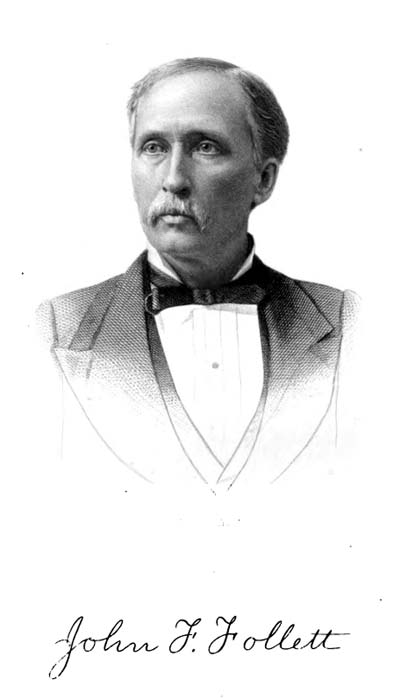
John F. Follett |
JOHN FASSETT FOLLETT,
lawyer, Cincinnati, is the son of a new England farmer, the
youngest but one of a family of nine children, and was born
in Franklin County, Vermont. Of the nine children six
were boys, all of whom have become exceedingly strong and
able men. Three have honored the law - Charles,
Martin D., and John F.; Charles having
been elected for two terms Judge of the Common Pleas Court,
and Martin D. having been elected Judge of the
Supreme Court of Ohio, in October, 1883. One,
Alfred, has chosen the field of medicine; while the
other two, George and Austin W., have
been unusually successful in mercantile pursuits in New York
City. In 1837, when the subject of this sketch was
less than five years of age, his father removed to Ohio, and
settled in Licking County. His ealry education was
received in the log school houses, and such academies as the
county of Licking then afforded. Ambitious for a
higher and broader culture than was afforded by these
primitive institutions, he determined to procure for himself
a classical education, and entered Marietta College in 1851,
and graduated with the highest honors of his class in 1855.
After leaving college he taught school for two years - the
first in the Asylum for the Blind, at Columbus; and the
second as the principal of the Columbus High School.
the income derived from teaching enabled him to liquidate
the debt which he had contracted in obtaining a collegiate
education. In July, 1858, he was admitted to the bar,
at Newark, Ohio, and at once entered into a partnership with
his brother, the Hon. Charles Follett, which
continued until the fall of 1868, when he removed to
Cincinnati, where he has since resided. In 1865, he
was elected as a Representative to the Fifty-seventh General
Assembly, from Licking County, and was re-elected in 1867.
Upon the organization of the Fifty-eighth General Assembly,
in January, 1868, he was nominated by the Democrats in
caucus, and afterward was elected, Speaker of the House of
Representatives, the duties of which office he discharged
with signal ability. Before the opening of the
adjourned session, in the fall of 1868, he had removed to
Cincinnati, to engage in the practice of the law, and
consequently resigned the Speakership as well as his office
as Representative. Destined to be a leader, he
has risen rapidly in his profession, and, upon going to
Cincinnati, took rank immediately with the foremost men of
that unusually able bar, amongst whom it is doubtful if he
has a superior as an advocate. His practice has been
very large and lucrative, and he has been identified as
counsel in much of the most important litigation in both the
State and federal courts in Southwestern Ohio.
Thoroughly devoted to his profession, he has steadfastly
declined to be led away from the law by the allurements of
public office until his fame as a lawyer was firmly
established. In 1880, he was nominated by acclamation,
by the Democratic State Convention, as one of the Electors
at large for Ohio, on the Hancock and English President
ticket. In 1881, although he was very prominently
mentioned for Governor, no canvass was made in his interest,
and, preferring to let the nomination seek him, rather than
to seek it, he was not the selection of the convention.
In 1882, he was made the temporary chairman of the
Democratic State Convention. In the fall of 1882, he
was nominated by acclamation, by the Hamilton County
Democratic Convention, to represent the First District of
Ohio in Congress. His opponent was the Hon.
Benjamin Butterworth, a candidate for a third term, and
probably the best campaigner in the State of Ohio, and whom,
after a most gallant and hotly contested canvass, he
defeated by a majority of 819. In politics he has been
a life-long Democrat, one of the old school, whom shadows
and reverses have not changed. Gifted and eloquent as
a speaker, he has few, if any, equals on the stump in Ohio.
For years he was cheerfully devoted weeks to every campaign,
and his services are in constant demand at the Executive
Committee rooms of his party. Thee is scarcely a
county in the State where his voice has not been heard, and
where he does not number his friends by the score. Of
wonderfully popular manners, and of brilliant parts, he will
command such attention in the nation's councils as to endear
him to every true Democrat in Ohio. At the
commencement of 1879 his Alma Mater, in recognition
of his scholarly attainments and public services, conferred
upon him the the honorary degree of Doctor of Laws.
Source:
A Biographical Cyclopaedia and Portrait Gallery
of Distinguished Men, with an Historical Sketch
of the
State of Ohio.-
Illustrated with Portraits on Steel,
Published by John C. Yorston & Company - 1879 - Page
562 |



 Source: