ON the 9th of July, 1788, Governor St.
Clair, the newly-appointed governor, arrived
at Marietta, and, with the help of the
judges and secretary, proceeded to organize
the northwestern territory. Congress
had appointed Winthrop Sargent,
secretary, and Samuel Holden Parsons
and John Cleves Symmes as judges.
The district embraced was a vast one,
including all the country lying northwest of
the Ohio as far west as the Mississippi.
The laws adopted for the governmental needs
of the territory were those provided in the
celebrated ordinance of 1787, which has been
fitly described as having been "a pillar of
cloud by day, and of fire by night," in the
settlement and government of the
northwestern States.
In 1788 the county of Washington was organized by
proclamation of the governor and judges.
It included that part of the Western Reserve
east of the Cuyahoga river, the old Portage
path, and the Tuscarawas river. In the
year 1795, Wayne county was established,
including with other territory of vast
extent, the remainder of the Reserve not
embraced in Washington county In 1797,
Jefferson county was organized, and its
boundaries were such as to include all of
the Western Reserve east of the Cuyahoga.
Notwithstanding the inclusion of the soil of the
Reserve, by act of the territorial
government, within the limits of these
several counties, civil government was of
binding force upon the inhabitants of New
Connecticut until the year 1800. Prior to
this date, Connecticut and the Connecticut
Land company denied to the United States the
right of jurisdiction over the soil of the
Reserve, and refused obedience to the laws
of the territorial government. (The
reasons for this
[Page 22]
refusal are given in a former chapter of
this work.) Thus it happened that,
from 1796-97, the time the first settlers
arrived, until May 30, 1800, the pioneers of
the Reserve were without municipal laws.
Their conduct was regulated and restrained,
and their duties were prescribed, solely by
their New England sense of justice and
right. There was no law governing the
descent and conveyance of real property, or
of the transfer of personal goods; there
were no regulations for the redress of
Wrongs or for the protection of private
rights. They were literally
a law unto themselves. Happily but few
cases of misdemeanor arose; but if a settler
was guilty of theft, or if he misused his
wife, his neighbors constituted a court of
justice, and decided what punishment should
be inflicted. The offender’s back
generally furnished the only record of these
judicial proceedings.
On the 10th day of July, 1800, the general government
having ceded to Connecticut her claim to the
soil of the Reserve, and Connecticut on her
part having transferred to the general
government all right of jurisdiction within
the limits of New Connecticut, the
Western Reserve was erected into a single
county and called Trumbull, in honor of
Jonathan Trumbull, then governor
of Connecticut. This was effected by
proclamation of the governor and judges of
the Northwestern Territory. The
county-seat was at Warren. Now had the
people of the Reserve a government to which
they gladly acknowledged allegiance.
The first court of this large county
convened in Warren on Monday, Aug. 25, 1800.
The following were the first officers of
Trumbull county:
John Young, Turhand Kirtland
(for whom Kirtland township was named),
Camden Cleaveland, James
Kingsbury, Eliphalet Austin,
Esqs, justices of the peace and
quorum.
John Leavitt, justice of the peace and
judge of probate; Solomon Griswold,
Martin Smith, John
Struthers, Caleb Baldwin,
Calvin Austin, Edward
Brockway, John Kinsman,
Benjamin Davison, Ephraim
Quinby, Ebenezer Sheldon,
David Hudson, Aaron
Wheeler, Amos Spafford, Moses
Park, and John Miner,
justices of the peace.
Calvin Pease, Esq., clerk;
David Abbott, Esq.,
sheriff; John Hart Adgate,
coroner; Eliphalet Austin,
treasurer; John Stark Edwards,
recorder.
The following is an extract taken from Judge Turhand
Kirtland’s diary:
“Monday, 25th. - Went to Warren; took dinner at
Adgate’s, and went to Quinby’s;
met the judge and justices of the county,
when they all took the oath of office, and
proceeded to open the court of quarter
sessions and court of common pleas,
agreeably to the order of the governor.
They proceeded to divide the county into
eight townships, and appointed constables in
each. A venire was issued to
summon eighteen persons as grand jurors.”
The following is an abstract from the records of
Trumbull county:
| |
"TRUMBULL COUNTY,
"AUGUST TERM, 1800. |
} |
ss. |
“Court of general quarter sessions began and
holden at Warren, within and for said county
of Trumbull, on the fourth Monday of August,
in the year of our Lord eighteen hundred,
and of the independence of the United States
the twenty fifth. Present: John
Young, Turhand Kirtland, Camden Cleaveland,
James Kingsbury, and Eliphalet
Austin, Esqs, justices of the quorum,
and others, their associates, justices of
the peace, holding said court. The
following persons were returned and appeared
on the grand jury, and were impaneled and
sworn, namely:
Simon Perkins, foreman; Benjamin
Slow, Samuel Menough,
Hawly Tanner, Charles
Daly, Ebenezer King,
William Cecil, John
Hart Adgate, Henry Lane,
Jonathan Church, Jeremiah
Wilcox, John Partridge
Bissell, Isaac Palmer,
Geo. Phelps, Samuel
Quinby, and Moses Park.
“The court appointed Amos Spafford,
David Hudson, Simon
Perkins, John Miner, Aaron
Wheeler, Edward Paine,
and Benjamin Davis a committee
to divide the county of Trumbull into
townships, to describe the limits and
boundaries of each township, and to make a
report to the court thereof."
THE
FIRST DIVISION OF THE RESERVE INTO
TOWNSHIPS.
This committee executed its instructions by
dividing the Reserve into eight townships
for the better government of the few and
scattered settlers. These eight
townships or districts were Richfield,
Painesville, Cleveland, Middlefield, Vernon,
Youngstown, Warren, and Hudson. The
present townships of Geauga and Lake
Counties were distributed in reference to
these districts as follows: Madison and
Thompson belonged to Richfield; Chester,
Russell, Bainbridge, and Willoughby to
Cleveland; Auburn, Troy, Parkman,
Middlefield, Burton, New bury, Munson,
Claridon, and Huntsburg to Middlefield;
Chardon, Hambden, Montville, Le Roy,
Concord, Perry, Painesville, Mentor, and
Kirtland to Painesville. We should
like to show how each of these townships
came to be carved out of the larger
districts and organized as they now stand,
but the information extant upon this matter
is so meagre, owing to the fact that the
original records of the several townships
have been in so many instances destroyed,
that it is quite impossible to do this. In
1800 the people living on the territory now
comprising Geauga and Lake Counties voted
with the people of one or another of these
four districts, and there probably was no
change made until the organization of the
county, when all the territory then embraced
in Middlefield and lying within the present
limits of Geauga County was erected into a
township and called Burton. For any
further information in regard to township
organization that can be gathered the reader
is referred to the several township
histories.
Geauga County was formed from Trumbull in 1805, and was
organized in March of the year following.
The following act of the State Legislature
severing the county from Trumbull gives the
original boundaries of Geauga.
Dec. 31, 1805, an act was passed creating the county of
Geauga. This took effect the
subsequent March 1: “That all that part of
the county of Trumbull lying north and east
of a line, beginning on the east line of
said county, on the line between townships
number eight and nine, as known by the
survey of said county, and running west on
the same to the west line of range number
five; thence south on said west line of
range five to the northwest corner of
township number five, to the middle of
Cuyahoga river, where the course of the same
is northerly; thence up the middle of said
river to the intersection of the north line
of township number four; thence west on the
said north line of township number four to
the west line of range fourteen, wherever
the same shall run when the county west of
the Cuyahoga river shall be surveyed into
townships or tracts of five miles square
each; and thence north to Lake Erie, shall
be, and the same is hereby set off and
erected into a new county by the name of
Geauga."
Feb. 10, 1807, “that all that part of the Connecticut
Western Reserve which lies west of the
Cuyahoga river, north of the township
numbered four, shall belong to, and be a
part of the county of Geauga, until the
county of Cuyahoga shall be organized.”
January 16, 1810, “all that part of the
limits of Geauga County, lying west of the
ninth range, was organized as Cuyahoga
county." January 22, 1810, “that part
of Geauga County, lying cast of the sixth
range of townships, organized as Ashtabula
county."
In 1840 the seven townships of Madison, Painesville,
Mentor, Kirtland, Concord, Le Roy, and Perry
were taken from Geauga, and, with Willoughby
from Cuyahoga, erected into a county and
called Lake.
The following abstract from the records will show who
the first officers of the county were, and
will furnish some other interesting
information:
Extract from Common Pleas Record for
Geauga County, Book "A." - "The State of
Ohio, Geauga County, court of common pleas
begun and holden at New Market, now
Painesville, within and for the county of
Geauga, on the first Tuesday in March, in
the year of our Lord one thousand eight
hundred and six, and of the Independence of
the United States the thirtieth, and of the
State of Ohio the fourth. Present,
Aaron Wheeler, John Walworth,
and Jesse
Phelps, Esquires associate judges for
said county (by lawful authority
commissioned and sworn), holding said court.
"Be it remembered, that the court on the first day of
June term, 1806, appointed Edward Paine,
Jr., clerk, pro tempore, who was
duly sworn according to law. The court
also appointed Robert B. Parkman,
Esquire, prosecutor for said
county, and Abraham Tappan, county
surveyor."
First official act after organization was an action
for debt. - Moses Warren vs.
Joshua Hall, Jr., amount claimed
$463. Judgment rendered; costs $7.50.
The following were the first grand jurors: Abraham
Tappan, foreman, Eleazer
Heacock, Samuel Holmes,
William W. Williams, Nathaniel
Doan, John A. Harper, Ebenezer
Merry, Joseph Pepoon,
Isaac Palmer, Joel
Paine, Anson Sessions,
Elijah Button, Elah. S. Clapp,
and Joseph Clark, who, having
been duly charged, retired. Causes
assigned for trial at this term:
|
Names of Parties |
Attorneys. |
Result. |
Benjamin Nye
vs.
James A. Harper |
J. S. Edwards
R. B. Parkman. |
Non-suit |
Reuben Hyde
vs.
Amos Spafford |
R. B. Parkman.
J. S. Edwards. |
Continued |
Talcott Flint
vs.
John Craw. |
R. B. Parkman.
J. S. Edwards. |
Judgment by default.
Damages, $157.65.
Costs, $11.21 5. |
Elijah Mason
vs.
Wm. W. Williams |
R. B. Parkman. |
$228.66 |
| |
|
Benjamin Griffin
vs.
Wm. McFarland. |
On motion of R. B. Parkman, plaintiff's
attorney, ordered that this cause come on
for trial. |
[Page 23]
Whereupon, the following jurors being
called, appeared and were duly empaneled and
sworn, to wit: James Lewis, Joseph Rider,
Theodore Roys, George Russel, Jonathan Root,
Ira Blanchard, Ezra Sprague, Benjamin
Hopkins, John Paxton, Jarius J. Andrews,
Henry G. Edwards, and Jonathan
Hubbard.
|
Witnesses for Plaintiff |
Witness for Defendant |
James Lewis,
Ezra Gregory,
James A. Harper,
Elisha Graham, |
Benjamin Hartwell. |
The jury retired, and after consultation
returned and gave verdict for the plaintiff
in the sum of seventy (70) dollars.
Judgment rendered accordingly with costs
CONTRACT
FOR BUILDING FIRST COURT-HOUSE.
"March, 1807. - Contract entered into
between the Comrs.of Geauga Co. and
Abraham Skinner whereby he agrees to
'build of logs, hewed on two sides, a house
within the limits of the prison bounds (as
established by the court of com. please),
twelve by fourteen feet on the ground, with
two good log or plank floors, and one window
with iron grates; with a good and sufficient
chimney, and made in every other respect to
the acceptance of the Comrs. and sheriff of
said county.
. . . And said
Skinner, on his part, doth agree to
rent said house (when built) to the Comrs.,
or their successors in office, for a jil,
and to keep the same in sufficient repair
without expense to the county, so long as
they shall wish to use it for a jail, for
the sum of fifteen dollars a year.' "
In 1807 Ashtabula and Cuyahoga were carved from Geauga,
the former organized in 1811, and the latter
in 1810. Geauga's limits became then
what those of Geauga and Lake now are,
except that up to 1840 Willoughby township
belonged to Cuyahoga.
CIVIL
ROSTER
Governors. - The following citizens
have been governors of the Commonwealth of
Ohio:
| Samuel
Huntington in 1808, and Seabury
Ford in 1848 |
Members of Congress - Ohio, before
its admission as a State, in 1802, was a
part of the Northwestern Territory, and its
representative in the Seventh Congress from
1801 to 1803 as Paul Fearing.
He was born in May, 1762, and died in Ohio
in 1822. Upon the State's admission
into the Union, in 1802, its entire
territory constituted one congressional
district, and no change was made until 1813.
During this time it was represented by
Jeremiah Morrow in the Eighth,
Ninth, Tenth, Eleventh, and Twelfth
Congresses. He was born in
Pennsylvania in 1770. Died in Ohio in
1852. After the expiration of his term
of office as representative he became United
States Senator. He was twice elected
governor of the State in 1822 and 1824.
This district was represented in Congress from 1813 to
1814 by Reson Bell, and from 1814 to
1817 by David Clendening. From
1817 to 1819, Peter Hitchcock, of
Geauga, was the delegate. (See
biography.) He was one of the foremost
men of his day. His name appears below
as a member of the House and Senate of Ohio.
He was one of the supreme judges of the
State for twenty-eight years, - part of the
time chief-justice, and was one of the
ablest and most useful judges the State ever
had.
John Sloan represented the congressional
district of which Geauga was a part in the
Sixteenth and Seventeenth Congresses, or
from 1819 to 1823. He was born at
York, Pennsylvania, 1779, and died at
Wooster, Ohio, in 1856. Hon.
Elisha Whittlesey, from 1823 to
1838, represented the Geauga district in
Congress. He was one of the ablest men
in Congress at that time. He was born
in Connecticut in 1783, and died in
Washington, District of Columbia, 1863.
Whittlesey was succeeded by the
Hon. Joshua R. Giddings, in 1838, who
served until 1859, and was succeeded
by John Hutchins. Mr.
Hutchins’ term of office was from
1859 to 1863, when Hon. James A. Garfield,
the presentable representative, was elected.
Mr. Garfield has represented this
district continuously since 1863. He
is the acknowledged Republican leader in the
House of Representatives. At the
present time he is a resident of Mentor,
Lake County.
Presiding Judges. - Prior to 1810,
Calvin Pease and Turhand
Kirtland were probably the presiding
judges. In 1810 Benjamin
Ruggles succeeded to the office; 1815,
George Todd; 1830, Reuben
Wood; 1833, Matthew
Burchard; 1837, Van R. Humphrey;
1844, Eben Newton; 1847, B.
F. Wade; 1851, Reuben
Hitchcock; 1854, Eli T. Wilder;
1855, Horace Wilder; 1861,
N. L. Chaffee; 1871, M. C. Canfield.
Mr. Canfield died while in office,
and E. Lee was appointed to fill the
vacancy until the first succeeding election,
when D. W. Canfield was chosen to the
office, and served until 1876, when L. S.
Sherman, the present incumbent, was
elected. By special statute H. B.
Woodbury was elected at special
election, spring of 1875, and in the
succeeding fall was re-elected, to serve for
a term of five years.
Associate Judges. - 1n 1809,
Nehemiah King and Eleazer
Hickox were the associates; 1811,
Aaron Wheeler and Eliphalet
Austin; 1813, V. Stone and
Arris Clapp. Among other
associate judges there have been R. B.
Parkman, Asa Cowles, Jno. Hubbard,
Storm Rosa, A. Wright, Jno. P. Basley,
Joseph W.
Brackett, B. F. Avery, D. D. Aiken, Jno.
P. Converse, and Lester Taylor.
State Senators. -
Calvin Pease,
1806-7;
David Abbott, 1808-11;
Peter Hitchcock, 1812-15;
Aaron Wheeler and Almon Ruggles,
1816-17;
Aaron Wheeler and John Campbell,
1818;
Almon Ruggles and John Campbell,
1819;
Aaron Wheeler, 1820;
Samuel W. Phelps, 1821-22;
Samuel Wheeler, 1823-28;
Eliphalet Austin, 1829-30;
Uri Seeley, 1831-32;
Peter Hitchcock, Sr,
1833-34;
Ralph Granger, 1835-36;
Benj. F. Wade, 1837-38;
Benjamin Bissell, 1839-40;
Seabury Ford, 1841-42;
|
William L.
Perkins, 1843-46;
Brewster Randall, 1847-50;
Laban S. Sherman, 1852-54;
Lester Taylor, 1856;
Darius Cadwell, 1858;
John F. Morse, 1860;
Peter Hitchcock, 1862;
William C. Howells, 1864;
Abner Kellogg, 1866;
J. B. Burrows, 1868;
Decius S. Wade, 1870;
John S. Casement, 1872;
I. N. Hathaway, 1874;
S. S. Burrows, 1876;
W. P. Howland, 1878. |
State Representatives. -
John P.
Bissell and James Kingsbury,
1806;
John W. Seeley and James
Montgomery, 1807;
Nehemiah King, 1808;
Amos Spafford, 1809;
Peter Hitchcock, 1810;
Samuel Huntington, 1811;
Samuel S. Baldwin, 1812;
John H. Strong and William A.
Harper, 1813;
William A. Harper and Alfred
Kelley, 1814-15;
William Kerr and Alfred Kelley,
1816;
Lewis Dille and Levi Gaylord,
1817;
Lewis Dille and Ebenezer Merry,
1818;
Alfred Kelley and Ebenezer
Merry, 1819;
John Hubbard, 1820-21;
Samuel Wheeler, 1822;
Eleazer Hickox, 1823;
John Hubbard, 1824-26;
Charles C. Paine, 1827;
Samuel Butler and Charles C.
Paine, 1828;
V. Stone, 1829;
Chester Treat and Isaac Gillett,
1830;
Isaac Gillett, 1831;
Lewis Dille and Lester Taylor,
1832;
Lewis Dille, 1833;
Lewis Dille and Lester Taylor,
1834; |
Seabury Ford,
1835;
Seabury Ford and Timothy
Beckwith, 1836;
Seabury Ford and Thomas
Richmond, 1837;
Seabury Ford and Silas Axtell,
1838;
Seabury Ford and John F. Morse,
1839;
Seabury Ford, 1840;
John P. Converse, 1841-42;
Alfred Phelps, 1843;
Seabury Ford, 1844;
Alfred Phelps, 1845;
Anson Matthews, 1846-47;
Isaac Lee and A. G. Riddle,
1848;
John Hutchius and A. G. Riddle,
1849;
M. C. Bradley and G. H. Kent,
1850;
Samuel Durand, 1851-53;
Lester Taylor, 1854-55;
Lewis C. Todd, 1856;
Peter Hitchcock, 1858-60;
Benjamin B. Woodbury,
1862-65;
Peter Hitchcock, 1866;
Delos W. Canfield, 1868;
Peter Hitchcock, 1870;
Geo. H. Ford, 1872;
Peter Hitchcock, 1872-76.
Mr. Hitchcock is the present
representative. |
Prosecuting Attorneys. -
R. B. Parkman,
1806-17;
Samuel Wheeler, 1817-19;
Alfred Phelps, 1819-28;
S. Matthews, 1828-35;
Reuben Hitchcock, 1835-36;
Wm. L. Perkins, 1836-37;
R. Hitchcock, 1837-39;
|
Wm. L.
Perkins, 1839-40;
O. P. Brown, 1840-41;
A. G. Riddle, 1841-47;
M. C. Canfield, 1847-50;
A. H. Thrasher, 1850-54;
M. C. Canfield, 1854-58;
H. K. Smith, 1858-62;
|
D. W. Canfield,
1862-66;
T. N. Hathaway, 1866-70;
O. S. Farr,1870-72;
L. H. Durfee, 1872-76;
Jas. E. Stephenson, 1876-78;
N. H. Bostwick, 1878. |
County Clerks. -
|
Edward Paine, Jr.,
1806-28; D. D. Aiken,
1828-42; Reuben St. John,
1842-46; 1846 until the adoption
of the new State constitution in
1851, when A. H. Gotham
was elected. In the following
June he died, and H. K. Smith
was appointed to fill vacancy,
until next election, when
William N. Keeney, the
present incumbent, was elected
in the fall of 1857. |
Recorders. -
James A. Harper, 1806-11;
Edward Paine, Jr., 1811-35;
Ralph Cowles, 1835-39;
Wm. Kerr, 1839-41;
1841-44, first, Wm.
Wilbur, who was succeeded by
John Packard, Jr., in the
fall of 1841;
John French,
1844-56;
L. C. Ludlow, 1856-63;
C. H. Lamb, 1863-68;
A. W. Young, 1868-75.
Mr. Young died in
November of 1875, and
W. H. Young was appointed to
fill vacancy, and was elected in
1876. The duties of the
office have been discharged
during Mr. Young’s term
of office by Mrs. H. A.
Dimmick. |
Treasurers. -
Charles C. Paine,
1820-28;
Sylvester N. Hoyt, 1828;
William Wilbur, 1834,
S. N. Hoyt, 1837;
Samuel Squans, 1840;
A. P. Wilkins, Jr., 1842;
J. O. Worrallo, 1849;
Charles H. Foote, 1851;
Warren Loomis, 1852;
Job S. Wright, 1855;
H. N. Spencer, 1858;
O. R. Newcomb, 1862;
C. C. Fields, 1865;
Edward Patchen, 1867;
Henry F. Marsh, 1869;
F. C. Smith, 1871;
S. E. Bodman, 1875,
and is the present incumbent. |
Probate Judges. -
|
Alfred
Phelps, 1852; he was
succeeded by M. C. Canfield
in 1858; he served until
1867, when the present incumbent
resumed the control of the
office, -
H. K. Smith. |
Auditors. -
|
The first duplicate was
destroyed on the burning of the
court-house, July, 1868.
The earliest volume saved bears
date 1820, at which time
Edward Paine, Jr., was
auditor. He was succeeded
in 1822 by Eleazar
Paine, and he by Ralph
Cowles, who was succeeded
in 1835 by William Kerr,
and he by Ralph Cowles in
1839; next was
William K. Williston (1845);
Marsh Smith (1851); C. C.
Fields (1857); A. P.
Tildon (1865); M. L.
Maynard (1873); William
Howard, 1877, who is the
present incumbent. |
[Page 24]
Sheriffs. -
Joel Paine,
1806;
Abraham Tappan, 1810;
Elisha Norton, 1812;
Eli Bond, 1815; |
Hezekiah King,
1819;
James R. Ford, 1824;
William Kerr, 1828;
|
J. A. Tracey,
1833;
Abel Kimball, 1837;
Erastus Spencer, 1841; |
Commissioners. -
1807,
Abraham Tappan;
1808, Doane,
re-elected;
1809, Jedediah Beard;
1810, Joel Paine;
1811, John A. Harper;
1812, Norman
Canfield;
1813, Noah Paige;
1814, Jedediah Beard;
1815, Solomon
Kingsbury;
1816, John A. Harper;
1817, Jedediah Beard,
Jesse Laddard, and
Christopher Langdon;
1824, Ralph Cowles,
Charles Curtiss, and
Robert Blair;
1825, Augustus
Sessions;
1827, Isaac Moore;
1828, Veni Stone;
1831, J. F. Morse;
1832, Colbert
Huntington;
1833, James Thompson;
1835, Russell G.
McCarty;
1836, J. Hathaway;
1838, Albion C.
Gardner;
1849, David Shepherd;
1851, David W. Mead,
Jacob Thrasher;
1852, Lester Perkins;
1853, H. T. Johnston;
|
1854, Spencer Dayton;
1855, John A. Ford;
1856, H. T. Johnston;
1857, John V.
Whitney;
1858, Marsh Smith,
Benjamin B. Woodbury;
1859, J. W. Collins;
1860, Silas Gaylord,
Jr.;
1861, Lewis C. Reed;
1862. J. W. Collins;
1863, John T. Field;
1864, Alanson Moffet;
1865, J. W. Collins;
1866, Benj. Bidlake;
1867, Alanson Moffet;
1868, J. W. Collins;
1869, John V.
Whitney;
1870, Daniel Johnson;
1871, Horace J. Ford;
1872, Milan V. Scott;
1873, Daniel Johnson,
Darius Walcott;
1874, Horace J. Ford;
1875, Darius Wa
cott;
1876, Daniel Johnson;
1877, Orrin M. Barnes |
Coroners. -
1807,
Joseph Pepoon;
1810, Elisha Norton;
1812, Isaac Palmer;
1810, Calvin Cole;
1820, Wm. Holbrook;
1852, Horace W.
Morse;
1854, Philander Kyle;
1855, Sidney
Bostwick; |
1857, John
S. Cleveland;
1859-60, Benj.
Bidlake;
1862, A. E. Miller;
1864, Joseph G.
Durfee;
1865, Sam. Bodman;
1866-72,
Joseph G. Durfee;
1874-76, E. S.
Chapel; |
1877, P. M. Cowles. |
|
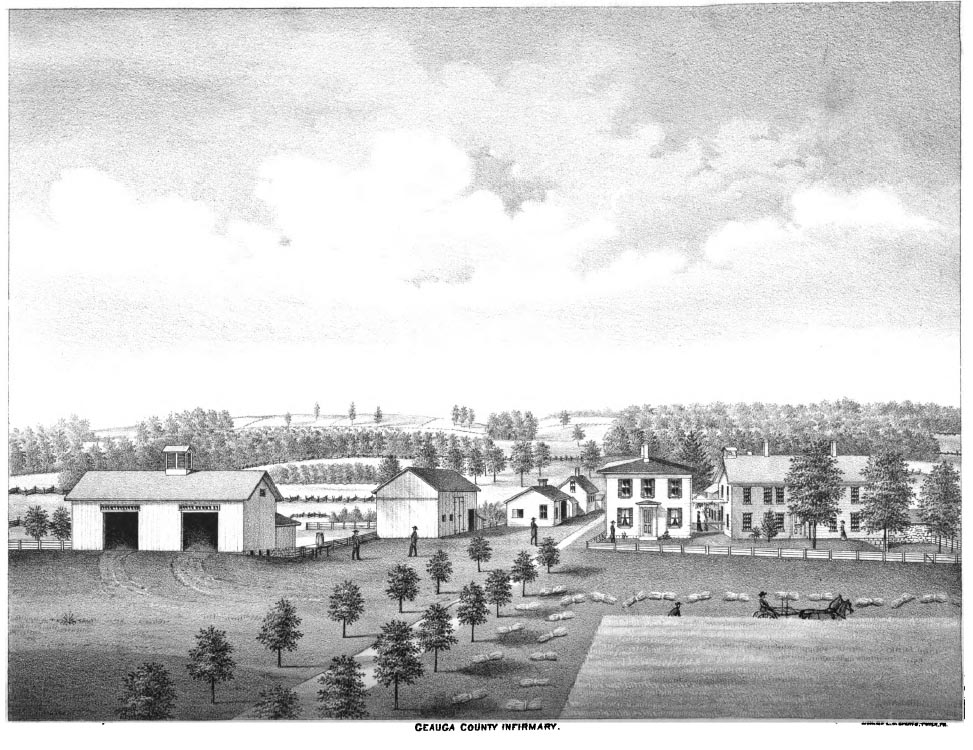
POOR FARM.
At a meeting of the board of
commissioners of Geauga County, held at
Chardon, in and for said county, on the
15th day of March, 1859, it was resolved
by the board that they deem it expedient
and for the benefit of the county to
purchase a farm for the support of the
poor of said county, and after examining
sundry farms and proposals for sale of
farms, have concluded to purchase the
farm of Nathaniel Stone, in Chardon
township, and have entered into contract
with him for the same, at the price of
twenty-four hundred dollars, and pay
three
hundred dollars in hand, nine hundred
dollars the 1st of November next, and
the balance in one year thereafter.
Also, resolved, that it is necessary to
build a house on said farm for the
reception of the poor of said county.
At a meeting held the 5th day of April, 1839, it was
resolved that David Eggleston
have the contract for building the
aforesaid house, he to be paid for same
two hundred and thirty-three dollars in
hand, and four hundred and sixty-five
dollars on 1st of December next; house
to be completed on the 1st of January
next.
Infirmary Directors. -
1849, Chester
Treat;
1851, Ralza Spencer;
1852, Abram Woodward;
1853, Seth W. Brewster;
1854, George Manley;
1855, Alonzo Richmond;
1856, Samuel C. Douglass;
1857, George Manley;
1858, Alonzo Richmond; |
1859, Alex.
McNish;
1860, George Manly;
1861, Arnold D Hall;
1862, Alex. McNish;
1863, George Manley;
1864, Abram Woodward;
1865, Charles P Bail;
1866, George Manley;
1868, R. E. Waters; |
1869, Chas.
O. Dutton;
1870, J. W. Nash;
1871, Rufus E. Waters;
1872, Lucius T. Wilmot;
1873, Amandar Gates;
1874, Oscar C. Douglass;
1875, Silas L. Beard;
1876, Amander Gates;
1877, David C. Hollis,
present incumbent |
The following is the contract for
the purchase of the ground on which
Chardon now stands:
“I, the subscriber, Simon
Perkins, of Warren, in the
county of Trumbull, and State of
Ohio, attorney to Peter
Chardon Brooks, of
Boston, in the Commonwealth of
Massachusetts, do hereby agree to
sell to Samuel W. Phelps, Esq,
director appointed for the purpose
by the court of common pleas of
Geauga County, two hundred acres of
land, to be located on and about the
place selected by the commissioners
appointed to fix on a place for the
permanent seat of justice for said
Geauga County, and so that the place
of trees marked by said
commissioners shall be central in
said tract, which is to be square,
and to be sold at the price of two
dollars per acre, payable one-half
in one year and the other half in
two years, with interest to be paid
annually, and the deed to be
executed to Samuel W. Phelps,
as director, on receipt of the money
or good security for it. In witness
whereof, I have, for said Peter
C. Brooks, hereunto set my hand,
this 23d day of November, 1809.
“SIMON PERKINS.”
“I, the subscriber above named, do agree to buy the
land described above, as above
stated.
“SAMUEL W. PHELPS.”
LAKE COUNTY
(CLICK
HERE to Go to Lake County, Ohio)
|