|
 |
ALVAH P. CLARK,
secretary, treasurer and general manager of one of the rapidly
developing and profitable pottery enterprises of Zanesville,
business being conducted under the name of the Ohio Pottery Company,
was born in Washington county, this state, in 1843. His
paternal grandfather, Seneca Clark, removed from the Empire
state to Ohio at an early day, settling near Marietta.
Washington county, when that district contained but a sparse
population, the work of progress and improvement being scarcely
begun. He afterward removed to the vicinity of Beverly, Ohio,
where he followed farming for a time, and then turned his attention
to distilling, which he conducted after the crude manner in which
the business was carried on at that early day. He married
Catherine Stull and they had three children, but only one is
living. Jane, deceased, was the wife of Theodore
Devol, who resides near Marietta, Ohio. The son,
Augustus S., was born in the Empire state and was about nine or
ten years of age at the time of his parents removed to Ohio.
He yet owns the land upon which his father's distillery was once
located. He remained upon the old home farm throughout the
days of his boyhood and youth and early manhood, and in fact, until
after the birth of his son, Alvah P., and followed both
general agricultural pursuits and distilling. He now resides
about three miles from his farm, in the town of Beverly, and has
reached the very advanced age of eighty-five years. He married
Sarah D. Ross, who is deceased. They had two children,
Alvah and Eva, the latter the wife of Charles W.
Reynolds, of Zanesville, by whom she has one child, Louise,
the wife of Professor C. S. Joseph. In the summer of
1904 Mr. Clark of this review, had a picture taken,
representing the four generations of the family, his father,
himself, his son and grandson.
Alvah P. Clark obtained a public-school
education at Beverly, Ohio, and when he had reached man's estate,
was engaged in the drug business of that place, his father owning
the store. He became familiar with the drug business at an
early age and for some time was connected with the store, but
afterward turned his attention to the manufacture of flour at
Beverly, where he continued for three years. In 1896 he was
one of the organizers of the Zanesville Stone Ware Company and
became its vice president. He then went upon the road selling
the product of the house to the trade. The business was
incorporated and he was connected with it until 1899, when he sold
his interest and organized the Ohio Pottery Company, now located in
the Brighton district. He then erected the plant of the
company. The first officers were: C. W. Reynolds,
president; Frank H. Herdman, vice president; and A. P.
Clark, secretary, treasurer and general manager. These
gentlemen still continue in their respective offices and from the
beginning, the business has been a prosperous one. They began
with one building one hundred by eighty feet, and in the summer of
1904, so great had been the growth of their trade, another building
fifty by one hundred and seven feet was erected. Stoneware
specialties are manufactured and employment is furnished to forty
men. They had at first but two kilns, but now five-kilns,
twenty feet in diameter, four of these kilns being fourteen feet
high. They also have one kiln sixteen and a half feet in
diameter and twelve feet high. Their ware is manufactured
after the most modern methods and finds ready sale on the market.
Mr. Clark was the first to introduce in this section of the
state the making of stone ware by steam, thus doing away with the
slow hand process. He has always kept in touch with the most
modern ideas concerning his business and is quick to adopt any new
methods whose practical utility he recognizes.
In 1870 Mr. Clark was united in marriage to
Miss Louise Johnson, who was born in Laporte, Indiana, and they
have one child, Frederick A., who was born in Beverly, Ohio,
and married Flora Miller, by whom he has one son, Earl K.,
a native of Cambridge, Indiana.
Mr. Clark is a Mason, being identified with the
fraternity in Zanesville, and politically he is a republican, but he
never seeks or desires public office, preferring to concentrate his
energies upon his business affairs. He is a representative of
one of the pioneer families of this section of Ohio and in
citizenship he is public-spirited in an eminent degree, being deeply
interested in the welfare of his country and the prosperity of his
community. He is to-day a typical representative of the
enterprising spirit which is leading to the rapid development of
Zanesville and making it a most important manufacturing and
commercial center.
 Source: Past and Present of the City of Zanesville, and
Muskingum Co., Ohio - Published Chicago: The S. J. Clarke Publishing
Co. - 1905 - Page 435
Source: Past and Present of the City of Zanesville, and
Muskingum Co., Ohio - Published Chicago: The S. J. Clarke Publishing
Co. - 1905 - Page 435 |
|
|
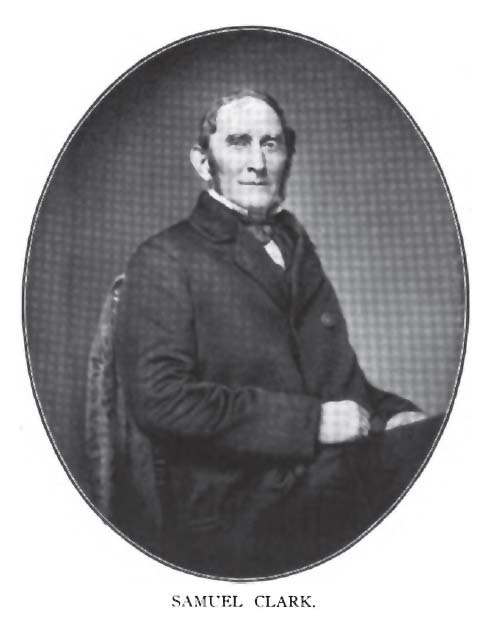
 SAMUEL CLARK,
deceased, was one of the early contractors of Zanesville, whose name
is inseparably connected with the history of this city at a time
when it was emerging from villagehood to take on the improvements
and changes of city life. He was born in Virginia, in1805.
His father, John Clark, served throughout the Revolutionary
war, valiantly aiding in the struggle for independence, and
afterward enjoyed the liberty and advantages of the new republic in
his Virginia home.
SAMUEL CLARK,
deceased, was one of the early contractors of Zanesville, whose name
is inseparably connected with the history of this city at a time
when it was emerging from villagehood to take on the improvements
and changes of city life. He was born in Virginia, in1805.
His father, John Clark, served throughout the Revolutionary
war, valiantly aiding in the struggle for independence, and
afterward enjoyed the liberty and advantages of the new republic in
his Virginia home.
Samuel Clark was reared in the Old Dominion and
in early life learned the carpenter's trade which he followed for a
number of years as a journeyman and afterwards did contract work.
He came to Zanesville when about ten or eleven years of age with his
parents and has spent his remaining days in this city. It was
but a small place when the family home was established here, there
being a little collection of pioneer houses in the midst of a
largely undeveloped district. After mastering the carpenter's
trade he worked upon many of the prominent early buildings of
Zanesville. He was one of the contractors on the First
Presbyterian church, built in 1839, and many of the best residences
of the early period were erected under his supervision and some of
these still stand as monuments of his enterprise, labor and skill in
his chosen vocation.
In 1846 Mr. Clark was married in Zanesville to
Miss Jerusha Williams, a native of Warwick, Massachusetts,
the wedding ceremony being performed by the Rev. Simeon Brown.
Her parents were Samuel and Polly (Stevens) Williams, the
former a farmer of Warwick, Massachusetts. He died at the very
advanced age of ninety-four years, while his wife passed away at the
age of forty-seven years. They were the parents of seven
children. Mrs. Clark being the fourth in order of
birth. Her grandfather was Colonel Samuel Williams, who
was a native of Roxbury, Massachusetts, and won his title through
service in the Revolutionary war, commanding a regiment which fought
for the independence of the nation. He was with the Colonial
Army and throughout the long struggle for liberty was a brave and
faithful officer. He married Triphenia Lyman, a native
of Northampton, Massachusetts, and they had a large family but
Mrs. Clark's father was the only son. In 1839 Mrs.
Clark came from Massachusetts to Muskingum county, Ohio, and
engaged in teaching school in Zanesville for eight years prior to
her marriage. She was born in June, 1815, and although now
ninety years of age is yet an energetic woman with faculties
unimpaired. Unto Mr. and Mrs. Clark were born six
children, of whom two died in early youth, while four are yet
living, namely: Annie T.; Samuel W., a lumber merchant of
Zanesville, who married Alice Miles of this city and has two
children. Ira G. and Cuyler L.; Ardelia,
the wife of W. J. Massey, who is represented elsewhere in
this volume, and Charles F., a practicing oculist of
Columbus, Ohio, who married Phoebe Rogers and has one
daughter, Margaret.
Mr. Clark passed away in 1883, being at that time
about seventy-eight years of age, and for more than sixty years he
had been a resident of Zanesville. He was very successful in
his business career and accumulated a large property, making
investments in real estate in this city when it sold at a low
figure. The growth and population and the improvements which
he placed upon his property caused its rise in value and at his
death he left a very good estate to his family. He was
prominent and influential in community affairs for many years and
served as a member of the city council. He was also a highway
surveyor of Zanesville, and his political support was given to the
democratic party. He was known as all times as a man reliable
and trustworthy so that he left behind him as honorable name and an
example that is well worthy of emulation. He enjoyed in large
measure the respect and trust of his fellow citizens and well
deserves mention among those who largely promoted the material
welfare of Zanesville and assisted in its building and improvement.
Mrs. Clark still survives her husband and has been a resident
of Zanesville for two-thirds of a century, so that its history is
familiar to her, her mind being stored with many interesting events
of the early days.
Source: Past and Present of the City of Zanesville, and
Muskingum Co., Ohio - Published Chicago: The S. J. Clarke Publishing
Co. - 1905 - Page 312 |
|
|
WILLIAM COBB,
manager of the Kapner Brothers & Duga knitting mill in
Frazeysburg, has been well trained for his present important
position by years of experience in the line of manufacturing knit
goods, for when a young lad he entered upon his business career in a
similar factory and throughout the greater part of his business
career he has directed his labors into channels of a like nature.
HE was born in Philadelphia, Pennsylvania, Oct. 20, 1857, his
parents being Isaac and Phoeba (Hunter) Cobb, both
representatives of old families of that state. The father was
a carpenter by trade.
William Cobb was educated in the public schools
of Beverly, New Jersey, and as a boy was employed in the knitting
mills. He began by "piercing on a mule" and through his
perseverance and capability he won promotion from time to time.
Going to Philadelphia he was employed by the Pilling &
Madley Stocking Company and at the age of nineteen was made
foreman in the mill, which position he acceptably filled until 1883.
In that year he went to Cincinnati, Ohio, where he acted as
superintendent of the mill owned by S. H. Hallsted & Company
until 1890, when he went to Indiana to install a mill at Kokomo.
When that task was completed he went to Piqua, Ohio, where he was
foreman in the underwear mills until 1893, when he returned to the
east and was connected with the underwear mills at Perry, New York,
until 1897. In that year he accepted a position as foreman in
the hosiery mill at Frederick, Maryland, where he continued for six
years. On the 15th of February, 1903, he came to Frazeysburg
to act as superintendent and manager of the hosiery mill just
established by Kapner Brothers & Duga.
The mill is thirty-four by seventy feet, two stories in height and
furnishes employment to thirty-eight operatives, turning out one
hundred and fifty dozen pairs of hose per day. Mr. Cobb
has thorough understanding of the business in principle and detail,
because of his practical experience in various departments, and is
well qualified to assume the management of this enterprise, which
under his capable direction is proving a profitable concern.
Mr. Cobb was married in Wilmington,
Delaware, to Miss Louisa Weigend, of Philadelphia, and eight
children have been born to them: Robert, Martha, Lilly,
and Otto and Mary, twins, all born in Kentucky,
opposite Cincinnati; Ollie, born in Piqua, Ohio; Laura,
a native of Philadelphia; and Ida, born in Perry, New York.
Mr. Cobb is identified with the Odd
Fellows and the Knights of the Golden Eagles. Politically he
is a republican and is now serving as president of the school board
in Frazeysburg, the cause of education finding in him a stalwart
friend, who exercises his official prerogatives for the betterment
of the schools. His life record shows as his dominant
qualities perseverance and the mastery of every task which has
fallen to his lot. It is these which won him ready recognition
in manufacturing circles and gained him promotion until the position
which he now occupies is a responsible one, bringing good financial
remuneration.
Source: Past and Present of the City of Zanesville, and
Muskingum Co., Ohio - Published Chicago: The S. J. Clarke Publishing
Co. - 1905 - Page 261 |
|
|
|
PHINEAS
COBURN, one of the first company of emigrants to
Ohio, was the eldest son of Major Asa Coburn, a gallant
officer of the Massachusetts line, who, with two brothers, entered
the army at the opening of the revolutionary war. He retired
from the conflict at its close with the rank of major; his brothers
both died on the battle-field. Major Coburn owned three
shares in the Ohio Company, and removed with his family to Marietta
August 19, 1788, and was a valuable acquisition to the settlement.
Phineas, his father, and family, joined the Waterford
association, and on the commencement of Indian hostilities were
domiciled in Fort Frye, where Major Coburn died during the
war. Early in 1795 the Coburns, with a few others, but
a block house, and began to clear their farms on the fertile
alluvial bottoms which border the Muskingum in Adams township.
Phineas made his permanent home in Morgan County, Ohio.
The gallant General Dumont, of Indiana, an officer in the
Union Army, claimed descent through his mother from Major Coburn.
 Source:
The founders of Ohio : brief sketches of the forty-eight pioneers -
Publ. Cincinnati by R. Clark & Co. - 1888 Source:
The founders of Ohio : brief sketches of the forty-eight pioneers -
Publ. Cincinnati by R. Clark & Co. - 1888 |
|
|
|
CAPTAIN EZEKIEL
COOPER, from Danvers,
Massachusetts, was a share-holder in the Ohio Company, and came on
in Major White's party. "He was an Ensign in Hutchinson's regiment at the siege of Boston; Lieutenant in
Putnam's (5th) regiment, 1777-82; commissioned Captain in
Sproat's (2d) regiment, January 7, 1783; removed to Ohio in
1788; living in Warrentown, Ohio, in 1807." Captain Cooper
was in command of the galley sent up the Ohio river to bring to
Marietta the failies who arrived at that place August 19, 1788.
He was a member of the Society of the Cincinnati.
Source:
The founders of Ohio : brief sketches of the forty-eight pioneers -
Publ. Cincinnati by R. Clark & Co. - 1888 |
|
|
|
EBENEZER COREY
came with the first company. He was a man of much enterprise
and industry. It is recorded the first season that, "a piece
of bottom land on the bank of the Ohio, belonging to Mr. Corey,
had been harvested, and measured one hundred and four bushels of
corn to the acre." He was the architect of the bridge over
Tyber Creek, which was "twenty-five feet high, ninety feet long, and
twenty-four feet wide, covered with hewn planks four inches thick."
Colonel May writes, "It is called 'Corey's bridge,'
ion honor of the master workman. There is not so good a
bridge, or any thing like it, betwixt it and Baltimore."
Mr. Corey and his wife were in Campus Martius during the war,
but afterward went to Waterford. *\
Source:
The founders of Ohio : brief sketches of the forty-eight pioneers -
Publ. Cincinnati by R. Clark & Co. - 1888 |
|
|
|
SAMUEL SULLIVAN COX Source: Past and Present of the City
of Zanesville, and Muskingum Co., Ohio - Published Chicago: The S.
J. Clarke Publishing Co. - 1905 - Page 238 |
|
|
|
SAMUEL
CUSHING, one of the
forty-eight, came from New Bedford, Massachusetts. He was the
brother of Mrs. Benjamin Shaw, and was related to the well
known Sumner and Cushing families of Massachusetts.
He was a member of the Waterford Association, and one of the young
men who remained during the war to aid in the defense of the
settlers. He afterward married a daughter of Judge Gilbert
Devol, and settled on a farm on Round Bottom, where he died
October 9, 1823. "His was the first death in the Mount Moriah
Masonic Lodge; and the members, as a token of regard, wore a blue
ribbon about the left arm from the time of his death to the next
regular communication."
Source:
The founders of Ohio : brief sketches of the forty-eight pioneers -
Publ. Cincinnati by R. Clark & Co. - 1888 |
|
|
|
|
|
|
|
JERVIS CUTLER
was the son of Dr. Cutler, one of the Directors of the Ohio
Company. Dr. Cutler's published journal says, "Monday,
December 3, 1787. This morning a part of the men going to Ohio
met here (at his house Ipswich Hamlet), two hours before day.
1 went on with them to Danvers. The whole joined at Major
White's. Twenty men employed by the Company, and four or
five on their own expense, marched at eleven o'clock. This
party is commanded by Major White. Captain (Jethro) Putnam
took the immediate charge of the men, wagons, etc. Jervis
went off in good spirits." The Rev. G. W. Kelly, who
for sixteen years filled the pulpit at Hamilton, formerly Ipswich
Hamlet, in a recent letter, says: "An esteemed lady, Mrs. P.
Roberts, often informed me about the company which left Hamilton
an hundred years ago to make a settlement in the wilderness west of
the Ohio river. A wagon appeared in the highway in front of
Dr. Cutler's house, covered with black canvas, but it had on
both sides of it painted in white letters, 'For Ohio.' As the
home of Mrs. R. was directly opposite that of. Dr. Cutler,
she could see all that took place. The wagon was drawn by
oxen, a team most likely to be useful when snow fell on the way."
Temple Cutler stated his recollections thus: "The little band of
pioneers assembled at Dr. Cutler's house, and there took an
early breakfast. About the dawn of day, they paraded in front
of the house, and after a short address from him, the men being
armed, three volleys were fired, and the party went forward cheered
heartily by the by-standers. Dr. Cutler accompanied
them to Danvers.
Jervis Cutler had, at the age of sixteen, made a
voyage to France, and now, at nineteen, he joined this company of
adventurers, and was the first of the forty-eight who leaped on
shore at the mouth of the Muskingum, April 7, 1788. He was one
of the associates who begun the settlement at Waterford, in the
spring of 1789, and remained in the west until 1790, when he
returned to New England and married Miss Philadelphia
Cargill; in 1802 he settled at Bainbridge, Ohio, as a
fur-trader. He was chosen Major of Colonel
McArthur's Ohio regiment in 1806, and enlisted a company for
active service, of which he was appointed Captain. This
company was ordered to New Orleans in the spring of 1809. Soon
after his arrival there, he was prostrated by yellow fever, and the
United States Senate having refused to confirm his appointment as
Captain, because of a charge that he had made speeches attacking the
administration, he returned to New England. In 1812 he
published a book entitled "A Topographical Description of the State
of Ohio, Indiana Territory, and Louisiana," with a "Concise Account
of the Indian Tribes West of the Mississippi." In 1818, he
again came west, and settled as an engraver of plates for bank
notes, in Nashville, Tennessee. His first wife died in 1822.
In 1824, he married Mrs. Elizabeth Chandler, of
Evansville, Indiana. He died in Evansville, in 1844. His
only son, now living, is Dr. George A. Cutler,
of Chicago.
Source:
The founders of Ohio : brief sketches of the forty-eight pioneers -
Publ. Cincinnati by R. Clark & Co. - 1888 |
|
|
|